- A new international coalition launched at COP31 will bring together governments, development banks and private financiers to support electrification in developing economies.
- Separately, the Climate Investment Funds announced a $15 million guarantee for Liberia’s solar and battery-storage program, expected to help mobilize about $200 million.
- Liberia’s electricity access remains low, with only 34.9 percent of the population connected in 2024, according to World Bank data.
By Aria Deemie | Climate and Environment Reporter
A new international financing coalition launched at the 31st United Nations Climate Change Conference aims to bring governments, development banks and private investors together to expand access to electricity in developing countries.
The Electrify Now Finance Coalition is expected to help countries prepare investment projects, address barriers to private investment and improve access to financing for clean electricity.
“Policies only show direction; they don’t make customers.”
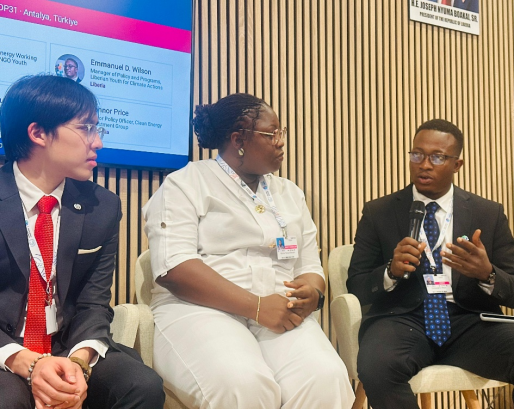
The statement came from Emmanuel D. Wilson, Manager of Policy and Programs at Liberian Youth for Climate Actions Liberia, made the remark in an interview with FrontPage Africa after participating in a COP31 side event on youth-led clean energy investment at the Liberia Pavilion on November 10.
His concern comes as Liberia continues to face a major electricity access gap. World Bank data show that 34.9 percent of the country’s population had access to electricity in 2024. In rural areas, the figure was just 9.2 percent, compared with 35.7 percent across sub-Saharan Africa. For households without electricity, access to reliable lighting and the ability to use electrical appliances remain limited. Businesses and public facilities also depend on dependable power to operate equipment and provide services.
The new coalition is intended to help mobilize investment for electricity expansion, but questions remain about how countries such as Liberia will access its support and what financing will become available.
The coalition was launched alongside the 35-by-35 Global Electrification Pledge, which aims to increase electricity’s share of global final energy consumption from about 23 percent to 35 percent by 2035. The African Development Bank and World Bank are expected to co-lead the coalition from 2027, bringing together development institutions, governments and private financiers.
The initiative is expected to work with developing countries to identify priority projects, build investment pipelines, reduce risks and address regulatory barriers that can discourage private investment. However, details of country eligibility, application procedures and the amount of financing that could be mobilized for individual countries were not specified in the launch announcement.
FrontPage Africa sought clarification from the African Development Bank on how Liberia could benefit from the coalition, what countries would need to do to access its financing, and whether the initiative would mobilize new funding or coordinate existing resources.
The questions were sent through Sonia Borrini, the bank’s Communication and Knowledge Management Specialist, whom this publication contacted at the Africa Pavilion during the conference. Borrini said she had forwarded the questions to the person responsible for responding. The bank had not provided a response by publication time. FrontPage Africa will update this story in its online version once a response is received.
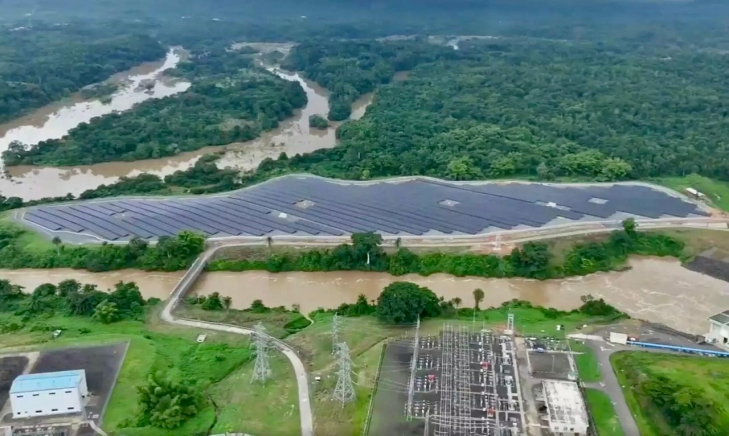
Separately, the Climate Investment Funds announced a $15 million first-loss payment guarantee for Liberia’s utility-scale solar and battery-storage program. The guarantee is not a $15 million cash grant to the Liberian government. Instead, it is designed to cover certain payment risks associated with the electricity off-taker under the second phase of the Liberia Electricity Sector Strengthening and Access Project, which will be implemented with the World Bank.The guarantee is expected to help attract about $200 million in investment for solar and battery projects by reducing some of the financial risks investors may face and encouraging private-sector participation.
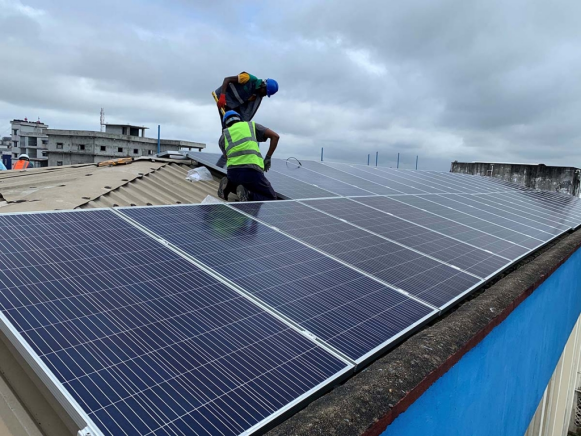
Solar plants generate electricity from sunlight, while battery systems store electricity for use when generation is lower, including after sunset.
The financing announcements come as Liberia seeks international support to implement its climate and energy plans.
Emmanuel K. Urey Yarkpawolo, Executive Director of Liberia’s Environmental Protection Agency, said financing remains the main obstacle to implementing the country’s climate and energy plans.
“We have the policies. I think we have the political will. I think what is needed is the financing.”
Liberia’s latest national climate action plan targets a 64 percent reduction in emissions by 2035, with about 90 percent of the planned reduction dependent on international support, according to Yarkpawolo. Investment in renewable energy, he said, would be important to achieving the target. He also called for a simpler process for accessing climate finance.
“We hope that this new financing mechanism can help Liberia to be able to meet its target,” he said, adding that the process should be “transparent and simplified.”
Yarkpawolo described the Environmental Protection Agency’s role in ensuring that energy projects meet environmental requirements and undergo environmental and social impact assessments. He also pointed to the development of net-metering policies and regulations as part of efforts to support renewable energy.
Net metering allows households and businesses with solar systems to supply surplus electricity to the public grid and receive credits for the power they contribute. Liberia has taken steps towards establishing the framework. The Ministry of Mines and Energy validated a draft national policy in 2025, while the electricity regulator gazetted Embedded Generation Regulations in July 2026.
But having the rules in place does not necessarily mean households and businesses can afford solar systems or that the grid can accommodate electricity from privately owned installations. Wilson also highlighted affordability and the financial risks facing young entrepreneurs as barriers to expanding clean-energy solutions.
The question of access to climate finance was also raised by Dr. Hakima El Haite, COP22 High-Level Climate Champion, during an Economic Commission for Africa event at the Africa Pavilion on November 10.
“Our projects fail not because of the risk. We are not as risky as any other country. It is because of the perception of the risk,” she said.
Speaking at the event, titled From Pledges to Implementation: Delivering on Presidential Initiatives – Lessons for Africa on the Road to COP32, El Haite addressed Mr. Amer Baig, Chief Investment Officer of the Green Climate Fund, who was seated beside her. She called on the Fund to make its financing more accessible to African countries.
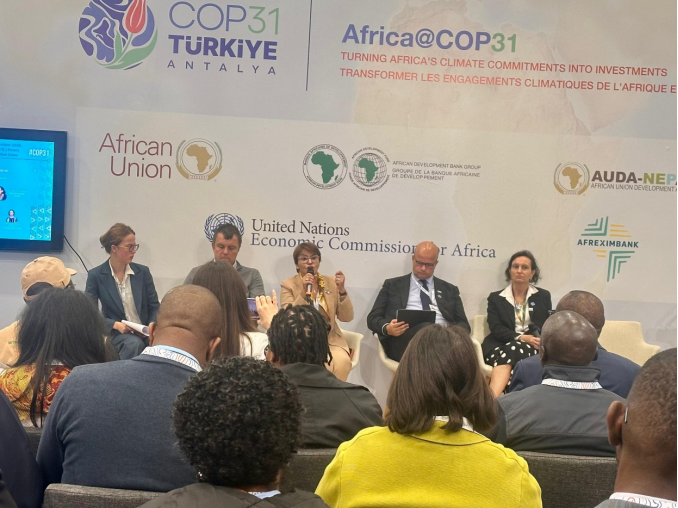
“Our projects fail not because of the risk. We are not as risky as any other country. It is because of the perception of the risk,” she said.
She urged Baig and the Fund to help African countries overcome difficulties in accessing climate finance, pointing to the limited number of accredited institutions across the continent and the complexity of the application process.
“Please make it simple for Africans to implement climate actions,” she said.
El Haite also raised concerns about the debt burden facing African countries, saying governments were spending time negotiating and taking loans while trying to finance climate action.
For Liberia, the financing challenge extends beyond large-scale electricity projects to the ability of local businesses and communities to participate in the energy transition.
An earlier FrontPage Africa investigation documented how changing rainfall patterns and difficulties sustaining farming had pushed some rural residents towards charcoal production. Another investigation also found that a project involving women producing briquettes from palm-kernel shells in Todee District, Montserrado County, stalled after equipment broke down and the women struggled to find buyers. Without repairs and a market for their products, they returned to producing wood charcoal.
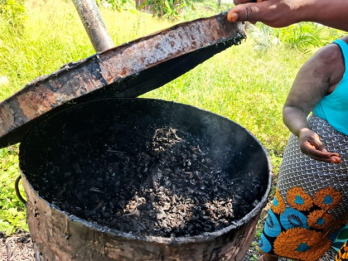
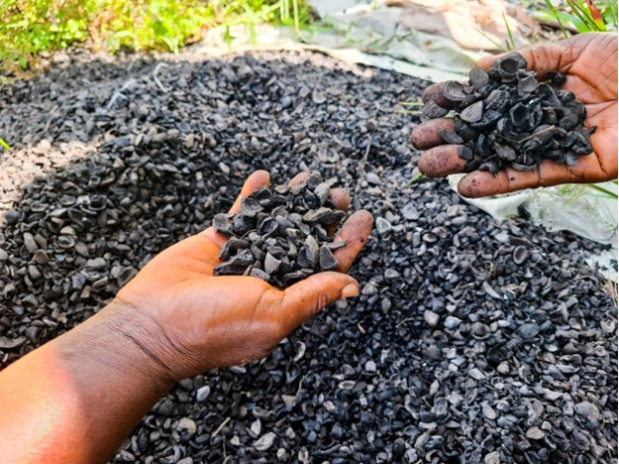
Wilson said his organization’s clean-cooking survey in a rural community found that charcoal production was an important source of income for some households, helping them pay for food and school fees. He said switching to cleaner alternatives could be difficult if households lost that income without other livelihood options.
He said young entrepreneurs also face difficulties obtaining loans because they often lack collateral and an established business record. He called for financing that takes account of what households can afford and gives young businesses technical support and room to test their products before taking on major debt. He added that young people should have a role in implementing and monitoring climate policies, not only in consultations.
Liberia is also part of Mission 300, a separate initiative led by the African Development Bank and World Bank that aims to connect 300 million people in Africa to electricity by 2030. The country has a National Energy Compact outlining its energy access priorities. The new Electrify Now Finance Coalition is a separate initiative, and its launch does not by itself guarantee additional funding for Liberia under Mission 300.
The announcements at COP31 have placed new attention on the role of finance in expanding electricity access. For Liberia, the next questions are how its proposed projects will qualify for support, whether the new coalition will bring additional financing and how the planned investments will translate into more reliable electricity for households, businesses and public services.
This story was produced as part of the COP31 Climate Change Media Partnership,a journalism fellowship organized by Internews’ Earth Journalism Network, Informed Earth and the Stanley Center for Peace and Security.
Support Independent Journalism
Your support helps FrontPage Africa continue delivering independent, credible, and impactful journalism. Every contribution strengthens our ability to investigate, inform, and hold power accountable while keeping quality journalism accessible to our readers.
Support our journalism or subscribe to receive the latest FrontPage Africa stories and updates.