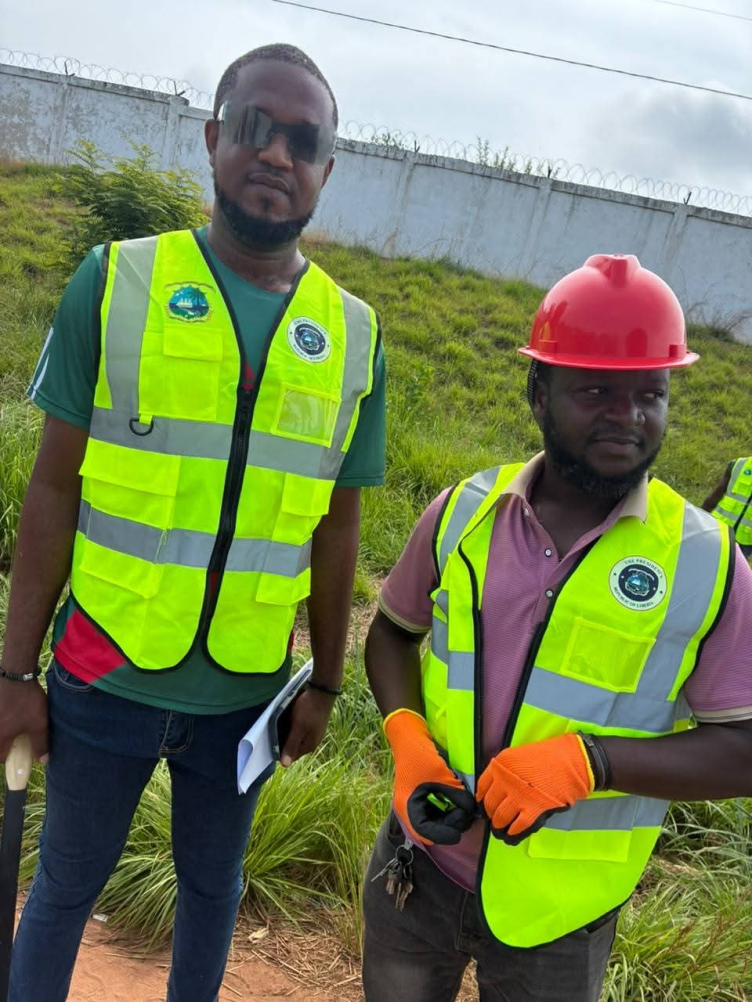
MONROVIA – Every morning, young men and women across Liberia’s towns and cities pick up cutlasses, brooms and wheelbarrows to clear roadsides and drains. Among them are two university graduates who once pictured themselves in offices, laboratories and farms, applying what they learned in lecture halls. Instead, they are part of a government sanitation program that offers short-term work to unemployed youth.
By Selma Lomax, [email protected]
Their names are Aloysius Tokpah and Jonathan Kien. Their paths to the program differ in detail, but they share a common thread: both did what Liberian families have long told their children to do. They went to university, finished their studies, and waited for the doors that a degree is supposed to open.
A degree in public service, a job on the roadside
When Tokpah enrolled at Cuttington University, the plan seemed straightforward. He would study hard, graduate, and move into a professional career where his knowledge could serve both his own future and his country’s development.
He majored in Public Administration, with a minor in Economics, and graduated in the 2024/2025 academic year. It is a combination suited to work in government institutions, public service, policy planning and economic development, the very fields in which Liberia says it needs capable people.
But the months after graduation did not unfold as he had hoped. Instead of landing a role in his field, Tokpah found himself doing roadside brushing under the Government of Liberia’s Presidential Clean Cities Initiative, a program designed to improve urban sanitation while giving young people temporary income. On November 10, he shared his feelings on Facebook. He wrote about the sacrifices behind his education, the hope that came with it, and the strangeness of finding himself doing roadside work simply to survive. Life, he reflected, sometimes takes people in directions they never imagined.
The post struck a chord because it spoke for many. It offered a glimpse of the distance between academic ambition and the realities of Liberia’s job market. There is an irony in his situation that is hard to miss. A graduate trained in public administration and economics could, in principle, contribute to planning, managing and evaluating public programs, including the sort of initiative in which he now works with his hands. Rather than sitting in an administrative office, he is helping to clean public spaces.
Supporting a family after graduation
Kien’s story is rooted in a different, equally pressing concern. A 2024/2025 graduate of Bong County University, he studied Agriculture, a field with obvious relevance for a country that wants to raise food production and strengthen rural livelihoods.
Yet since completing his studies, Kien has not found a job. With no income and a mother and other relatives depending on him, he said he accepted a place in the sanitation programme because he needed a way to support them.
For Kien, the decision was less about career than about responsibility. Waiting for the perfect opportunity in his field might mean months more without earnings, and family needs do not wait. Taking available work, however modest, became the practical choice.
His situation reflects a reality confronting many young Liberians: graduating does not automatically lead to employment, and a certificate does not guarantee economic independence.
These stories also point to something less often discussed, the sacrifices families make to educate their children. Tuition, transport, books and daily upkeep are often paid for through great effort. When graduation does not bring a job, the disappointment is felt well beyond the graduate.
What the numbers say
The experiences of Tokpah and Kien arrive at a moment when the World Bank is urging Liberia to look beyond headline growth. In the seventh edition of its Liberia Economic Update, titled Beyond Growth: Addressing Structural Constraints to Job-Rich Growth in Liberia, launched in Monrovia on November 3, 2026, the Bank reported that the economy grew by 5.1 percent in 2025.
That growth was driven largely by a strong rebound in mining, which expanded by 17 percent, and by continued gains in services, which grew by 4.6 percent. Agriculture, the sector where Kien trained, lagged behind at 2.6 percent.
The Bank’s message was that good growth figures are not enough. For expansion to improve ordinary lives, it said, the economy must generate more and better jobs. It pointed to constraints that hold businesses back and limit hiring: high production costs, unreliable infrastructure, limited access to financing, and weak links to markets. Its recommendations included sustained macroeconomic stability, stronger private-sector development, better governance, and policies that widen productive opportunities.
World Bank Country Manager for Liberia Georgia Wallen stressed that the central challenge is converting economic gains into opportunities that improve people’s lives. For graduates, that challenge is concrete. A country can post solid growth while sectors that create the most visible wealth employ relatively few people.
A labour market dominated by informal work
The problem is not only how many people lack jobs, but what kind of work is available. In a May 2026 analysis of the private sector, the World Bank found that about 87 percent of Liberian workers were in informal employment, including smallholder farming and unregistered micro-enterprises. It also reported that roughly 14.8 percent of people aged 15 to 24 were neither in education, employment nor training, and cautioned that, given the scale of informality, youth underemployment may be far larger than conventional unemployment figures suggest.
A different picture comes from Liberia’s 2024 Labour Force Survey, cited in an International Monetary Fund assessment. It recorded an unemployment rate of 12.6 percent and found that 44.2 percent of young people aged 15 to 24 were neither in education, employment nor training.
The figures differ because the datasets and measurements differ, but they tell the same story: the labour market offers too few stable, productive opportunities for young people entering it.
For graduates like Tokpah and Kien, then, the obstacle is not unwillingness to work. It is the difficulty of finding work that pays enough and makes use of what they studied. How a sanitation drive became a lifeline
The Presidential Clean Cities Initiative is a Government of Liberia intervention championed by President Joseph Nyuma Boakai Sr. It aims to improve sanitation in urban communities while providing structured, short-term jobs for young Liberians. It also seeks to encourage community ownership of public spaces and deepen cooperation among citizens, youth groups, community-based organisations and local authorities.
The first phase began on November 10, covering eight counties, 14 cities and one township. Participating locations include Monrovia and Paynesville in Montserrado County; Ganta, Sanniquellie and Tappita in Nimba; Gbarnga and Totota in Bong; Foya and Voinjama in Lofa; Buchanan in Grand Bassa; Kakata City, Unification City and Schieffelin Township in Margibi; Tubmanburg in Bomi; and Zwedru in Grand Gedeh.
The targets are specific. Government plans to engage 1,250 young people and 30 community-based organisations, with at least 40 percent of participants expected to be women. The programme aims to clean and maintain at least 120 public spaces and 100 drainage systems, support the disposal of at least 2,000 metric tonnes of solid waste, and reach at least 500,000 citizens through sanitation and awareness activities.
The first phase is expected to last three months, with participants reportedly receiving US$100 a month, or US$300 in total if those terms hold. The programme is fully funded by the Ministry of State for Presidential Affairs. Its implementing partners include the Ministries of Local Government, Information, and Youth and Sports; the Environmental Protection Agency; county and city authorities; community-based organisations; and the President Delivery Unit, which is expected to independently track progress.
For participants, the stipend may bring genuine if temporary relief. For Kien, it can help meet family needs. For Zlatan, it is a way to earn while his professional path remains uncertain.
After the three months
The harder question is what happens when the programme ends. Three months of work, and a modest stipend, cannot by themselves solve a structural jobs shortage. Participants will return to the same labour market, with the same competition and the same limited openings.
None of this diminishes the work itself. There is dignity in honest labour, and clean public spaces and clear drains protect communities from environmental hazards and support public health. No one should look down on the young people doing it.
The real issue is why graduates who invested years in higher education must so often rely on temporary work far from their fields to meet basic needs. Producing graduates is only half of a development strategy. The other half is building an economy that can absorb them.
Liberia needs trained public administrators to strengthen state institutions, economists to guide development planning, and agricultural professionals to raise food production and productivity. These are exactly the areas where Tokpah and Kien studied, and where they could contribute if the right openings existed.
That points back to the World Bank’s argument. Businesses need cheaper operating conditions, dependable infrastructure, access to finance and stronger market connections if they are to expand and hire. A healthier private sector, supported by stable macroeconomic policy and good governance, is where lasting jobs for graduates are most likely to come from.
For the Boakai-Koung administration, the Clean Cities Initiative offers a chance to tackle immediate sanitation problems while giving young people temporary support. The test will be whether such programmes sit within an employment strategy that creates sustainable opportunities rather than standing alone.
Behind every broom
As the first phase continues, Tokpah and Kien remind the country that behind every sanitation worker is a person with ambitions, responsibilities and, sometimes, years of university study.
For Tokpah, the road from Cuttington’s classrooms to roadside brushing is not the one he planned. For Kien, accepting the work was about supporting his mother and family after months without a job. Both made a choice that many young graduates face when survival becomes more urgent than professional expectations.
Ultimately, Liberia’s development will not be measured only by how many graduates its universities produce or how fast its economy grows. It will depend on whether educated young people can find decent work, support their families, and put their knowledge to use for their country.
Until that happens more consistently, the stories of graduates like Tokpah and Kien will remain a stark reminder that in Liberia, earning a degree and finding a job are still two very different achievements.
Support Independent Journalism
Your support helps FrontPage Africa continue delivering independent, credible, and impactful journalism. Every contribution strengthens our ability to investigate, inform, and hold power accountable while keeping quality journalism accessible to our readers.
Support our journalism or subscribe to receive the latest FrontPage Africa stories and updates.