President Joseph Nyuma Boakai said a small number of government officials were asked to step aside or move to other roles ahead of an upcoming midterm review. Still, some have been reluctant or have refused to leave.
- The Request: President Boakai made the remarks at the start of the administration’s 26th Cabinet meeting in Monrovia, explaining that the request is meant to reposition officials into roles where they can perform better ahead of a midterm review.
- Reluctance: He noted that while government jobs are a matter of service rather than prestige or personal entitlement, a few affected individuals have been resistant to stepping down.
By: Austin S. Fallah – A True Son of the Planet Earth: [email protected]
A presidency is more than the person who occupies the Executive Mansion.
It is an institution created by the Constitution to provide national leadership, execute laws, preserve public order, manage government affairs, and ensure that public officials serve the people rather than themselves.
In Liberia, the President has substantial constitutional authority.
The President appoints ministers, agency heads, commissioners, county superintendents, ambassadors, military leaders, and many other public officers.
These appointments are not merely ceremonial privileges.
They are instruments through which the Executive Branch is expected to function effectively and carry out the public mandate.
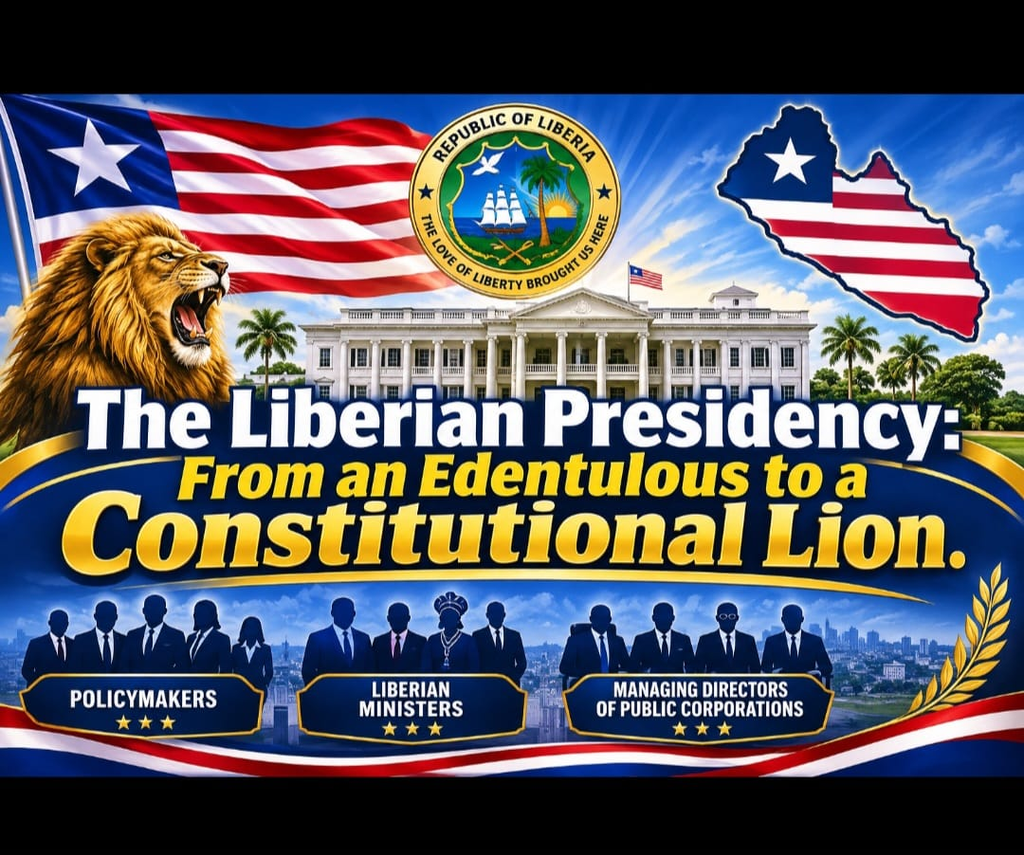
Yet a serious question confronts Liberia’s democracy: Is the Liberian Presidency capable of “biting” and making its constitutional authority under the Executive respected by those appointed?
Put differently, can a Liberian President command discipline, loyalty to public service, and compliance with lawful directives from ministers, commissioners, managing directors, and other appointed officials?
The answer must be yes—but only if presidential authority is exercised constitutionally, consistently, and in the public interest.
The Presidency must be respected.
It cannot become an edentulous that barks loudly but is ignored by those entrusted with public responsibilities.
At the same time, it should not become a reckless beast that devours democratic institutions.
Liberia needs a fierce lion: a presidency strong enough to enforce discipline and accountability, but wise enough to respect the Constitution, the rule of law, and the independence of other branches of government.
The Constitution of Liberia gives the President a central role in administering the state.
As head of the Executive Branch, the President must ensure that laws are faithfully executed.
This responsibility necessarily includes supervising appointed officials.
A President who appoints ministers and senior public servants but cannot direct, evaluate, discipline, or remove them when they fail in their duties is not fully exercising executive power.
Government would become fragmented, with ministries and agencies operating as personal kingdoms rather than as coordinated parts of a single national administration.
Appointed officials derive much of their authority from the offices they occupy, but those offices exist within a constitutional hierarchy.
A minister is not elected by the entire nation to pursue an independent agenda.
A managing director of a state-owned enterprise is not given a position to build a personal political empire.
A commissioner is not appointed to ignore government policy, defy lawful instructions, or use public resources for private or partisan gain.
These officials are entrusted with authority because the people, through the Constitution and through the President’s appointment power, expect them to contribute to national development.
Their first loyalty must be to Liberia and its laws, not to their personal interests, business associates, political factions, or ethnic constituencies.
For this reason, the Liberian Presidency must have the capacity to bite when necessary. “Biting” should not be understood as intimidation, abuse, threats, or arbitrary punishment.
Rather, it means taking decisive lawful action against misconduct, negligence, corruption, insubordination, and incompetence.
If an appointed official refuses to implement lawful government policy, misuses public funds, undermines the President’s legitimate authority, or performs poorly in office, the President must respond.
That response may include a warning, an investigation, suspension where permitted by law, reassignment, or dismissal.
Failure to act sends the dangerous message that public officials can disregard the Executive Branch without consequence.
A toothless presidency produces weak government.
When senior officials believe that they cannot be disciplined, they become comfortable with poor performance.
They may arrive late to work, ignore citizens’ complaints, abandon development projects, and fail to account for public money.
They may publicly contradict the government’s policies while remaining in office.
They may use their positions to reward friends and punish opponents.
Eventually, ministries become inefficient, agencies become corrupt, and citizens lose faith in government.
The public does not distinguish carefully between an ineffective minister and an ineffective President.
If a ministry fails to deliver health services, education, roads, electricity, security, or clean water, citizens naturally blame the administration as a whole.
Therefore, presidential weakness toward appointed officials is not a private management problem; it is a national governance crisis.
Liberia’s history makes this issue particularly important.
The country has experienced political exclusion, civil conflict, institutional fragility, and deep public distrust of government.
Since the end of the civil wars, Liberia has worked to strengthen democratic institutions, rebuild public confidence, and establish a culture of constitutional governance.
However, postwar reconstruction cannot succeed if public institutions remain dependent on personalities rather than rules.
The President must insist that public officials understand that government service is not an entitlement.
It is a trust.
Every appointed official should know that the office belongs to the Liberian people and that continued service depends on integrity, competence, and obedience to lawful authority.
Respect for the Presidency is also necessary because the President represents national unity.
Liberia is a diverse country, with many ethnic communities, counties, languages, political interests, and religious traditions.
In such a society, the Presidency often serves as the most visible national institution.
When appointed officials openly defy the President or treat the Executive Branch with contempt, they do more than insult one individual.
They weaken the authority of the state itself.
They encourage division and signal that public order is negotiable.
If those at the highest levels of government disregard lawful authority, it becomes harder to persuade ordinary citizens to obey laws, pay taxes, respect courts, and cooperate with public institutions.
However, the demand for a strong Presidency must not be misunderstood as a call for dictatorship.
Liberia does not need a President who acts above the law, silences criticism, punishes political opponents, or treats every disagreement as rebellion.
A fierce lion is not the same as a tyrant.
The Constitution creates limits on presidential authority for good reason.
Liberia’s democracy depends on checks and balances among the Executive, Legislature, and Judiciary.
The Legislature has oversight responsibilities, including confirmation powers in many appointments and authority over appropriations.
The Judiciary must interpret the law and protect constitutional rights.
The media, civil society organizations, religious leaders, professional groups, and ordinary citizens also have legitimate roles in holding government accountable.
A President should therefore distinguish between disloyalty to the Constitution and disagreement over policy.
Appointed officials should not be expected to flatter the President or agree with every private opinion.
Good governance requires honest advice.
A minister who respectfully warns the President that a proposed policy is financially dangerous or legally questionable may be performing a patriotic duty.
The President should welcome competent advice, debate, and evidence-based disagreement within the proper channels.
But once a lawful decision has been made, executive officials have an obligation either to implement it faithfully or resign from office.
They cannot remain in government while publicly sabotaging the administration they were appointed to serve.
This distinction is crucial.
A healthy presidency does not demand blind obedience; it demands professional discipline.
Blind obedience creates yes men and yes women who hide problems, praise leaders excessively, and let mistakes grow into national disasters.
Rather than having a frank discussion with the presidency, they go around gossiping how the president does not listen, how he favor some ministers over others.
Gossiping is wrong today, wrong tomorrow and will always be wrong.
Professional discipline, by contrast, allows candid internal discussion but requires unity in lawful execution once decisions are reached.
Liberia needs officials who can speak truth to power respectfully, not officials who undermine power irresponsibly.
A President who punishes every honest disagreement will surround themselves with fear.
A President who tolerates every act of defiance will surround themselves with disorder.
Effective leadership lies between these two extremes.
To become a constitutional lion, the Liberian Presidency must strengthen the systems through which executive authority is exercised.
First, appointments must be based more on merit, integrity, competence, and public service than on political loyalty alone.
A President who appoints unqualified friends, campaign financiers, relatives, or political brokers may later find it difficult to demand performance from them.
Such appointees may believe that their political connections protect them from consequences.
By contrast, qualified professionals with clear terms of reference are easier to evaluate and hold accountable.
Second, every appointed official should receive written performance expectations.
Ministers and agency heads should know what the government expects of them to accomplish within specific time frames.
These expectations may include improving service delivery, reducing waste, completing infrastructure projects, expanding access to education or health care, increasing revenue collection, or strengthening anti-corruption measures.
Clear goals make accountability possible.
Without measurable standards, officials can always claim that they are working hard even when public results remain poor.
Third, the Executive Branch should establish regular monitoring and evaluation mechanisms.
The President should not wait for scandals, newspaper reports, or public protests before discovering that an agency is failing.
The Executive Branch should establish professional systems to review budgets, procurement practices, staffing, project implementation, and citizen complaints.
Oversight should not simply aim to catch wrongdoing.
It should also help ministries solve problems, coordinate policies, and identify weaknesses before they become crises.
Strong executive authority requires accurate information.
Fourth, disciplinary action must be consistent. Nothing weakens a President more than selective enforcement.
If one official is dismissed for corruption while another is protected because of political influence, the public will conclude that the government does not truly believe in accountability.
Likewise, if low-level civil servants are punished while powerful ministers escape scrutiny, the presidency will appear hypocritical.
A constitutional lion must have the courage to act against friends, allies, and politically important figures when evidence establishes wrongdoing.
Respect cannot be demanded by speeches alone; it must be earned through fairness.
Fifth, presidential discipline decisions should follow due process.
Officials accused of wrongdoing should have an opportunity to respond to allegations, especially where the law provides protections or where the accusations may damage reputations.
Investigations should be credible, transparent when appropriate, and free from political manipulation.
Due process does not make the President weak. On the contrary, it gives presidential decisions legitimacy.
When the public sees that a dismissal or suspension is based on evidence, procedure, and law, the action carries greater moral and political authority.
The President must also model the behavior expected from appointees.
It is difficult to demand discipline from ministers if the President’s own office is disorganized, inaccessible, or associated with favoritism.
It is difficult to condemn corruption if executive decisions are opaque.
It is difficult to require respect for institutions if presidential advisers bypass legal procedures.
Leadership flows downward.
If the Executive Mansion demonstrates punctuality, transparency, professionalism, and respect for public funds, those standards are more likely to spread throughout government.
Moreover, the public has a role in ensuring that presidential strength remains constitutional.
Citizens should demand both firmness and restraint.
They should criticize a President who allows appointees to mismanage public institutions, but they should also resist any attempt to use executive power to silence peaceful criticism or destroy democratic opposition.
The goal is not merely to have a feared President.
Fear can temporarily produce obedience, but it rarely produces trust or lasting institutional strength.
Liberia needs a respected President, one whose authority is acknowledged because it is lawful, fair, and directed toward the common good.
Ultimately, the Liberian Presidency is capable of biting, but its bite must be constitutional.
The President possesses sufficient authority to demand accountability from appointed officials, remove those who fail the public trust, and ensure that government functions as a unified Executive Branch.
What is often needed is not additional power, but the courage, discipline, institutional capacity, and political will to use existing power responsibly.
Liberia cannot afford a toothless bulldog presidency that barks at corruption, incompetence, and insubordination while allowing them to flourish.
Such a presidency invites disrespect, weakens public institutions, and betrays the hopes of citizens who expect effective government.
Yet Liberia also cannot afford an unchecked presidency that confuses strength with oppression.
The better vision is that of a fierce lion: alert, disciplined, courageous, and protective of the national interest.
A constitutional lion does not attack the innocent or devour democratic institutions.
It guards the public trust, enforces lawful authority, demands performance from appointees, and ensures that no official is greater than the Republic.
Support Independent Journalism
Your support helps FrontPage Africa continue delivering independent, credible, and impactful journalism. Every contribution strengthens our ability to investigate, inform, and hold power accountable while keeping quality journalism accessible to our readers.
Support our journalism or subscribe to receive the latest FrontPage Africa stories and updates.