Liberia, Canada Investment Office facilitates high-level engagement involving Liberia National Fire Service, Ghanaian counterpart and Premium Pole Investments; proposed cooperation targets training, modern equipment, and institutional reforms
By: Willie N. Tokpah
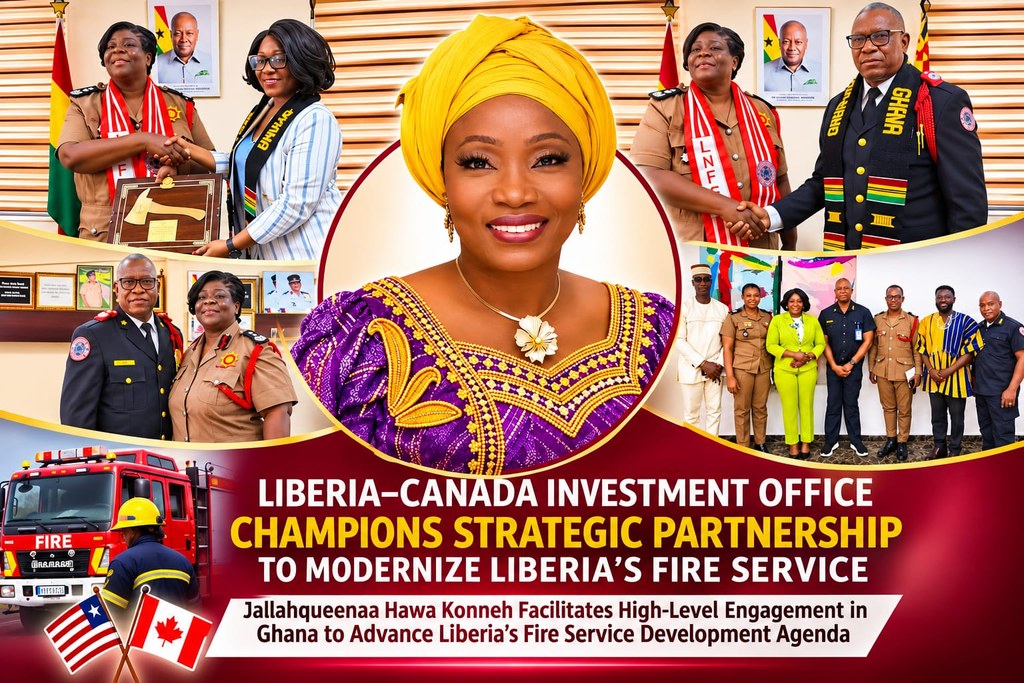
Monrovia-Liberia is exploring an international partnership with Ghana aimed at strengthening its firefighting capacity, modernizing emergency response services and addressing longstanding institutional challenges within the Liberia National Fire Service, LNFS, an initiative being advanced through the investment diplomacy of the Liberia–Canada Investment Office.
The initiative, led by Jallahqueenaa Hawa Konneh, has facilitated a high-level working engagement in Ghana involving Liberia’s Chief Fire Officer, G. Warsuwah Barvoul, the Ghana National Fire Service and private-sector entity Premium Pole Investments.
The engagement is intended to explore areas of cooperation that could support the implementation of Liberia’s Five-Year National Fire Service Strategic Plan, 2025–2030, with particular emphasis on professional firefighter training, modern firefighting equipment, technical assistance, institutional capacity-building and potential public-private partnerships.
The initiative reflects an effort to extend investment diplomacy beyond conventional capital attraction by connecting Liberia’s public institutions with international technical expertise and prospective private-sector partners capable of supporting critical national development priorities.
For a country where emergency response capacity remains an important component of public safety, infrastructure protection and economic resilience, the proposed cooperation could represent an opportunity to strengthen an institution whose effectiveness has implications for households, businesses, industries and public infrastructure.
However, the proposed partnership remains subject to further discussions, with no finalized agreement or confirmed financial commitment announced in the information released by the investment office.
Konneh’s Imvestment Diplomacy Targets Institutional Development
At the center of the initiative is Jallahqueenaa Hawa Konneh, whose leadership of the Liberia–Canada Investment Office is being used to facilitate international engagements around Liberia’s development priorities.
Through the Ghana engagement, the office is seeking to connect the country’s emergency management institution with potential partners who can contribute technical knowledge, professional training, and investment opportunities.
The involvement of the Ghana National Fire Service is particularly relevant because the proposed cooperation creates an avenue for Liberia to explore institutional knowledge-sharing and professional development with an established regional counterpart.
Premium Pole Investments is also part of the engagement, introducing a private-sector dimension to discussions surrounding technical support and potential investment collaboration.
The initiative highlights a broader development approach in which international relationships are used not only to attract foreign investment but also to address practical institutional needs.
For Konneh and the investment office, the underlying objective is to translate international connections into partnerships capable of producing measurable improvements in Liberia’s public institutions.
Five-Year Strategic Plan At The Center Of The Initiative
The proposed engagement is aligned with the Liberia National Fire Service’s Five-Year Strategic Plan for 2025–2030, which provides the framework for strengthening the institution’s operational and administrative capacity.
Among the priority areas identified for cooperation are professional firefighter training, modern firefighting equipment, technical assistance, and institutional strengthening.
These areas are particularly important given the demands placed on fire and emergency response institutions in an increasingly urbanized environment.
Effective firefighting requires more than personnel and emergency vehicles. It depends on continuous professional training, reliable communication systems, appropriate protective equipment, functional fire stations, water access, operational coordination, and the ability to respond quickly to emergencies.
For Liberia, strengthening these capacities could help reduce the risks associated with residential fires, commercial property destruction, industrial accidents, and other emergencies.
The proposed engagement also opens discussions around potential public-private partnerships, an arrangement that could create opportunities for private-sector participation in areas where government resources alone may be insufficient.
Nevertheless, the extent of Ghana’s technical contribution, the nature of Premium Pole Investments’ participation, and the financing arrangements remain to be established through further negotiations.
Why Ghana Matters To Liberia’s Fire Service Development
The engagement with Ghana offers Liberia an opportunity to explore regional cooperation rather than relying exclusively on external technical assistance from outside Africa.
Through collaboration with the Ghana National Fire Service, Liberia could potentially benefit from professional exchanges, operational experience, training methodologies, and institutional knowledge relevant to emergency response management.
Such cooperation could also help strengthen professional relationships between the two countries and encourage broader South-South development partnerships.
The involvement of Premium Pole Investments further introduces the possibility of linking technical cooperation with private-sector resources and investment facilitation.
However, the success of the initiative will depend on the practical arrangements eventually agreed upon, including the identification of training requirements, equipment needs, implementation timelines, financing, and accountability mechanisms.
Beyond Firefighting, A National Development Priority
The modernization of the Liberia National Fire Service has implications extending well beyond emergency response.
A stronger firefighting institution can contribute to the protection of commercial investments, public infrastructure, residential communities, and economic assets.
For businesses and prospective investors, reliable emergency services are an important part of the broader environment required to protect property, sustain operations and manage operational risks.
For ordinary Liberians, improved firefighting capacity can mean better protection of homes, markets, schools, hospitals, and other essential facilities.
The proposed initiative therefore, connects public safety with investment confidence and national economic development.
It also highlights the importance of strengthening public institutions as part of Liberia’s broader efforts to create an environment capable of supporting sustainable investment and economic growth.
Turning Diplomatic Engagement Into Results
While the engagement has created an opportunity for international cooperation, its ultimate significance will be determined by what follows.
Liberia will need clearly defined commitments, practical implementation arrangements, and measurable targets if the proposed partnership is to move beyond diplomatic engagement.
Among the issues requiring further attention are the scale of firefighter training, the procurement and maintenance of modern equipment, technical assistance arrangements, funding commitments, and the long-term sustainability of any partnership.
There will also be a need for transparent coordination among the Liberia National Fire Service, the Liberia–Canada Investment Office, Ghana National Fire Service, and the private-sector partner.
For Konneh, the initiative provides an opportunity to demonstrate how investment facilitation can be directed toward strengthening national institutions and addressing development challenges.
For Chief Fire Officer G. Warsuwah Barvoul, the engagement creates an avenue to advance the operational needs of the institution and explore external support for implementing its 2025–2030 strategic agenda.
Ultimately, the proposed Liberia-Ghana cooperation could become an important component of efforts to improve the country’s emergency preparedness, provided that the discussions produce concrete and sustainable commitments.
As Liberia continues to pursue international partnerships, the modernization of its fire service offers a practical example of how investment diplomacy can intersect with public safety, institutional development, and economic resilience.
The challenge now is to move from international engagement to implementation, and ensure that the benefits of any eventual partnership are felt not only within government institutions but also by the communities, businesses and citizens the fire service exists to protect.
Support Independent Journalism
Your support helps FrontPage Africa continue delivering independent, credible, and impactful journalism. Every contribution strengthens our ability to investigate, inform, and hold power accountable while keeping quality journalism accessible to our readers.
Support our journalism or subscribe to receive the latest FrontPage Africa stories and updates.