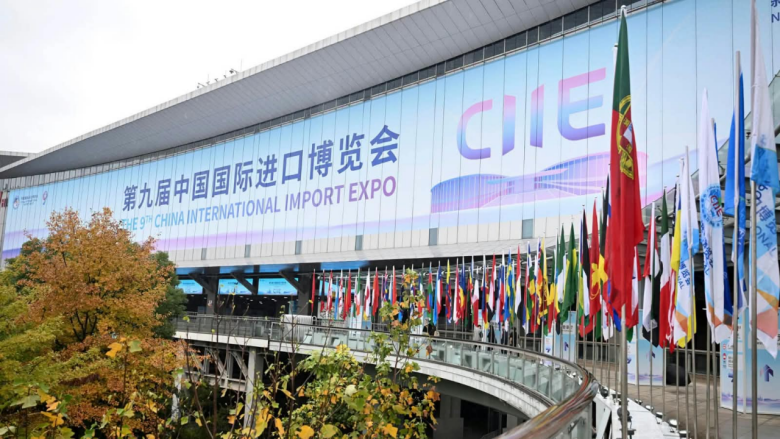
SHANGHAI, China — China has reaffirmed its commitment to expanding international trade, opening its vast consumer market to foreign businesses and strengthening global economic cooperation as it is hosting the ninth edition of the China International Import Expo (CIIE) amid growing concerns over trade imbalances, protectionism and disruptions in global commerce.
By J.H. Webster Clayeh [email protected]
The annual trade event, held under the theme “New Era, Shared Future,” provides a platform for countries and regions worldwide to explore opportunities created by China’s modernization drive, promote greater economic openness and advance mutually beneficial international cooperation.
The expo encourages foreign companies to export goods and services to China, providing access to one of the world’s largest consumer markets while expanding choices for Chinese consumers and enterprises.
The opening ceremony brought together Ding Xuexiang, Member of the Standing Committee of the Political Bureau of the Communist Party of China Central Committee and Vice Premier of the State Council; Brice Clotaire Oligui Nguema, President of Gabon, Christian Stöcker, Chancellor of Austria and Alexander De Croo, Administrator of the United Nations Development Programme (UNDP).
More than 50 ministerial-level and senior officials from over 30 countries, regions and international organizations, alongside diplomatic envoys accredited to China, also attended the ceremony.
A total of 162 countries, regions and international organizations are participating in this year’s expo. Among them, 65 countries and four international organizations are taking part in the Country Exhibition, while more than 4,100 exhibitors are showcasing their products and services at the Business Exhibition.
The event has also recorded new highs in the number of participating enterprises, Fortune Global 500 companies, industry-leading businesses and overall exhibition space.
China Defends Trade Surplus Amid Global Concerns
Addressing the opening ceremony, Vice Premier Ding Xuexiang defended China’s growing role in global commerce, insisting that Beijing remains committed to expanding imports, promoting investment and strengthening international economic cooperation.
Ding argued that growing concerns over global trade imbalances should not lead countries toward restrictive economic policies but should instead encourage stronger international trade and investment partnerships.
According to him, the expo has played an important role in advancing China’s economic reforms, with several major opening-up policies first announced or further developed during previous editions.
He disclosed that China’s overall tariff level had declined to 7.3 percent, while Beijing had extended zero-tariff treatment to all least-developed countries with which it has established diplomatic relations in Africa.
Acknowledging the increasing pressure on economic globalization, Ding cited rising protectionism, unilateral trade measures, development inequalities and disruptions to the international economic and trade order as major challenges confronting the global economy.
However, he maintained that China was pursuing a more balanced approach to international trade through increased imports, investment promotion and technological cooperation.
Ding disclosed that China had remained the world’s second-largest importer of goods for 17 consecutive years and had become a major export destination for nearly 80 countries.
He said imports into China increased by 22.3 percent during the first three quarters of the year, nearly six percentage points higher than the country’s export growth over the same period.
He also pointed out that China’s current account surplus had declined from 9.9 percent of gross domestic product in 2007 to 3.7 percent in 2025, a level he described as falling within the internationally recognized reasonable range.
According to him, Beijing does not deliberately pursue trade surpluses but intends to maintain a positive and sustainable trade balance while contributing to global economic growth.
The Vice Premier said China would continue organizing its “Export to China” initiatives to encourage foreign businesses to access its vast consumer market and increase the volume of quality goods and services imported into the country.
The Chinese Vice Premier further urged governments to address trade disputes through dialogue, consultation and mutual understanding rather than restrictive economic policies.
He warned that excessive security restrictions and policies designed to protect domestic markets at the expense of trading partners could worsen global trade imbalances.
Citing research by the World Trade Organization, Ding said nearly 20 percent of global goods imports were affected by existing restrictive measures.
He argued that trade barriers and differences in regulatory systems were increasing the cost of international commerce and limiting access to products that countries needed.
He specifically noted that some high-technology products China wanted to import remained inaccessible because of trade restrictions.
Ding called on countries to respect one another’s legitimate concerns, resolve disagreements through consultations and pursue equal-footing dialogue to reduce trade costs and improve the movement of goods and services across borders.
China Says Expo Promotes Shared Global Prosperity
Speaking as host, China’s Minister of Commerce, Wang Wentao, said the CIIE, conceived, proposed, planned and personally advanced by President Xi Jinping, had developed into a major platform for China’s economic opening-up and international cooperation.
He said the expo had become a showcase of China’s new development paradigm, a platform for high-standard opening-up and a global public good shared by all, winning wide acclaim and active participation from the international community.
Also addressing the ceremony, Gabonese President Brice Clotaire Oligui Nguema described the expo as more than a symbol of China’s commitment to international trade.
“It is a window of China’s opening-up to the world, but also the world’s opening-up to China. It stands as evidence that trade can be an instrument of peace, solidarity and shared prosperity,” the Gabonese President said.
“We see that President Xi Jinping has led China in achieving carbon peaking and carbon neutrality and advancing green development. We also see President Xi Jinping’s global vision.
This is reflected in the zero-tariff treatment towards African countries. Products coming to China enjoy zero tariff. This is conducive to building a community with a shared future for humanity,” he added.
Austria Seeks Stronger Economic Ties with China
Christian Stöcker, Chancellor of the Republic of Austria, said his country is deeply connected to international trade, global markets and European integration.
“And I’m convinced that economic exchange creates opportunities, prosperity and mutual understanding. Austrian and Chinese companies have built meaningful partnerships over many years. We want to further foster this positive dynamic and make our relations more resilient,” he said.
He pledged to deepen economic relations between Austria and China, adding that he was confident significant opportunities remained for cooperation, particularly in areas that would shape the two countries’ future.
“As a neutral country in the heart of Europe, we are convinced that dialogue is the fundament of a common, prosperous future for all,” Stöcker said.
UNDP Says Trade Can Accelerate Sustainable Development
Adding to the calls for stronger international economic cooperation, Alexander De Croo, Administrator of the United Nations Development Programme, said the UNDP views development as the foundation for stability and prosperity.
“It defines whether people can earn a decent living, whether women and girls can enjoy equal opportunities, whether communities can withstand shocks, and whether countries have the capacity to shape their own futures,” De Croo said.
“For us, it is very clear that trade can be an incredibly powerful accelerator to achieve those outcomes.
The 2030 Agenda for Sustainable Development specifically recognizes trade as an engine for inclusive growth, trade as a means for poverty reduction, as a very powerful tool for advancing sustainable solutions,” he added.
Support Independent Journalism
Your support helps FrontPage Africa continue delivering independent, credible, and impactful journalism. Every contribution strengthens our ability to investigate, inform, and hold power accountable while keeping quality journalism accessible to our readers.
Support our journalism or subscribe to receive the latest FrontPage Africa stories and updates.