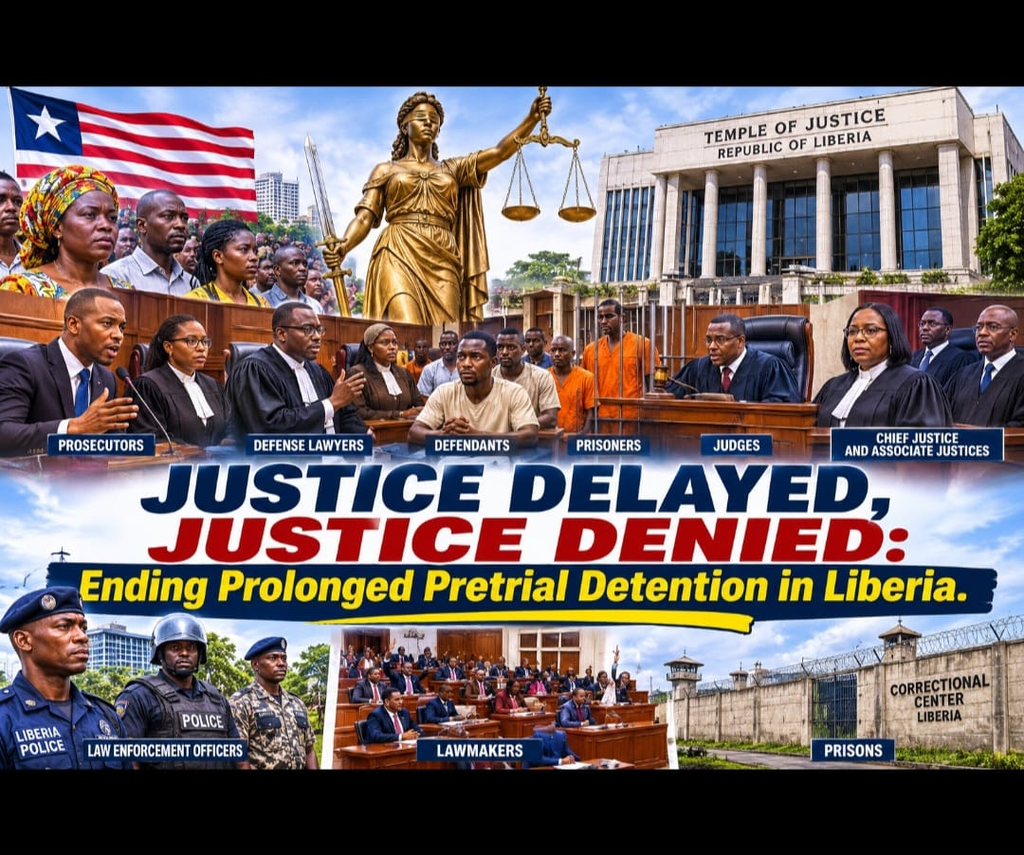
Prolonged pretrial detention is not simply an administrative weakness or a prison-management problem. It is a fundamental human rights concern, a threat to the presumption of innocence, an assault on human dignity, and a challenge to the Liberian justice system’s constitutional responsibility.
By: Austin S Fallah – A True Son of the Planet Earth Soil: [email protected]
President Joseph Nyuma Boakai, Sr.: Official Executive Mansion statement, March 11, 2025: At the opening of the March 2025 Term of the Supreme Court of Liberia: “without fear, favor, or delay”
Relevance: This is particularly powerful for your publication. The President’s own call for justice without delay provides an important foundation for demanding practical reforms to end prolonged pretrial detention—source: Executive Mansion – President of Liberia Addresses Supreme Court at Opening of March 2025 Term.
OFFICIAL GOVERNMENT STATEMENT · OCTOBER 13, 2025
President Boakai also stated:
“A nation cannot advance where laws are ignored or where the weak have no recourse.”Relevance: People held for years without trial, particularly those without financial resources or adequate legal representation, are among the most vulnerable people in the justice system. Source: President Boakai Highlights the Judiciary’s Central Role in Strengthening Rule of Law and Democracy.
Chief Justice Yamie Quiqui Gbeisay:
His March 9, 2026 Court opening address: “Justice, which is the firmest pillar upon which this, and every nation on earth, rests its hope, is the greatest asset of any nation, for equal protection and peace.”
Source: Chief Justice Gbeisay’s March 2026 Opening Address.
Former Chief Justice Sie-A-Nyene Gyapay Yuoh: “The Supreme Court finds it unacceptable for cases to remain pending in court for longer than the legally prescribed durations.”
Source: Chief Justice Yuoh Warns of Case Delay – Reports 231, October 18, 2024.
Former Chief Justice Francis S. Korkpor, Sr: Described prolonged pretrial detention as:
“legally wrong”: Relevance: This is a judicial pronouncement that is particularly important cause it directly addresses the subject of your publication. Source: Liberian Judiciary – Judges Want Befitting Retirement Laws Passed.
On the meaning of justice: Justice loses its meaning when an individual spends years behind prison walls awaiting a trial that the State has a constitutional and legal obligation to provide.
On the presumption of innocence: A prison cell must never become a courtroom, and detention must never become a substitute for conviction.
On Liberia’s responsibility: Liberia cannot credibly proclaim its commitment to human rights, constitutional democracy, and the rule of law. At the same time, thousands of its citizens remain incarcerated without the timely determination of their cases.
On reform: The measure of a justice system is not merely the number of people it prosecutes or incarcerates, but its ability to protect the innocent, hold the guilty accountable, and safeguard the liberty and dignity of every person.
On the urgency of reform: Every day a person remains unlawfully detained is another day the promise of constitutional liberty is denied.
The integrity of a nation’s justice system is measured not by the strength of its laws on paper, but by the fairness with which those laws are applied to the most vulnerable people within society.
At the center of every legitimate legal system is a basic principle: an accused person is not guilty merely because they have been arrested, charged, or placed behind prison walls.
Guilt must be determined through a fair, transparent, and competent legal process.
When the courts, prosecutors, police, and correctional institutions fail to provide that process within a reasonable period, they do more than make administrative mistakes.
They violate constitutional rights, undermine public trust, and inflict serious human suffering.
In Liberia, the continued detention of people for months or years without trial represents a grave threat to justice, human dignity, and the rule of law.
Dr. Martin Luther King Jr. famously declared that “justice too long delayed is justice denied.”
Although those words were spoken in the context of the American civil rights movement, they apply powerfully to Liberia and every other democratic society.
A person who remains in prison indefinitely without being tried is, in practical terms, being punished without a conviction.
Such treatment contradicts the presumption of innocence, one of criminal law’s most important protections.
Liberia cannot claim to be committed to justice, democracy, and human rights while allowing hundreds of citizens to languish in detention without being allowed to defend themselves before a court of law.
The country must urgently reform its criminal justice system to ensure prompt hearings, access to legal counsel, meaningful bail procedures, judicial accountability, and the protection of every accused person’s right to a free and fair trial.
The presumption of innocence is the foundation of justice.
It means that every person accused of a crime must be treated as innocent until the government proves guilt beyond a reasonable doubt in a competent court.
This principle is not merely a legal technicality designed to benefit criminals.
It safeguards all citizens. Anyone can be falsely accused, wrongly arrested in a political dispute, or detained because of mistaken identity.
Without the presumption of innocence, the state can abuse its power arbitrarily against ordinary people.
A justice system that assumes guilt before trial is not a system of justice; it is a system of punishment without accountability.
In Liberia, prolonged pretrial detention creates the dangerous impression that arrest itself equals conviction.
For many poor citizens, being arrested may lead to immediate loss of employment, separation from family, social stigma, and financial hardship.
Even if the person is eventually found innocent, the damage may already be irreversible.
A father who is detained for a year without trial may lose the ability to support his children.
A mother who is imprisoned while awaiting court proceedings may be separated from her young children and lose her livelihood.
A student held without trial may be unable to complete school.
In these cases, the state has imposed a severe punishment even though no judge or jury has found the accused guilty.
This problem is especially troubling in light of statements reportedly made by Liberia’s Acting Minister of Justice, Cllr. Betty Muslyn Lamin-Blamo, during her confirmation hearing before the Liberian Senate.
Her acknowledgment that hundreds of Liberians are held in prison for months and years without going through the proper legal processes should be understood as an urgent call for reform.
When a senior justice official recognizes this problem, the country cannot dismiss it as isolated or insignificant.
It suggests a structural failure within the criminal justice system—one that demands immediate action from the Ministry of Justice, the Judiciary, the Legislature, law enforcement agencies, and civil society organizations.
The Constitution of Liberia, like the constitutions of other democratic states, recognizes the importance of due process.
Due process requires that no person be deprived of liberty without lawful procedures, fair hearings, and an opportunity to respond to accusations.
The right to a speedy trial is closely connected to this principle.
A trial after years of detention cannot always be fair, especially if witnesses have disappeared, evidence has been lost, memories have faded, or the accused has been unable to consult effectively with an attorney.
Justice is not served simply because a trial eventually occurs.
Justice requires that the trial occur within a reasonable time and under conditions that allow both sides to present their cases fairly.
Liberia is also bound by broader human rights principles.
International human rights standards recognize that arbitrary detention is unlawful and that individuals accused of crimes are entitled to a fair and public hearing within a reasonable time.
The Universal Declaration of Human Rights affirms that everyone has the right to a fair and public hearing by an independent and impartial tribunal.
Likewise, the International Covenant on Civil and Political Rights emphasizes that anyone arrested or detained on a criminal charge must be brought promptly before a judge and is entitled to trial within a reasonable time or release.
These standards are not foreign ideas imposed upon Liberia.
They represent universal protections that reflect the dignity of every human being.
Some may argue that prolonged detention is unavoidable because Liberia’s courts face serious challenges.
These challenges include limited funding, too few judges, inadequate transportation for detainees, overcrowded prisons, weak investigative capacity, a lack of trained public defenders, and delays in obtaining witnesses or evidence.
These are real concerns, and they should not be ignored. However, resource limitations cannot excuse violations of constitutional rights.
A government may face financial and logistical difficulties, but it still has a duty to protect its people’s liberty.
If the state cannot prosecute an accused person promptly, it should not keep that person incarcerated indefinitely.
Moreover, prolonged detention often worsens existing problems.
Overcrowded prisons create unhealthy and dangerous conditions for detainees and correctional officers.
When prisons are filled with people awaiting trial, the state spends scarce resources feeding and housing individuals who have not been convicted.
This contributes to congestion, disease, violence, and poor sanitation.
It also weakens the ability of correctional institutions to rehabilitate convicted offenders, because facilities become overwhelmed by large pretrial populations.
In this way, denying timely trials is not only unjust; it is inefficient and costly.
Pretrial detention also has major consequences for public trust in government.
Citizens are more likely to respect the law when they believe the law treats people fairly.
But when Liberians see people held in prison for years without appearing before a judge, confidence in the courts and law enforcement institutions declines.
Families may begin to believe that justice is available only to wealthy people, politically connected individuals, or those who can afford private attorneys.
Poor citizens may conclude that the legal system is designed to punish them while protecting the powerful.
Such perceptions are dangerous because they encourage frustration, cynicism, and, in some cases, the temptation to seek justice outside the legal system.
A country recovering from conflict and working to strengthen democratic institutions cannot afford to allow justice to be manipulated by politics, wealth, or personal influence.
Liberia has a proud historical identity and has often presented itself as an advocate for freedom, peace, and justice within Africa and the broader international community.
During the twentieth century, Liberia played important roles in regional and international affairs and promoted ideals of sovereignty and African leadership.
In the 21st century, however, Liberia must ensure that its commitment to justice begins at home.
A nation cannot credibly speak against injustice abroad while tolerating the denial of due process to its own citizens.
Political manipulation of criminal justice is particularly destructive.
When an accused person is detained because they are viewed as politically inconvenient, socially unpopular, or unable to defend themselves, the court system becomes an instrument of oppression rather than an institution of justice.
The law must not be used as a weapon against opponents or vulnerable communities.
Prosecutors must pursue cases based on evidence, not political pressure.
Judges must decide cases based on law, not personal relationships or intimidation.
Police officers must make arrests based on reasonable grounds, not rumors or orders from powerful individuals.
Above all, every accused person must have the opportunity to appear before an impartial court.
To address this crisis, Liberia should implement several practical reforms.
First, the government should establish strict timelines for bringing arrested persons before a judge.
No one should remain in emtional prison,police custody or prison for an extended period without a judicial review of the legality of the detention.
Courts should regularly examine cases involving detainees who have not yet been tried and should order release where the prosecution cannot show sufficient cause for continued detention.
Second, Liberia should strengthen its public defense system.
Many accused persons remain in prison because they cannot afford lawyers.
Without legal representation, detainees may not know their rights, understand the charges against them, apply for bail, or challenge unlawful detention.
The government should invest in qualified public defenders, legal aid clinics, and partnerships with the Liberia National Bar Association, law schools, and human rights organizations.
Legal representation should not be a privilege reserved for the wealthy; it should be a basic component of equal justice.
Third, the judiciary should expand the use of bail and noncustodial measures for low-risk defendants.
Not every person accused of a crime poses a danger to the public or a risk of fleeing the country.
In appropriate cases, accused persons should be released on reasonable bail, personal recognizance, community supervision, or other lawful conditions while awaiting trial.
Detention should be the exception rather than the rule, particularly for minor offenses and nonviolent charges.
This would reduce prison overcrowding while allowing people to continue working, caring for their families, and preparing their legal defense.
Fourth, the Ministry of Justice and the Judiciary should improve case management.
Courts need reliable records showing who is detained, what charges they face, when they were arrested, whether they have counsel, and when their next hearing is scheduled.
A modern case-tracking system could help prevent detainees from being forgotten in prison.
Regular jail delivery or detention-review hearings should be conducted so that judges, prosecutors, defense lawyers, and prison officials can identify cases that have been delayed unnecessarily.
Transparency is essential.
The public should be able to know whether the justice system is meeting its obligations.
Finally, accountability must accompany reform. Judges, prosecutors, police officers, and prison administrators should be held responsible when negligence or misconduct causes unlawful delays.
This does not mean that every delay is intentional or that every official should be punished for institutional weaknesses.
However, there must be consequences when authorities knowingly disregard court orders, fail to bring detainees before the court, lose case files, or use detention as a substitute for proper investigation.
Public officials are entrusted with power over the liberty of others, and such power must be exercised carefully, lawfully, and humanely.
The demand for timely trials is not a demand for criminals to escape accountability.
On the contrary, it is a demand for a stronger justice system.
Victims of crime also deserve timely justice.
When cases remain unresolved for years, victims and their families are denied closure, witnesses may lose faith, and evidence may disappear.
A fair and efficient justice system protects everyone: the accused, the victim, the community, and the nation.
It ensures that the guilty are convicted based on credible evidence and that the innocent are not punished for crimes they did not commit.
Liberia stands at an important moment.
The country can either permit the continued detention of citizens without trial or choose a path that respects law, human rights, and constitutional government.
The choice should be clear. No Liberian should be imprisoned indefinitely merely because the system is slow, underfunded, disorganized, or influenced by political interests.
Every accused person deserves a free and fair trial before a competent, independent, and impartial court.
The government must ensure that justice speaks through evidence, due process, and the rule of law,not through delay, neglect, or political manipulation.
Justice delayed is indeed justice denied.
Liberia must therefore act with urgency to end prolonged pretrial detention and restore faith in its courts.
A nation that protects the rights of the accused protects the rights of all its people.
Support Independent Journalism
Your support helps FrontPage Africa continue delivering independent, credible, and impactful journalism. Every contribution strengthens our ability to investigate, inform, and hold power accountable while keeping quality journalism accessible to our readers.
Support our journalism or subscribe to receive the latest FrontPage Africa stories and updates.