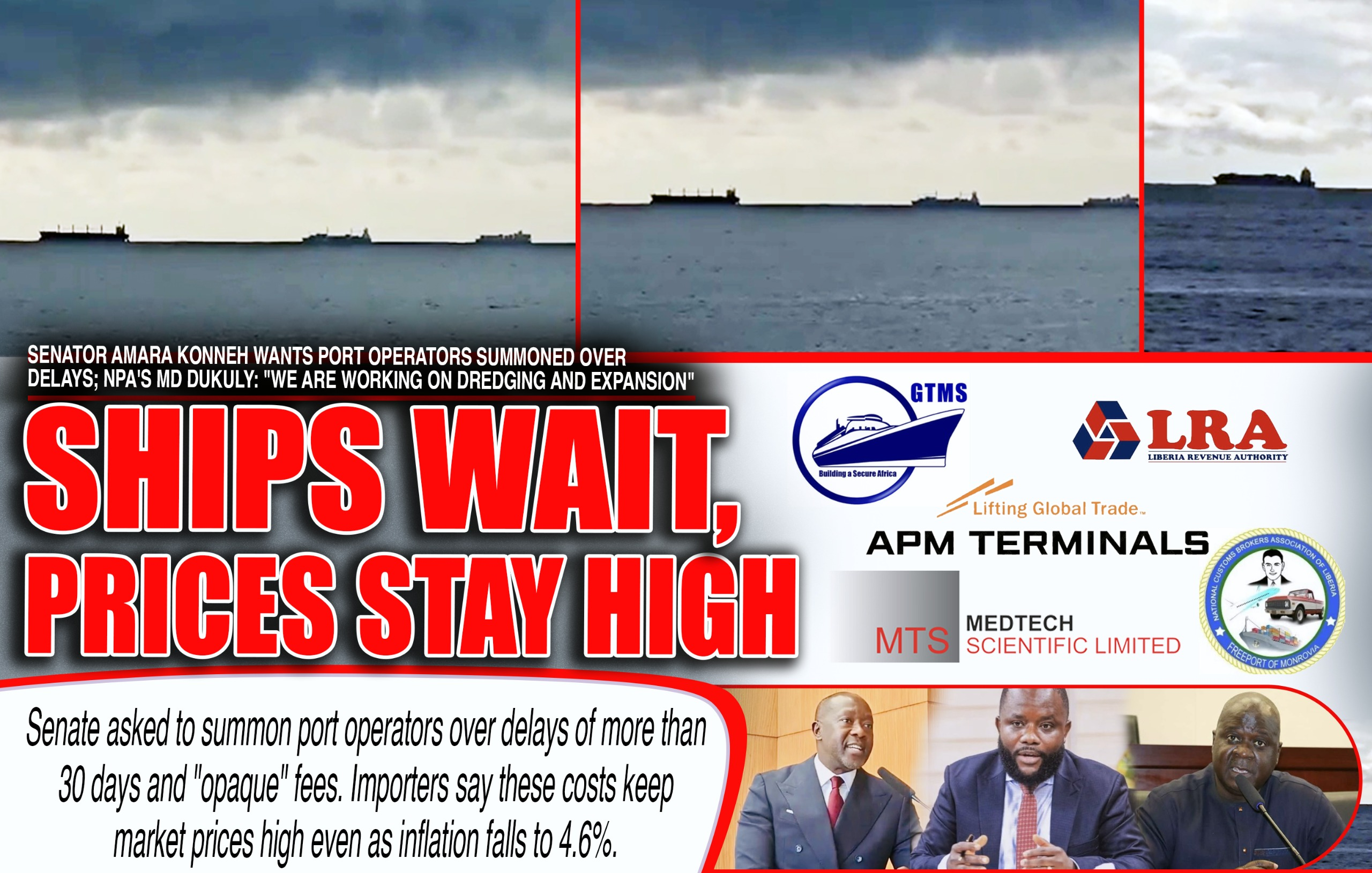
MONROVIA – Seen from the beaches of Monrovia, the problem is easy to spot. On a grey afternoon this week, several cargo ships sat at anchor on the horizon off Liberia’s capital. They were waiting for a berth at the Freeport of Monrovia, the country’s main gateway for imported food, fuel, building materials and consumer goods.
By Rodney D. Sieh
Video footage seen by FrontPageAfrica shows at least five vessels anchored in a line offshore. A frayed Liberian flag flaps on a wooden pole in the foreground, and fishing canoes sit on the beach.
For Liberian importers, those waiting ships mean money lost. Business owners say every day a container spends at sea pushes up their costs, and those costs end up in the prices ordinary Liberians pay at the market.
Now the issue has reached the Liberian Senate. In an October 25, 2026 letter to President Pro-Tempore Nyonblee Karnga-Lawrence, Senator Amara M. Konneh of Gbarpolu County asked the Senate to summon port operators and government agencies. They would appear before the full Senate, sitting as a Committee of the Whole, to explain what he called “protracted delays of containers, high transaction costs, and their impact on businesses and consumer prices.”
‘Over 30 days at sea’
Konneh is a former Minister of Finance and Development Planning. He wrote that “serious and persistent complaints” from the business community, especially small and medium-sized enterprises (SMEs), had reached lawmakers over the past several months.
According to the Senator, importers and shipping agents report that containers bound for Liberia now spend “an average of over 30 days at sea” before berthing in Monrovia. He said most of these vessels are being routed to and held at ports in neighbouring Côte d’Ivoire and Ghana.
The letter gives two alleged causes. The first is a lack of yard space at the Freeport to hold more containers. The second is that larger vessels cannot berth because dredging of the port basin and channel has been “prolonged.”
Responding to the concerns, National Port Authority (NPA) Managing Director Sekou Dukuly told FrontPageAfrica: “We are working on dredging and expansion.” He did not give a timeline or say what the work would cost.
“These delays are severely hurting business inventories, tying up working capital, leading to stock-outs, and imposing heavy demurrage costs,” Konneh wrote. Demurrage is the daily penalty shipping lines charge when containers are held beyond an agreed period. In a small, import-dependent economy like Liberia’s, such costs are rarely absorbed by businesses. They are passed on to shoppers.
A ‘multiplicity of opaque’ fees
The Senator also pointed to costs that importers face once their goods reach the dock. He said businesses carry “a multiplicity of opaque transaction costs and fees.” He named APM Terminals, MEDTECH Scientific Limited, Global Tracking and Maritime Solutions (GTMS) and “other actors in the supply chain” as the bodies charging them.
APM Terminals, part of the Danish shipping group A.P. Moller-Maersk, operates the Freeport’s container terminal under a long-term concession agreement with the Government of Liberia. MEDTECH and GTMS provide services in Liberia’s cargo-clearance chain. “These charges are being passed on to consumers,” Konneh wrote.
Falling inflation, but prices still high
The Senator’s main economic argument is a puzzle many Liberians will recognise. On paper, the economy is improving. In practice, market prices have barely moved.
Konneh noted that headline inflation has fallen to 4.6 percent and that the Liberian dollar has gained against the US dollar. Both signal progress under the Government’s economic stabilisation programme, backed by an International Monetary Fund (IMF) Extended Credit Facility. Even so, he wrote, “consumer prices remain stubbornly high.”
He argued that problems at the port “are potentially a major driver of these sticky prices.” That, he said, risks “negating the gains” of the reform programme.
If the problems are not fixed urgently, the letter warned, they “will continue to undermine private sector competitiveness, discourage investment, and erode the purchasing power of ordinary Liberians.”
Seven bodies named
Konneh asked that the following appear before Plenary to respond to the allegations and present solutions:
* The National Port Authority (NPA)
* APM Terminals Liberia
* MEDTECH Scientific Limited
* Global Tracking and Maritime Solutions (GTMS)
* The Liberia Revenue Authority (LRA), Customs Department
* The Ministry of Commerce and Industry
* The Brokers Union / Customs Brokers Association of Liberia
Lawmakers want clarity on four things: the current state of dredging, the berthing and yard capacity problems, the full schedule of fees charged at the port, and the immediate and medium-term steps being taken to clear congestion and reduce costs for Liberian businesses.
“I pray that Plenary will accord this matter its urgent and kind consideration,” the Senator wrote.
Calls for concession reform
Outside the Senate, some Liberians have been pressing for changes to how the Freeport is run. They are making three demands.
First, they want the Government to review, fix and extend the APM Terminals concession, so the company can invest more money in yard expansion and equipment.
Second, they want the Government to review, negotiate and sign a proposed US$230 million concession from Moroccan port operator Marsa Maroc. That deal would allow the company to build a new multipurpose terminal with three berths and compete with APM Terminals.
Third, they want dredging obligations written into the financial model of both concessions, to ensure the port basin and channel are dredged regularly and on time. Lack of dredging is one of the causes Konneh’s letter blames for the delays.
Why it matters beyond Liberia
Liberia imports most of what it consumes, including much of its rice, the national staple. Congestion at its main port affects more than a single industry. It reaches every household.
The complaints also matter for the region. If, as the letter alleges, Liberia-bound vessels are queuing at Abidjan and Tema, then delays in Monrovia are adding to pressure on West Africa’s wider shipping network, at a time when governments across the region are trying to attract investment and lower the cost of trade.
It was not immediately clear when the Senate would take up the request. Beyond Dukuly’s brief comment on dredging and expansion, the NPA did not respond to the Senator’s other concerns, including yard space, delays at sea and port fees. As of press time, APM Terminals Liberia, MEDTECH and GTMS had not publicly responded to the allegations in the Senator’s letter.
Support Independent Journalism
Your support helps FrontPage Africa continue delivering independent, credible, and impactful journalism. Every contribution strengthens our ability to investigate, inform, and hold power accountable while keeping quality journalism accessible to our readers.
Support our journalism or subscribe to receive the latest FrontPage Africa stories and updates.