President Joseph Nyuma Boakai, Sr.: Source: Liberia Ministry of Justice, August 9, 2025: The Ministry of Justice reported President Boakai’s appointment of the chairman and members of Liberia’s Board of Parole, describing the action as a step toward addressing prison overcrowding and advancing justice-sector reform and humane treatment.
By: Austin S Fallah – A True Son of the Planet Earth Soil:[email protected]
The Ministry’s official Corrections & Rehabilitation page states: “To create a safe and secure society through the successful Rehabilitation and Reintegration of offenders.”
Former President George Manneh Weah: Source: Executive Mansion, December 21, 2023: The Executive Mansion announced that President Weah had granted executive pardons to 101 people detained in correctional facilities across Liberia. The announcement explained that the beneficiaries included people convicted of minor offenses, people with life-threatening illnesses, older adults, and individuals who had served substantial portions of their sentences and demonstrated good behavior.
South Africa’s former President Nelson Mandela: “A nation should not be judged by how it treats its highest citizens, but its lowest ones.”Source: United Nations, The Nelson Mandela Rules. Relevance: A society’s commitment to human rights is measured in part by how it treats people in custody, including those convicted of serious offenses.
A correctional facility is a broad term for an institution that holds people charged with or convicted of criminal offenses.
A prison, by contrast, is a particular type of correctional facility generally designed for individuals serving longer sentences after conviction.
This distinction is important for Liberia because the country’s public-safety challenges require more than a general call for more prisons.
Liberia needs a coordinated national correctional policy that provides secure detention for high-risk offenders while also protecting due process, human dignity, rehabilitation, and community safety.
In particular, Liberia must develop modern maximum security correctional capacity, strengthen facilities in district headquarters, enact and enforce stronger laws against organized drug crime, and seek international assistance for infrastructure, training, and oversight.
The reported prison break in Kakata should serve as a serious wake-up call: when correctional institutions are weak, overcrowded, underfunded, or poorly secured, dangerous offenders may return to the streets, public confidence collapses, and vulnerable communities, especially young people face greater harm.
Liberia has endured civil conflict, political instability, economic hardship, and major public health challenges.
These conditions have affected nearly every public institution, including law enforcement, courts, and corrections.
Yet the correctional system is essential to national stability.
Police officers may arrest suspects, prosecutors may bring charges, and courts may issue judgments.
Still, the justice system cannot function effectively if prisons and detention centers cannot safely hold people who pose a serious risk to the public.
A correctional facility that lacks adequate walls, surveillance, staffing, transportation, communication systems, or emergency procedures creates a gap between the law on paper and the law in reality.
Criminals who are arrested may escape before trial or after conviction, weakening deterrence and encouraging others to believe that the government cannot protect its citizens.
The case for stronger correctional institutions is especially compelling when dealing with high-profile and high-risk offenders, including major drug traffickers, organized criminal networks, child abductors, violent offenders, and those who use financial influence or political connections to evade accountability.
Such offenders often have resources ordinary detainees lack.
They may bribe officials, intimidate witnesses, recruit accomplices outside prison walls, or exploit weak infrastructure.
A low-security or poorly managed facility may be unable to contain individuals with these capacities.
Therefore, Liberia must establish secure maximum security institutions that meet professional standards and are specifically equipped to manage prisoners who present a significant risk of escape, violence, corruption, or continued criminal activity.
However, calls for tougher prisons must be matched by a commitment to the rule of law.
Not every person in a correctional facility has been convicted of a crime. Many detainees are awaiting trial, and the presumption of innocence must remain central to Liberia’s justice system.
A person accused of drug trafficking or any other serious offense should receive a fair hearing before an independent court.
The goal should not be indiscriminate imprisonment or punishment without evidence.
Instead, the goal should be secure, lawful detention for those facing serious charges; fair, timely trials; and appropriate sentences for those convicted.
Building stronger correctional facilities without addressing court delays, legal representation, and case management could worsen overcrowding and create new human-rights concerns.
Thus, prison reform must be part of broader criminal-justice reform.
Drug trafficking is one of the most urgent reasons Liberia needs stronger correctional capacity and enforcement.
Drug traders and cartels do not merely violate the law; they can damage families, communities, schools, and the nation’s future.
Substance abuse can contribute to addiction, family breakdown, school dropout, unemployment, exploitation, and petty or violent crime.
Young people are often the most vulnerable targets because they may face poverty, lack of employment opportunities, peer pressure, trauma, or limited access to treatment.
When drug networks recruit youth as users, couriers, dealers, or lookouts, they transform human potential into profit.
A nation that loses large numbers of young people to addiction and organized crime risks losing part of its future workforce, leadership, and social stability.
The consequences can also be particularly severe for girls and women.
Drug dependency and economic desperation may expose women and girls to exploitation, abuse, trafficking, homelessness, and survival sex.
Families affected by drug addiction may experience domestic conflict, neglect of children, and financial collapse.
It is therefore understandable that many citizens demand firm action against the individuals and networks that distribute harmful substances.
Liberia should not allow powerful traffickers to operate freely while communities suffer the consequences.
Those proven to have organized or financed serious drug crimes should face meaningful penalties, including secure imprisonment where appropriate.
Still, it would be a mistake to treat drug users, low-level offenders, and major cartel leaders as though they are the same.
The law should distinguish between the person struggling with addiction and the person who profits from addiction.
Drug traffickers and cartel leaders who knowingly exploit vulnerable communities should be investigated and prosecuted aggressively.
At the same time, people living with substance-use disorders should have access to treatment, counseling, mental-health support, education, and reintegration services.
A correctional policy based entirely on punishment may fill facilities without reducing demand for drugs.
A balanced policy,one that is strict against organized trafficking but compassionate and evidence based toward addiction, would better protect Liberia’s youth and reduce the cycle of crime.
Building correctional facilities in district headquarters could help Liberia address several challenges, but such construction must be strategic, not symbolic.
District-level facilities can reduce the difficulty and cost of transporting detainees over long distances.
They can also let accused persons stay closer to their families, lawyers, courts, and communities as their cases proceed.
This may improve access to justice and reduce unnecessary delays.
In addition, local facilities can strengthen district authorities’ ability to respond quickly to crime and maintain public order.
Nevertheless, not every district facility should be a maximum-security prison. Maximum-security prisons are expensive to build, staff, maintain, and supervise.
They require specialized architecture, trained correctional officers, secure perimeters, controlled movement systems, intelligence units, medical capacity, electronic surveillance, and emergency-response plans.
Liberia may be better served by establishing a small number of regional maximum-security institutions for the highest-risk prisoners, supported by secure district detention centers for lower-risk detainees and individuals awaiting trial.
This approach would use limited public resources more effectively while ensuring that the most dangerous prisoners are housed in facilities designed to prevent escape and criminal coordination.
The physical design of correctional institutions matters greatly.
A secure prison should not depend only on locks and walls.
It should have multiple layers of protection, including reinforced perimeter fencing or walls, controlled entry points, secure watchtowers where appropriate, reliable lighting, surveillance cameras, visitor-screening procedures, communication controls, emergency alarms, and well-maintained transportation systems.
Prison records must be accurate and protected from manipulation.
Authorities should know exactly who is being held, where they are housed, what their legal status is, and when they are scheduled to appear in court.
Facilities should also have systems for regular headcounts, contraband searches, monitoring gang activity, and preventing staff corruption.
Yet infrastructure alone cannot solve the problem. The people who work in correctional institutions are equally important.
Correctional officers should be recruited professionally, paid adequately, thoroughly trained, and held to clear ethical standards.
Underpaid or unsupported officers may become vulnerable to bribery, intimidation, or burnout.
By contrast, well-trained personnel are more likely to follow procedures, recognize security risks, manage conflict peacefully, and treat detainees lawfully.
Liberia should invest in training programs on prison security, human rights, crisis management, intelligence gathering, mental-health awareness, anti-corruption practices, and the management of high-risk prisoners.
Staff members should also have access to professional support because correctional work can be stressful and dangerous.
The reported prison break in Kakata demonstrates why these reforms cannot be delayed.
Whether an escape results from weak infrastructure, insufficient staffing, poor supervision, inadequate intelligence, corruption, overcrowding, or a combination of factors, the government has a responsibility to investigate openly and correct the underlying failures.
The public deserves to know what went wrong and what measures will prevent similar incidents in the future.
A serious review should examine staffing levels, prisoner classification, physical security, communication systems, emergency response, and possible misconduct.
If negligence or corruption contributed to the incident, those responsible should face lawful consequences.
At the same time, the review should not become merely a search for scapegoats.
Its primary purpose must be institutional learning and reform.
A national prison-security policy should also include a strong prisoner classification system.
Not all detainees require the same level of security.
Some may be nonviolent offenders, first-time offenders, people awaiting trial, or persons with medical and mental-health needs.
Others may be escape risks, gang leaders, repeat violent offenders, or individuals connected to organized criminal groups.
Housing all categories of prisoners together can create danger and disorder.
Low-risk detainees may be exposed to criminal influence, while high-risk prisoners may receive insufficient supervision.
Proper classification allows correctional authorities to place people in facilities and units appropriate to their security risk, legal status, age, gender, health condition, and rehabilitation needs.
The international community has an important role to play in supporting Liberia’s correctional reform.
Liberia should seek assistance from the United Nations, regional African institutions, development partners, human-rights organizations, and friendly governments with expertise in justice-sector reform.
Such assistance could include funding for secure facilities, technical advice on prison design, officer training, court-management systems, rehabilitation programs, and independent monitoring mechanisms.
International partners can also help Liberia develop anti-corruption safeguards and modern information systems that track detainees from arrest through trial, sentencing, release, or transfer.
However, international assistance should strengthen Liberian ownership rather than replace it.
The responsibility for public safety belongs first to Liberia’s elected leaders, justice institutions, security agencies, and citizens. Foreign donors can provide resources and expertise, but long-term success depends on transparent national planning, responsible budgeting, legislative oversight, and professional administration.
Funds allocated for prison construction and correctional reform must be protected from misuse.
Public confidence will grow only if citizens can see that resources are producing real improvements: safer facilities, fewer escapes, fairer trials, better trained officers, and meaningful rehabilitation.
The Liberian Legislature also has an essential role.
Lawmakers should review existing laws related to drug trafficking, money laundering, organized crime, prison administration, bail, sentencing, and witness protection.
Where legal gaps exist, they should pass carefully drafted legislation that targets major traffickers and cartel leaders while respecting constitutional rights.
Laws should provide appropriate penalties for serious organized drug offenses, especially where criminal activity involves minors, violence, coercion, cross-border trafficking, or large-scale distribution.
At the same time, legislation should avoid excessive punishment for minor possession cases where treatment and supervision may be more effective than long-term incarceration.
Witness protection is another necessary part of the strategy.
High-level criminals are often difficult to prosecute because witnesses fear retaliation.
If victims, police officers, community members, and informants believe that they will be threatened or harmed for speaking out, prosecutions may fail even when evidence exists.
Liberia should develop stronger witness protection procedures, confidential reporting channels, and anti-retaliation measures.
Effective prosecution, secure detention, and reliable courts must work together.
A prison cannot compensate for weak investigations, just as a strong law cannot compensate for an insecure prison.
Ultimately, the purpose of correctional institutions should not be revenge.
Their purpose is to protect the public, uphold lawful court decisions, prevent escape and further criminal activity, and provide opportunities for rehabilitation where possible.
Society has a right to be protected from those who harm others, especially individuals who profit from the destruction of young lives through drug trafficking and organized crime.
But Liberia will be strongest when its response combines firmness with fairness.
Secure prisons must not become places of abuse, neglect, or indefinite detention.
They must operate under law, with accountability, professional standards, medical care, and respect for human dignity.
Liberia stands at an important moment.
The country cannot afford to ignore prison insecurity, drug trafficking, or the vulnerability of its young people.
The events in Kakata should encourage urgent action rather than temporary outrage.
Liberia should establish modern regional maximum security facilities for high-risk offenders, improve secure correctional capacity in district headquarters, train and support correctional officers, reform drug-trafficking laws, expand addiction treatment, strengthen courts and witness protection, and invite responsible international support.
These actions will not solve every social problem overnight, but they will build a more credible justice system.
A safe nation is not one that simply arrests more people.
It is one that investigates crimes fairly, prosecutes offenders effectively, protects the innocent, securely confines those legally sentenced, treats addiction as a public-health concern, and gives young people alternatives to crime.
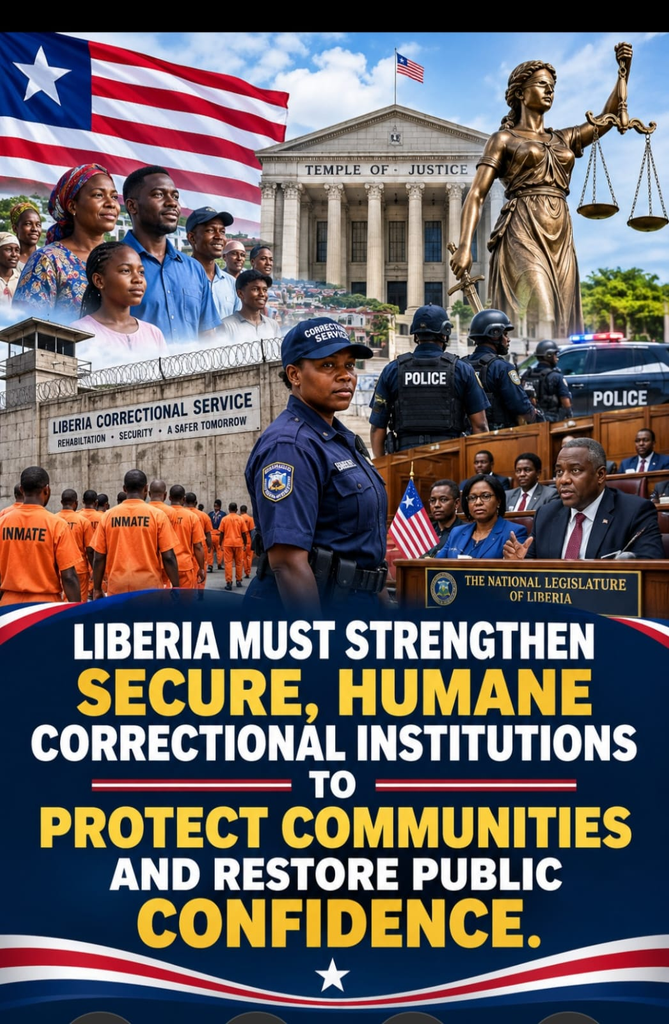
By investing in secure, humane, and accountable correctional institutions, Liberia can protect its citizens, deny organized criminals the freedom to continue their activities, and preserve the future of the nation’s youth.
Support Independent Journalism
Your support helps FrontPage Africa continue delivering independent, credible, and impactful journalism. Every contribution strengthens our ability to investigate, inform, and hold power accountable while keeping quality journalism accessible to our readers.
Support our journalism or subscribe to receive the latest FrontPage Africa stories and updates.