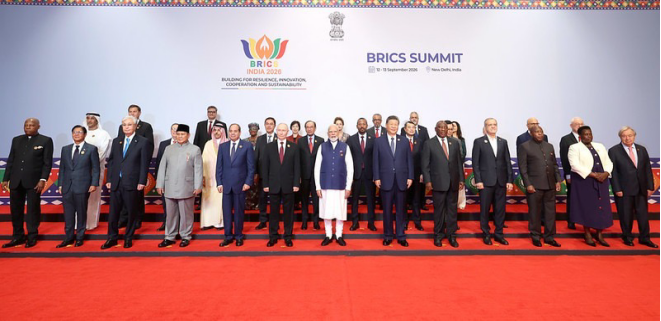
NEW DELHI, India — India has reaffirmed its push for a stronger and more influential Global South, as the 18th BRICS Summit concluded in New Delhi with leaders adopting the New Delhi BRICS Leaders’ Declaration, calling for a more representative, equitable and inclusive international order.
By Patience M. Jones
The two-day summit, held from September 12–13, 2026, under the theme “Building for Resilience, Innovation, Cooperation and Sustainability,” brought together BRICS leaders amid growing geopolitical tensions and mounting global economic and development challenges.
The New Delhi Declaration outlines shared priorities for strengthening cooperation among emerging markets and developing countries, with emphasis on global governance, peace and security, trade, sustainable development, food and energy security, health, technology and climate change.
Addressing the Summit, Indian Prime Minister Narendra Modi stressed that countries of the Global South are frequently on the front lines of global crises but remain underrepresented in institutions where major international decisions are made.
He called for a transformation of the existing “pyramid of privilege” into a “platform of partnership,” arguing that global governance must reflect contemporary political, economic and demographic realities.
Modi particularly renewed calls for greater representation of developing countries in key international institutions, including the United Nations Security Council, saying the voices of the Global South must translate into meaningful influence over decisions affecting the world.
He further urged developing countries to move from being “rule-takers” to “rule-shapers,” emphasizing that if the future is shared, the right to shape that future must also be shared.
Africa, Least Developed Countries in Focus
Strengthening the voice of the Global South emerged as one of the central issues at the New Delhi Summit, with BRICS leaders reiterating their support for reforms of the United Nations and international financial institutions.
The leaders called for greater representation of emerging markets and developing countries in global decision-making, reflecting their growing economic and demographic importance.
The Declaration also placed emphasis on increasing the participation of Least Developed Countries, particularly African countries, in international decision-making processes.
Beyond institutional reform, BRICS leaders addressed practical development priorities affecting millions across developing economies, including food and energy security, agriculture, healthcare, climate change, digital transformation, artificial intelligence, trade and sustainable development.
India emphasized technology and innovation as critical tools for promoting inclusive economic growth and improving living standards across the developing world.
Food Security and Sustainable Agriculture
Food security and resilient agriculture featured prominently on the BRICS cooperation agenda.
India advanced initiatives focused on digital agriculture, agroecology, regenerative agriculture and agricultural inputs, highlighting the need for sustainable and resilient food systems capable of responding to future economic, environmental and climate-related pressures.
The emphasis reflects growing concerns over food security and the vulnerability of developing economies to climate change, supply-chain disruptions and other global shocks.
BRICS Calls for Dialogue Amid Global Conflicts
On international peace and security, BRICS leaders reaffirmed the importance of dialogue, consultation and diplomacy as mechanisms for resolving disputes.
The New Delhi Declaration called for restraint amid heightened tensions in West Asia, while stressing the protection of civilians and civilian infrastructure.
The leaders also expressed concern over the humanitarian situation in Sudan, calling for a peaceful resolution to the conflict through dialogue.
Strong Condemnation of Terrorism
BRICS leaders also delivered a strong condemnation of terrorism, reiterating their opposition to terrorism in all its forms and manifestations.
They specifically condemned the April 22, 2025 terrorist attack in Pahalgam, Jammu and Kashmir, in which 26 people were killed and several others injured.
The leaders also condemned the cross-border movement of terrorists, terrorism financing and the provision of safe havens to terrorist groups.
India’s Vision for BRICS
The 18th BRICS Summit marks another step in India’s effort to position the grouping as a practical platform for cooperation among developing countries while amplifying the collective interests of the Global South.
Under India’s chairship, the Summit placed strong emphasis on development, resilience, innovation, sustainability and the well-being of people, while pushing for reforms to create a more balanced and inclusive international system.
The New Delhi Declaration ultimately reflects BRICS’ broader ambition to strengthen cooperation among emerging economies and ensure that developing countries have a greater role in shaping the global rules that govern their economies, security and future.
Support Independent Journalism
Your support helps FrontPage Africa continue delivering independent, credible, and impactful journalism. Every contribution strengthens our ability to investigate, inform, and hold power accountable while keeping quality journalism accessible to our readers.
Support our journalism or subscribe to receive the latest FrontPage Africa stories and updates.