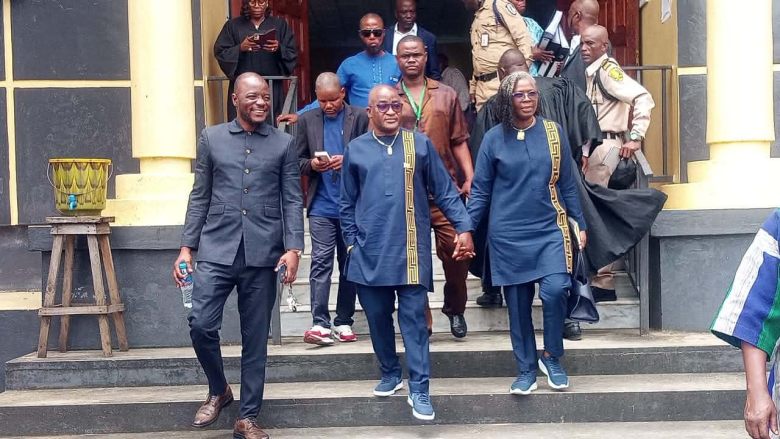
MONROVIA – Whatever the jury in Criminal Court “C” ultimately decides about Ambassador Dee-Maxwell Saah Kemayah’s guilt or innocence, the trial now in its 27th day has already surfaced something that may outlast the verdict, evidence that Liberia’s disaster relief apparatus may not have known where its own rice went, who received it, or whether it arrived at all.
By Willie Tokpah
That question — not Kemayah’s individual culpability, but the system’s basic functionality — has quietly become the trial’s second, unofficial subject.
A Community That Says the Rice Never Came
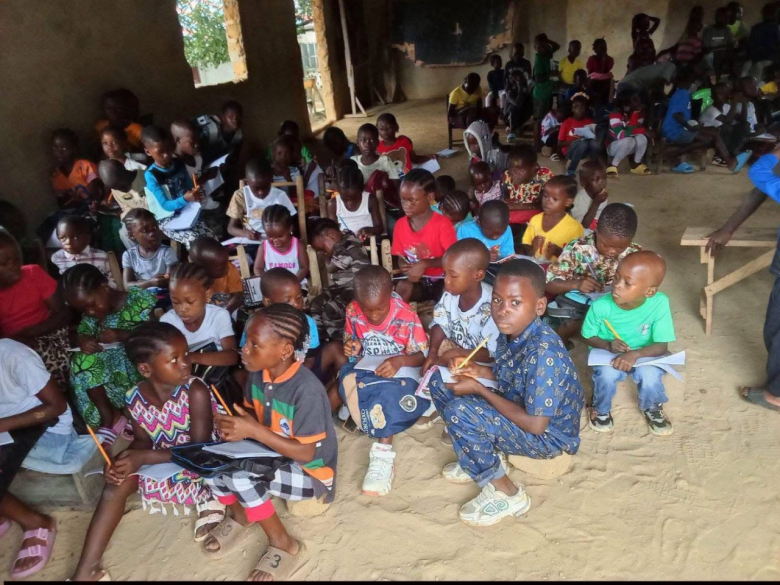
Perhaps the most telling testimony so far came not from an official or an investigator, but from the chairman of the Seven Blocks of Lakpazee Community, describing what disaster relief looks like when it actually works.
He pointed to a recent rice distribution by a local church, conducted openly, shared evenly, and known to everyone in the community. It was, in his account, the kind of transparent process that leaves no room for dispute.
The Saudi-donated rice, he testified, left no such trace in Lakpazee. He said he had no knowledge of any of it reaching the community, and was confident that a distribution of that scale could not have occurred without his awareness. If Lakpazee had received rice, he suggested, residents would have called a meeting to celebrate it — not stayed silent.
That single comparison — between a distribution everyone remembers and one nobody can recall — does more to illustrate the case’s central mystery than any of the accounting disputes that have dominated the courtroom.
When the Paperwork and the People Don’t Match
The community testimony sits alongside a string of numerical contradictions that have piled up over four weeks of hearings. An early prosecution witness alleged that one recipient, Archievico Doe, took delivery of 250 bags. Separately, the State claimed 5,000 bags sat pre-positioned at NDMA’s regional warehouse in Gbarnga — a claim the region’s own coordinator has reportedly disputed.
Each new witness seems to narrow, rather than widen, the space in which the rice can be accounted for. Numbers that should reconcile — bags donated, bags distributed, bags recorded, bags received — instead keep producing gaps, denials, and flatly contradictory accounts from people who should, in theory, agree.
The Institution That Still Hasn’t Spoken
Looming over all of it is an absence: after 27 days, the National Disaster Management Agency — the body legally responsible for receiving and distributing the donation — has not put a single witness on the stand to explain its own role.
For an institution whose job was to move rice from a port to a population in need, the silence has become almost as significant as any single piece of testimony offered so far.
That silence leaves basic operational questions unanswered in open court: what records NDMA kept, who signed for what, and how a shipment of this size could generate this much disagreement about where it actually ended up.
A Fire That May Not Have Happened
Even the human cost cited to justify urgency in the case has come under strain. An allegation that a fire in Zinc Camp, Block F, killed a disabled resident and his wife in 2023 — cited as part of the backdrop for why relief was needed — was met with flat denial from the same community chairman, who said he knew of no such incident despite acknowledging other events during his tenure.
If that detail cannot be substantiated, it raises a separate concern: that some of the urgency framing this case may rest on incidents the record cannot support.
A Trial About More Than One Man
None of this proves or disproves Kemayah’s personal role, which remains the narrower legal question the jury must resolve. But as testimony accumulates, the trial has increasingly become a public audit of how Liberia manages humanitarian aid — who tracks it, who verifies its arrival, and what happens when no single agency can say with confidence where a shipment went.
That may be the case’s most lasting consequence: regardless of the outcome for any individual defendant, the testimony now on the public record suggests Liberia’s disaster relief system has significant gaps between what is donated, what is documented, and what actually reaches the people it’s meant to serve.
Support Independent Journalism
Your support helps FrontPage Africa continue delivering independent, credible, and impactful journalism. Every contribution strengthens our ability to investigate, inform, and hold power accountable while keeping quality journalism accessible to our readers.
Support our journalism or subscribe to receive the latest FrontPage Africa stories and updates.