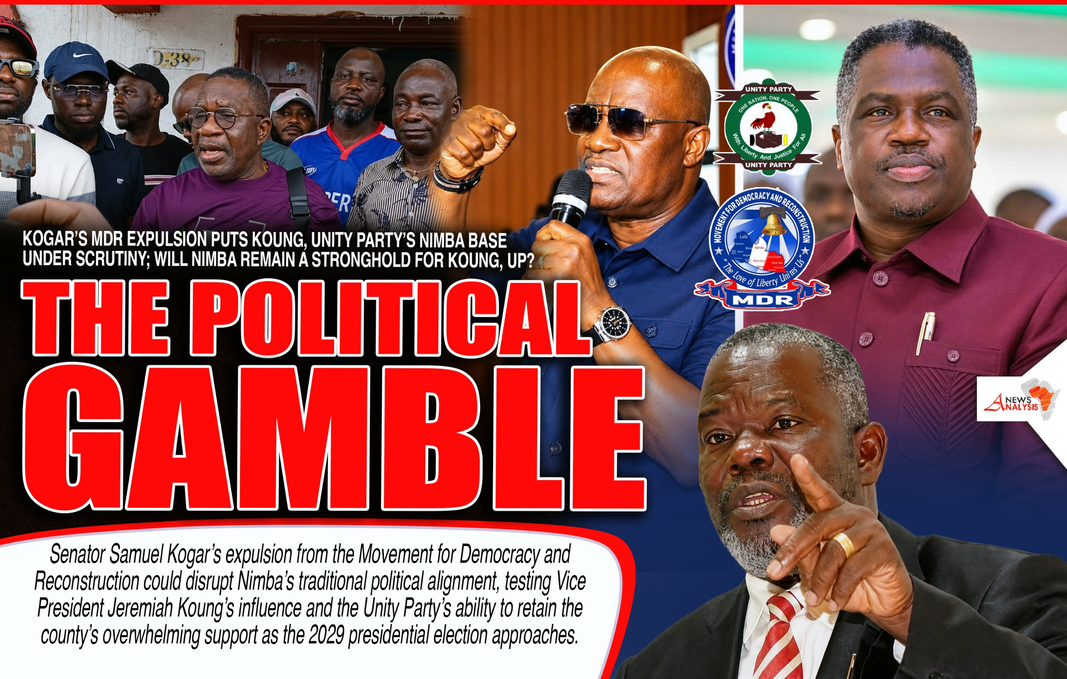

MONROVIA — The expulsion last week of Senator Samuel Gongben Kogar from the Movement for Reconstruction and Democracy (MDR) may have been decided inside a party meeting room, but its political implications could extend far beyond the walls of the party’s headquarters in Monrovia.
By Selma Lomax, [email protected]
For the MDR, the decision represents the enforcement of party discipline and a reaffirmation of its alliance with President Joseph Boakai and the governing Unity Party. For Kogar, however, the expulsion creates a new political reality for a senator who has built an electoral identity that predates his most recent association with the party.
For Vice President Jeremiah Kpan Koung, the development could prove even more delicate.
Koung’s political strength has long been closely associated with Nimba County, while the Unity Party’s historic victory in the county in the 2023 presidential election was one of the strongest pillars of the Boakai-Koung ticket’s national success.
The question now emerging is whether the political disagreement between Kogar and the MDR can remain confined to the party or whether it will eventually begin to alter the political calculations surrounding Nimba ahead of the 2029 presidential election.
The MDR Executive Committee voted to expel Kogar after a disciplinary process that Chairman Cooper Kruah said was triggered by a complaint alleging violations of the party’s constitution and bylaws.
Kruah has insisted that Kogar was given an opportunity to defend himself and that the expulsion followed established party procedures rather than being an arbitrary political decision.
“Anybody who contravenes the Constitution and bylaws of the party, that person will be dealt with in keeping with what the law says,” Kruah said.
According to the MDR chairman, Kogar received a copy of the complaint and initially participated in the process but subsequently failed to appear for a further hearing.
“He was provided with a copy of the complaint, and he submitted himself to the investigation, but continued to ask for excuses, one excuse after the other,” Kruah said.
Kruah added that when the matter was scheduled for further hearing, neither Kogar nor his lawyer appeared, which he characterized as a waiver of their right to be heard.
The committee subsequently recommended Kogar’s expulsion and instructed that anything belonging to the MDR that remained in his possession be returned to the party.
“That means, for today, he is no longer a member of the party,” Kruah declared.
But the chairman’s explanation went beyond the disciplinary process and directly entered the broader political relationship between the MDR and the Unity Party.
Kruah accused Kogar of taking positions that were inconsistent with the governing coalition and argued that a politician cannot simultaneously participate in government while presenting himself as an opposition voice against that same government.
“This party is in collaboration with the Unity Party. We are part of the government. You cannot be part of the government and sit and play opposition in the same government that you are a part of,” he said.
Kruah was equally emphatic about the MDR’s continuing allegiance to President Boakai.
“This party stands with the Unity Party and stands with this president,” he said, adding that the party supported Boakai in the past, supports him presently and intends to support him in the future.
That position makes Kogar’s expulsion politically significant beyond the question of party membership.
The MDR is not simply another political organization in the Liberian landscape. It is the party founded by the late Senator Prince Y. Johnson, whose political influence transformed Nimba into one of the most closely watched electoral battlegrounds in the country.
And the response from Johnson’s family indicates that the dispute may increasingly become entangled with the unresolved question of who carries the political legacy of the late senator.
Amy Johnson, daughter of the late Prince Johnson, publicly came to Kogar’s defense following the expulsion. Her statement was sharply critical of individuals she accused of having betrayed her father while expressing sympathy and support for Kogar.
She argued that the senator’s expulsion was not necessarily an unexpected political development and warned him to be cautious, drawing comparisons with what she described as the treatment her late father received from people within his own political circle.
Her intervention was also framed around the history of the MDR and her father’s political legacy. She questioned why individuals who had previously left or opposed the party had returned following Prince Johnson’s death, while recalling earlier internal battles involving her father and Kogar.
At the heart of her message was a declaration of solidarity with the senator: “Da My Pa Party: We Will Stand By Kogar.”
The statement does not automatically translate into an electoral bloc for Kogar, but its political symbolism should not be underestimated. Prince Johnson spent decades constructing a political organization whose influence was particularly powerful in Nimba, and the question of what remains of that influence after his death is likely to become increasingly important as the 2029 election approaches.
That is where the history of Nimba becomes particularly relevant.
The county has repeatedly demonstrated that it can produce powerful political movements around individual leaders, but its electoral history also shows that no politician has been able to permanently command every voter.
In the first round of the 2017 presidential election, Prince Johnson demonstrated the scale of his political influence when he received 107,430 votes in Nimba, equivalent to 53.50% of the county’s presidential vote. Joseph Boakai received 39,964 votes, representing 19.90%, while George Weah secured 16,002 votes, or 7.97%, and Alexander Cummings received 12,548 votes, representing 6.25%.
The political importance of PYJ’s influence became even more evident in the runoff. Following his decision to support George Weah, Weah’s Nimba vote rose to 73,434, representing 57.14%, while Boakai received 55,083 votes, or 42.86%.
That election created a powerful precedent in Liberian politics: a dominant Nimba political actor could potentially move a substantial portion of the county’s electorate behind a national presidential candidate.
But subsequent elections have complicated the idea that Nimba’s vote belongs permanently to any one political leader.
When Koung contested the 2020 senatorial election on the MDR ticket, he won with 37,899 votes, representing 36.12% of the vote. Edith Gongloe-Weh received 34,153 votes, or 32.55%, while Garrison Yealue secured 15,607 votes, representing 14.87%.
Koung therefore became senator with considerably less than half of the countywide vote, demonstrating that even a strong political figure backed by an influential political machine could not automatically consolidate the entire Nimba electorate.
The political landscape changed dramatically in 2023 when Koung moved from the Senate to the national stage as Boakai’s running mate.
The Boakai-Koung ticket received 138,070 votes in Nimba in the first round of the presidential election, representing 59.53% of the county’s vote. George Weah received 50,427 votes, or 21.74%, while Tiawan Gongloe secured 17,024 votes, representing 7.34%.
In the runoff, the Boakai-Koung ticket increased its dominance, receiving 144,646 votes, or 74.14%, compared with Weah’s 50,453 votes, or 25.86%.
Those numbers established Koung as an exceptionally important electoral figure in Nimba and gave the Unity Party a political advantage that would be difficult for any rival to ignore.
But there is another way to read the same numbers.
Even when Nimba had a son of the county on the national ticket, approximately one-quarter of voters in the runoff still supported the opposing candidate.
That is perhaps one of the most important lessons for the Unity Party as it considers 2029. Nimba can strongly support a political ticket without becoming politically unanimous.
That distinction becomes even more important when examining what happened after Prince Johnson’s death.
The late senator died in November 2024, leaving behind not only a vacant Senate seat but also a political structure whose future was suddenly uncertain.
The April 2025 senatorial by-election therefore became an early test of the post-PYJ political order.
Kogar emerged as the MDR candidate and won decisively, receiving 62,136 votes, representing 52.08% of the countywide vote. Edith Gongloe-Weh received 40,506 votes, or 33.95%, while Mack Gblinwon secured 7,489 votes, representing 6.28%.
The significance of Kogar’s victory extends beyond the percentage. He crossed the 50% mark in a countywide election and accumulated more than 62,000 votes at a time when Nimba was still adjusting to the death of one of its most influential political figures.
Whether those votes represented Kogar personally, the MDR machinery, the continuing influence of the PYJ political network, support from Koung, or some combination of all four is difficult to establish with mathematical certainty.
But the result nevertheless demonstrated that Kogar possessed a substantial electoral constituency. That makes his expulsion from the MDR a political experiment of sorts.
The next question is whether Kogar’s support is attached primarily to the party, to the political establishment that backed him, to his own personality, or to a combination of those factors.
If the majority of his support was party-based, the MDR could potentially retain much of its political influence. If a significant portion was personally attached to Kogar, his departure could create a new political bloc.
If the 2025 victory was the product of several forces working together, then the outcome of the separation could depend on which of those relationships survive.
That uncertainty is precisely what makes the development important for Koung. Kogar is not an unknown political figure entering the electoral arena for the first time.
He has won four elections in Nimba, according to the political account surrounding his record, and has moved from the House of Representatives to the Senate. His political base is also described as extending across important parts of the county, including the Gbehlay-Geh and Buu-Yao areas, with maternal ties into the Mano belt.
Such a record does not guarantee future victories. But it does make the assumption that Kogar can simply be politically erased following an MDR expulsion difficult to sustain.
The danger for the Unity Party would be to confuse party membership with voter loyalty. A voter who supported Kogar in a senatorial election may not necessarily support him in a presidential election.
Similarly, a voter who supported Koung in 2023 may not automatically abandon the Unity Party because of a dispute between Koung and Kogar.
Liberian voters are not a single political constituency, and Nimba’s electoral history demonstrates that voters frequently make different calculations depending on the office being contested, the candidates involved and the alliances surrounding them.
Still, presidential elections are often decided by margins, and that is where Kogar’s political relevance could become significant. He does not have to take a majority of Nimba away from the Unity Party to affect the national equation.
If he were to move a meaningful portion of his supporters toward another political coalition, the effect could be enough to reduce the Unity Party’s margin in a county where the party might otherwise expect overwhelming support.
That is the political gamble.
In 2023, the Boakai-Koung ticket won 74.14% of Nimba’s runoff vote. If the Unity Party expects to reproduce that performance in 2029, it will have to contend with a political environment that may contain more competing centers of influence. The most important of those could be Kogar. There is also a generational dimension to the dispute.
For decades, PYJ represented the dominant political personality in Nimba. His death created space for other politicians to compete for influence. Koung is already one of the strongest beneficiaries of that transition, having moved from senator to vice president and becoming an important national figure.
Kogar’s rise represents another strand of the same transition. The two politicians are not politically identical, and their constituencies may overlap without being interchangeable.
If Kogar and Koung eventually reconcile, the episode could ultimately strengthen the governing coalition by bringing competing political interests back together.
If they remain divided, however, the dispute could evolve into a contest over who can mobilize the political constituency that once operated under the broader PYJ-MDR umbrella.
If Kogar aligns himself with an opposition presidential candidate in 2029, the calculation becomes even more serious for the Unity Party. And if he decides to become part of another presidential ticket—or pursues a presidential ambition himself—the potential for fragmentation could increase considerably.
But political analysis is not about predicting the future with certainty. It is about identifying the factors that could shape it.
Kogar’s political career has been shaped by battles over party structures, leadership and political loyalty, and his supporters now argue that he is once again being forced to fight for his political survival.
His critics, meanwhile, can point to Kruah’s explanation that Kogar was given due process and failed to appear for a scheduled hearing. Both narratives are likely to remain part of the political debate.
But the larger issue cannot be resolved by determining who won the argument inside the MDR meeting.
The real verdict will come from voters. If Kogar remains politically active, his next political move will provide an important indication of how much of his 2025 support was personal. If he can mobilize supporters outside the MDR structure, that would suggest that his political influence is broader than the party machinery.
If he struggles to reproduce that support, it would strengthen the argument that the MDR and the wider political coalition surrounding Koung were more important to his victory than his personal appeal.
For Koung and the Unity Party, therefore, the wisest response may not be to dismiss Kogar but to understand what his expulsion could mean.
Nimba politics has repeatedly punished those who assume that electoral loyalty is permanent. In 2017, PYJ demonstrated that his political influence could dramatically reshape a presidential contest.
In 2020, Koung won a competitive Senate election with 36.12% of the vote, demonstrating both his strength and the limits of political consolidation.
In 2023, the Boakai-Koung ticket transformed Nimba into one of its strongest political bases, winning 59.53% in the first round and 74.14% in the runoff. In 2025, Kogar demonstrated his own electoral strength by winning 52.08% and 62,136 votes in the senatorial by-election.
The numbers are different elections, under different circumstances, involving different candidates. They cannot simply be added together or treated as a direct projection of 2029.
Koung remains a formidable political figure in the county, but his political future will increasingly be judged against his ability to maintain the coalition that helped elevate him to the vice presidency.
Kogar, meanwhile, has been removed from the MDR, but he has not been removed from Nimba politics.
His 62,136 votes are not his permanent property. Neither are they irrelevant. Some belonged to the candidate, some may have belonged to the party, some may have been influenced by the broader political environment, and some may have reflected relationships built over years.
The challenge is determining how much of that coalition can travel with him. That is a question that cannot be answered by an MDR resolution.
It can only be answered through future political activity and, eventually, through votes. For now, the photograph of Kogar being removed from the MDR headquarters may be the most visible symbol of his political separation from the party.
But the more important picture may be the one voters will create in 2029.
Support Independent Journalism
Your support helps FrontPage Africa continue delivering independent, credible, and impactful journalism. Every contribution strengthens our ability to investigate, inform, and hold power accountable while keeping quality journalism accessible to our readers.
Support our journalism or subscribe to receive the latest FrontPage Africa stories and updates.