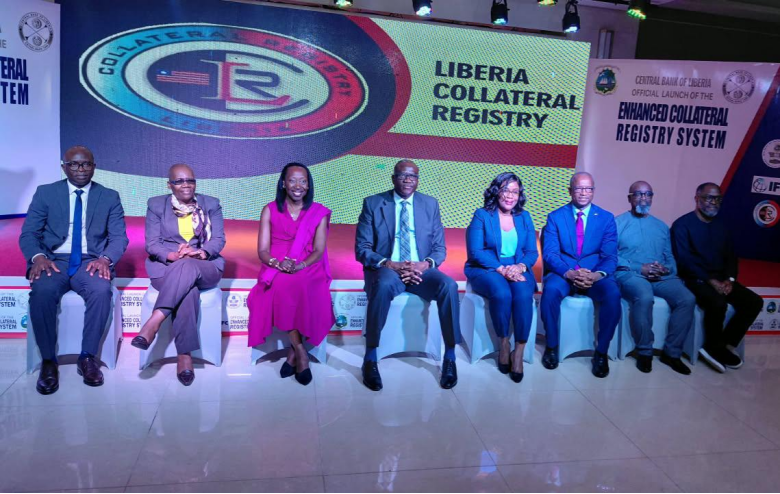
Congo Town– The Central Bank of Liberia (CBL) has launched an Enhanced Collateral Registry System, a major financial sector reform aimed at expanding access to credit for businesses and individuals by allowing lenders and borrowers to more efficiently register and verify collateral through a modern digital platform.
By Jaheim T. [email protected]
The launch, attended by senior government officials, development partners, representatives of financial institutions, and members of the private sector, marked what CBL Executive Governor Henry F. Saamoi described as an important step toward strengthening secured lending, promoting responsible borrowing, and deepening financial inclusion across Liberia.
In his keynote address, Governor Saamoi said the new system is designed to help unlock financing opportunities for entrepreneurs, small businesses, farmers, and other productive sectors of the economy that often struggle to access formal credit despite owning valuable assets.
“We are not merely launching a technological platform. We are launching a powerful instrument for economic empowerment,” Saamoi said.
“We are launching a reform that will help unlock capital, expand opportunity, and strengthen the foundations of inclusive economic growth in Liberia.”
The Governor explained that many Liberian businesses possess assets such as equipment, contracts, vehicles, inventory, and land, but have historically faced challenges converting those assets into bankable collateral due to weaknesses in the country’s credit infrastructure.
According to him, the enhanced registry addresses that challenge by creating a more transparent, reliable, and accessible framework for secured transactions.
The modernized system allows both movable and immovable assets to be registered through a unified digital platform that can be accessed around the clock.
Financial institutions can electronically register, amend, assign, discharge, and search security interests more efficiently, reducing delays and uncertainty in lending transactions.
Saamoi said the initiative forms part of Liberia’s broader effort to build a modern financial system capable of supporting investment, job creation, and sustainable economic growth.
He noted that the reform is aligned with the government of Liberia’s ARREST Agenda for Inclusive Development, which emphasizes inclusive economic growth and expanded access to financial services.
“We are not simply introducing new technology,” the Governor said. “The Enhanced Collateral Registry represents another important milestone in our collective efforts to modernize Liberia’s financial infrastructure and create a financial system that works for every Liberian.”
One of the key features of the upgraded platform is its ability to connect with other national databases and institutions.
The registry is linked with institutions such as the National Identification Registry, the Liberia Land Authority, the Liberia Business Registry, and vehicle registration systems.
This interoperability enables lenders to verify ownership information, identity records, and existing claims on assets with greater confidence.
According to the Saamoi, better access to reliable information will help reduce lending risks, strengthen transparency, and improve confidence within the financial system.
Experts say these improvements could encourage financial institutions to expand lending to sectors that have traditionally been underserved.
Saamoi emphasized that the reform could have a particularly strong impact on micro, small, and medium-sized enterprises (MSMEs), which remain the backbone of Liberia’s economy.
He said many entrepreneurs possess productive assets but are unable to access financing because traditional lending models often favor conventional forms of collateral.
“For too long, many small businesses, women-owned enterprises, young entrepreneurs, farmers, and rural producers have lacked access to traditional financing despite owning productive assets,” he said.
“A more inclusive financial system is not merely a banking objective. It is a national development imperative.”
Governor Saamoi said the true success of the registry would not be measured by the technology itself but by its impact on people’s lives and businesses.
“The real value of this platform will not be measured by the technology itself,” he said. “Its true value will be measured by the businesses it helps grow, the investments it supports, the jobs it creates, and the lives it transforms.”
The Governor summarized the broader vision behind the reform. “Today, we launch an enhanced system. Tomorrow, we unlock finance. Finance unlocks enterprise. Enterprise unlocks jobs. And jobs unlock hope.”
During his remarks, the Governor pointed to results achieved under the Liberia Investment, Finance and Trade (LIFT) Project as evidence that increased access to finance can produce positive economic outcomes.
He disclosed that a US$6 million line of credit established under the project had been fully deployed through seven participating financial institutions by the second quarter of 2026.
According to the Central Bank, the facility helped 358 MSMEs obtain affordable financing, with some businesses receiving loans of up to US$100,000.
The Governor further revealed that women-owned businesses accounted for 64 percent of all loan disbursements, while 130 beneficiary enterprises were located outside Montserrado County.
Reflecting on those achievements, Saamoi said the data demonstrates that Liberian entrepreneurs have the capacity to grow if given adequate support and access to financing.
“The truth is that Liberian entrepreneurs do not lack ambition. Liberian entrepreneurs do not lack innovation. Liberian entrepreneurs do not lack determination,” he said. “Too often, they simply lack access.”
Development partners also welcomed the launch and described it as an important milestone in Liberia’s economic development agenda.
World Bank Country Manager, Georgia Wallen said access to finance remains one of the biggest obstacles facing Liberian businesses.
She noted that many entrepreneurs possess productive assets but lack the traditional collateral required by lenders to secure financing.
“The Enhanced Collateral Registry System helps to bridge this gap,” Wallen said. “It will give lenders greater confidence to accept a wider range of assets, and it will help borrowers unlock the value of the assets that they possess.”
She recalled that Liberia’s first collateral registry, launched in 2014 with support from the International Finance Corporation (IFC), had produced encouraging results by facilitating more than US$237 million in financing within its first two years of operation.
According to Wallen, the enhanced version seeks to build upon those gains while addressing challenges identified over time.
Wallen stressed, however, that technology alone would not guarantee success. She said widespread adoption by banks, businesses, regulators, and other stakeholders would be necessary to ensure the registry achieves its intended objectives. She disclosed that training programs and public awareness campaigns are already being planned to support implementation.
The judiciary also expressed strong support for the reform. Commercial Court Judge Eva Mappy Morgan described the enhanced registry as a critical development that could improve transparency in lending transactions and strengthen the enforcement of financial agreements.
Morgan explained that disputes often arise when collateral cannot be properly identified or when multiple claims exist over the same asset.
She said the new system would help provide clarity regarding ownership and security interests, reducing legal uncertainties that have historically complicated the recovery of non-performing loans.
A more reliable collateral framework, she added, could increase confidence among lenders and investors while strengthening the overall business environment.
As Liberia continues its broader financial sector modernization agenda, the Central Bank says the Enhanced Collateral Registry will work alongside a modernized Credit Reference System currently being developed under the LIFT Project. Both systems are expected to improve credit information, support better lending decisions, and strengthen confidence throughout the financial sector.
Support Independent Journalism
Your support helps FrontPage Africa continue delivering independent, credible, and impactful journalism. Every contribution strengthens our ability to investigate, inform, and hold power accountable while keeping quality journalism accessible to our readers.
Support our journalism or subscribe to receive the latest FrontPage Africa stories and updates.