President Joseph Nyuma Boakai (Inaugural Address, January 22, 2024):
“We must discourage the culture of unfinished business, doing things in a haphazard and unserious manner.” Oracle News Daily.
Relevance: This underscores the importance of competence, diligence, and thoughtful decision-making over uninformed opinions.
“Liberia is not a poor country, but the problem of the country is the lack of sound and honest leadership.”Liberia Public Radio.
Relevance: Highlights the need for capable and principled leadership grounded in knowledge and integrity.
Associate Justice Jamesetta Howard Wolokollie (Liberian Judiciary):
The judiciary has stressed that:
“Professionalism and civility in the practice of law build public confidence in the justice system.”
Hon. Gabriel Baccus Matthews(A Political Activist, Statesman): In his 1979 letter to President William R. Tolbert Jr., he reflected on the importance of wisdom and experience:
“We are going nowhere for nothing unless we can rely on the experience and wisdom of men such as you.”
“Those of us who were so confident about our methods now have every reason to re-examine them thoroughly.” This quotation reflects intellectual humility and the willingness to reassess one’s views in light of experience.
Professor Alaric Tokpa(Intellectual, Academic Militant and Knowledge Impactor, Statesman): Warned against suppressing informed civic participation, stating: “Dictatorships atomize society and reduce it to very small units by removing organizations and institutions from between individuals and government.” FrontPage Africa Online.
He also cautioned:
“The suppression of legal forms of struggle usually provokes illegal forms of struggle.” These statements emphasize the importance of institutions, informed participation, and reasoned public discourse over impulsive opinion.
Former Chief Justice Francis S. Korkpor, Sr.: “The core of the rule of law principle is that all persons and authorities within the state… should be bound by and entitled to the benefits of laws duly administered in the courts of competent jurisdictions.”
Liberian Judiciary-Code of Moral and Professional Ethics: “It shall be unprofessional for any lawyer to advise, initiate or otherwise participate… in any act that tends to undermine… the authority, dignity, [and] integrity of the courts.”
“It is the duty of every lawyer to maintain towards the courts a respectful attitude.”
Former Associate Justice Kabineh M. Ja’neh Willie (To law students):
“Lawyers are agents of peace because they interpret the law.”
“The law profession is not a moneymaking thing.”
By: Austin S Fallah – True Son of the Planet Earth Soil: [email protected]
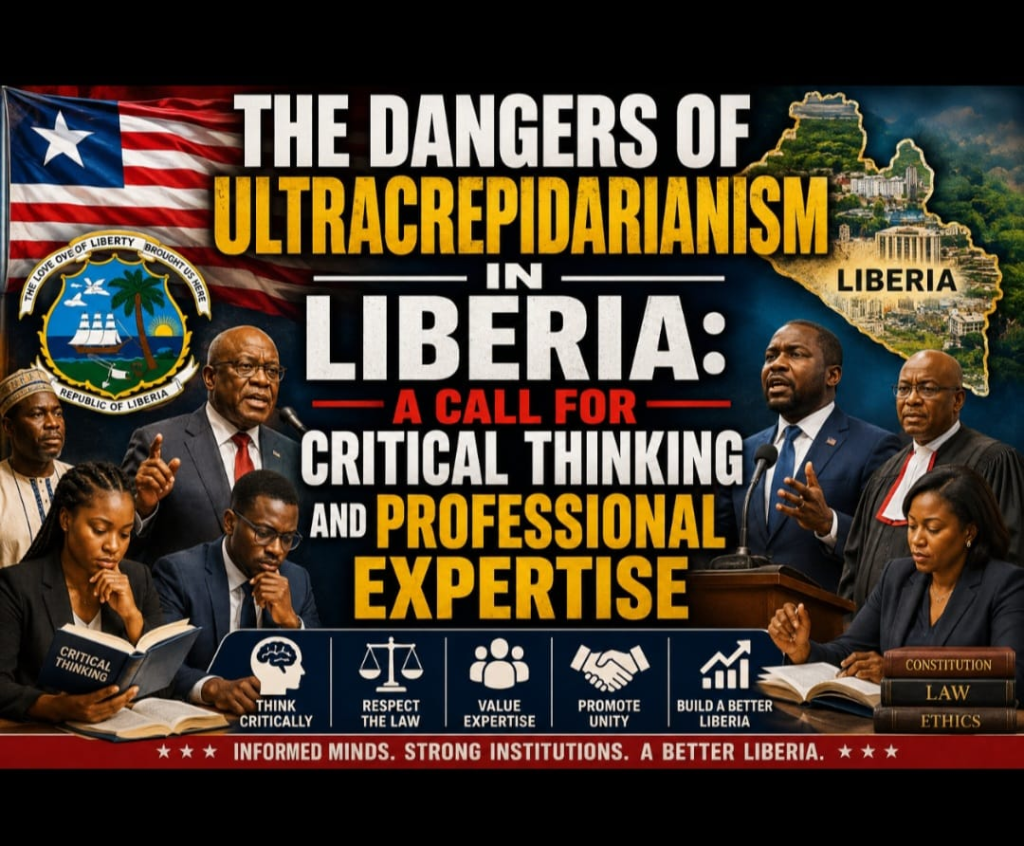
Liberia, a nation burdened by a history of turmoil and struggle, now faces a new challenge: the rise of ultracrepidarianism, a term coined for individuals who confidently opine on topics well beyond their expertise.
In our rapidly evolving digital landscape, the threshold for becoming a “political lecturer” has been lowered to little more than access to the internet and a social media account.
This pervasive phenomenon posits that anyone, irrespective of their educational background or understanding of complex issues, can engage in intellectual discourse about national matters.
However, this assumption is dangerously misguided and erodes informed conversation and expert guidance, both of which are crucial to national development.
Today, it seems that every air-breathing human being in Liberia believes they possess the acumen to address political issues, a belief that has far-reaching consequences.
As a nation in desperate need of critical thinking, creativity, and political innovation, Liberians are inundated with the voices of those who lack the qualifications to offer meaningful input on such matters.
Liberia’s political discourse has been compromised by individuals mouthing empty rhetoric devoid of expertise, leaving the populace more confused than enlightened.
The digital age has allowed these “so-called experts” to proliferate their opinions at an alarming rate, creating a cacophony of ill-informed voices that drown out those who have dedicated years to mastering their fields.
The emergence of social media as a platform for discussion amplifies this issue exponentially.
It has essentially democratized debate, but at the cost of quality.
With the stroke of a keyboard, anyone can transform into a journalist, a political commentator, or an economic analyst, despite lacking the requisite training or insight.
Journalism, which requires a deep understanding of ethics, storytelling, and critical examination, is now frequently reduced to mere commentary from untrained smartphone users.
The superficial nature of such commentary threatens the integrity of information being disseminated to the public.
It also creates an environment where misinformation can flourish, leading to further polarization and misunderstanding of vital national issues.
Furthermore, professions that necessitate extensive education and years of practical experience, such as accounting, economics, and medicine, also suffer from this trend.
The idea that a person can boast expertise in these fields merely by observing public discourse or tapping out opinions during leisure time is a dangerous fallacy.
Indeed, sitting at a drinking table or recording videos does not confer expertise on pharmacology or fiscal policy.
Such simplification undermines the complexity and rigor required in these fields, paving the way for reckless decision-making based on misconceptions.
This situation is not just an abstract concern; it has real-world implications for Liberia. Policymaking, foundational to any nation’s progress, must be guided by experts who understand the intricacies of governance, law, health, and economics.
When those in charge of crafting policies are influenced by the opinions of individuals lacking professional expertise, the outcome can be disastrous.
Decisions informed by the latest viral video or social media trend may provide short-term applause but often overlook the broader historical, social, and economic contexts vital to effective governance.
The rise of the so-called “advocates,” who seem to emerge from nowhere, is equally disconcerting.
With the ease of communication on social media, many individuals take up advocacy without a clear understanding of the issues at hand.
While advocacy is a noble pursuit, it should be grounded in research and backed by informed perspectives.
Advocacy driven by emotion rather than facts can fuel public outcry based on misconceptions, leading to protests against policies that may actually be beneficial.
The environment can become toxic when advocates, rather than educating themselves and their followers, choose to amplify unverified claims that stir unrest.
Moreover, liberal democracies thrive on robust discourse, where varying perspectives can coexist and contribute to a more nuanced understanding of national affairs.
Yet cultivating an environment conducive to such discourse requires a commitment to intellectual rigor and accountability.
The prevalence of ultracrepidarianism in Liberia hampers some Liberians’ ability to engage meaningfully with differing viewpoints.
Instead, they often find themselves trapped in echo chambers where only the loudest opinions, regardless of their veracity, prevail.
This dynamic limits some Liberians’ capacity to understand their challenges and collaborate on tangible solutions.
A profound shift in how some Liberians approach governance and civic engagement is necessary to rectify this troubling trend.
First and foremost, the importance of education cannot be overstated.
Liberians must cultivate an environment where individuals value critical thinking and are encouraged to seek knowledge rather than accept surface-level explanations.
This educational reform must start early, introducing students to the fundamentals of logic, reasoning, reading, and research.
Individuals should feel empowered to question narratives and investigate claims, developing a habit of thought that prioritizes evidence over hearsay.
Furthermore, as we advocate for a better-informed populace, media literacy must take center stage.
In an age dominated by digital communication, teaching citizens to discern credible sources from dubious ones is essential.
This will not only enable individuals to better engage with political discourse but will also foster a culture of accountability among those who choose to share their opinions publicly.
It is not enough to voice an opinion; one must also be prepared to substantiate it with reliable information.
Finally, the voices of genuine experts must be amplified and brought to the forefront of discussions.
Societal respect for qualifications, experience, and the rigor required for professional practice must be restored.
Policymakers and leaders must seek counsel from individuals who have demonstrated their expertise through education and practice.
By prioritizing expert opinion, we set a precedent that elevates Liberia’s national discourse and provides intelligent pathways to solving the myriad challenges every Liberian faces.
Liberia stands at a crossroads: one path leads toward a nuanced and informed society capable of crafting solutions to our pressing issues, while the other spirals into a realm dominated by superficial understanding and ultracrepidarianism.
It is incumbent upon every Liberian, individuals, educators, and leaders alike, to reject the notion that expertise is dispensable and to recognize the importance of grounding our discussions in the insights of those who have dedicated their lives to understanding complex subjects.
Only by fostering a culture of critical thinking, media literacy, and an appreciation for authentic expertise can we hope to elevate Liberia’s political discourse and engage meaningfully with the pressing issues that shape the nation’s future.
In transforming our approach to knowledge and discourse, we enable our nation to achieve its fullest potential, steering Liberia toward a brighter, more informed tomorrow.
Support Independent Journalism
Your support helps FrontPage Africa continue delivering independent, credible, and impactful journalism. Every contribution strengthens our ability to investigate, inform, and hold power accountable while keeping quality journalism accessible to our readers.
Support our journalism or subscribe to receive the latest FrontPage Africa stories and updates.