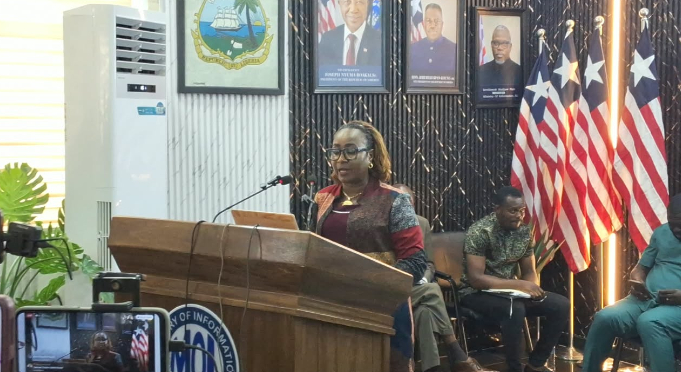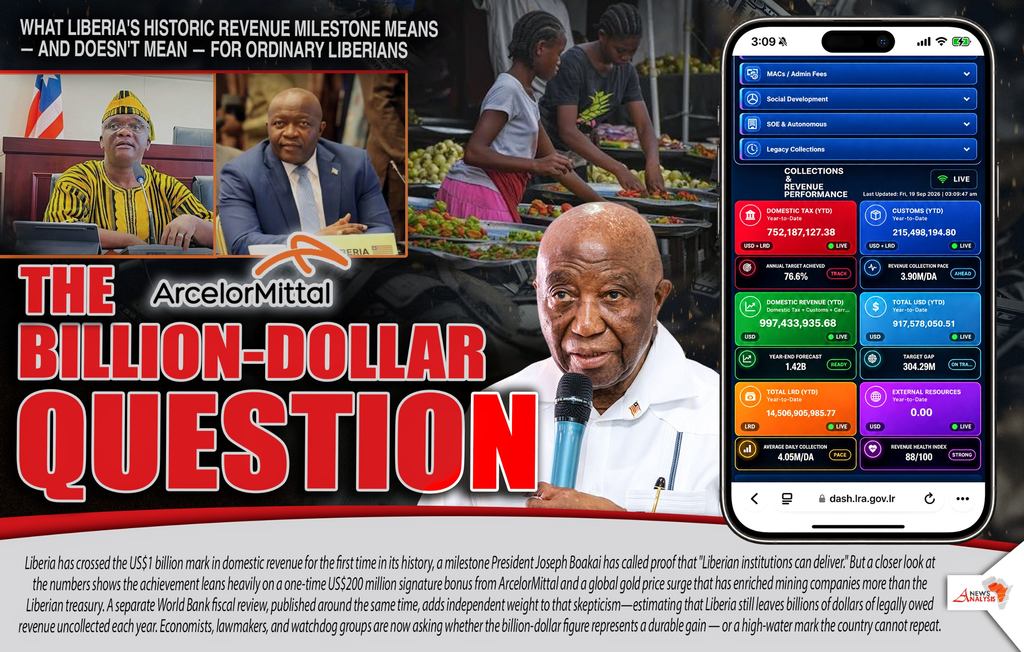
Monrovia — Liberia is celebrating a number. For the first time in the country’s 179-year history, domestic revenue collection has pushed past US$1 billion in a single year — a figure President Boakai described in a special address as proof that revenue “earned, not borrowed” can rebuild a nation’s confidence in itself.
By Rodney D. Sieh, [email protected]
It is a genuine milestone. As recently as 2023, domestic revenue stood at roughly US$612 million. It rose to about US$699 million in 2024 and climbed further to somewhere between US$818 million and US$848 million in 2025, depending on whether one uses the Liberia Revenue Authority’s year-end figure or the final consolidated number cited in the President’s address. Either way, the trajectory is real, and it reflects genuine gains in tax administration — digitization of customs and tax filing, a broader net for informal-sector taxpayers, and what officials describe as a “whole-of-government” push under Commissioner General James Dorbor Jallah.
But the headline number tells only part of the story. Behind the billion-dollar figure sits a one-time payment that will not repeat at the same scale, a global commodity boom that is enriching mining companies faster than it is filling the treasury, and a Legislature that has openly questioned whether the revenue assumptions behind the number can be trusted. A World Bank review of Liberia’s public finances, released this year, independently supports several of those doubts with hard estimates of its own.
What the President said, and what the numbers show
In his address marking the milestone, President Boakai framed the billion dollars as money the country raised itself rather than borrowed or received as aid, and credited the achievement to the Liberia Revenue Authority, the Finance Ministry, and what he called a whole-of-government effort. He was careful to note the country reached the mark years ahead of an earlier six-year target, and he cast the figure as a down payment on results Liberians should be able to see and feel — better-supplied hospitals, sustained health and education workers, improved roads, and support for market women and small businesses through a proposed financing vehicle. He also struck a note of caution of his own, telling Liberians the achievement should not breed complacency and that the country’s ambitions remain larger than one billion dollars.
Measured against the reporting above, the President’s framing holds up in some places and strains in others. His emphasis on domestic effort is accurate as far as it goes — the great majority of the money genuinely was collected through taxes, duties, and fees rather than foreign borrowing. But the speech did not mention that a substantial share of this year’s total, roughly a fifth of it, arrived as a negotiated mining payment rather than broad-based tax growth, or that the same payment shrinks in 2027. Nor did it address the gold-royalty gap that lawmakers from Grand Cape Mount have raised, or the mineral-trade reporting gaps that watchdog groups say may be costing the treasury tens of millions of dollars a year. The commitments he listed — salary reversals, payroll placements, hospital supplies, road equipment — are real and already being funded. The open question the speech leaves unanswered is whether they can still be funded in 2027 and 2028, once the ArcelorMittal installment is halved and the “year of the billion” is no longer a fresh windfall but a baseline the government has to defend.
The ArcelorMittal Factor
Yes — the billion-dollar figure includes a one-time signature bonus tied to ArcelorMittal Liberia’s renegotiated mining agreement, and it is large enough to matter.
When Finance Minister Augustine Ngafuan presented the draft FY2026 budget to the Legislature in November 2025, officials disclosed that the US$1.211 billion budget included a US$200 million signature bonus from ArcelorMittal, paid in connection with the extension of the company’s Mineral Development Agreement to 2050. Commissioner General Jallah has argued that Liberia would still have crossed the billion-dollar threshold without it — putting the underlying figure closer to US$1.011 billion — but independent economists have been less convinced that the distinction is so clean, warning that a meaningful share of the year’s growth rests on a payment that will not recur in the same form.
There is an important nuance the government has not emphasized loudly: the ArcelorMittal payment was not a single US$200 million check that vanishes forever. According to the company’s own disclosures, the US$200 million was the first of four installments — three further annual payments of US$100 million each are still owed. That means 2027 will likely see another ArcelorMittal payment, just half the size of this year’s. It softens the “cliff” scenario, but it does not eliminate it: revenue built on installment payments from a single mining concession is still fundamentally different from revenue built on a broadening, diversified tax base.
Adding to the picture, reporting from FrontPageAfrica indicates that March 2026 alone brought two separate one-off signature bonuses totaling US$211 million, of which US$200 million was the ArcelorMittal payment — meaning roughly US$11 million came from a second, smaller concession payment. Strip out these windfalls, and the LRA’s underlying monthly collection rate has run at around US$88 million between January and July 2026 — solid growth, but not the same growth story as the headline number suggests.
Lawmakers on the Legislature’s Joint Committee on Ways, Means, Finance and Public Accounts raised exactly this concern when the budget came up for review, with Committee Chair Representative P. Mike Jurry warning that the projected figures needed independent verification before the House would accept them, and pointing to past administrations that built budgets on optimistic assumptions only to return mid-year seeking emergency borrowing.
The World Bank’s own analysis, in its 2026 Liberia Public Finance Review, arrives at a strikingly similar diagnosis from a different angle. It finds that recent fiscal consolidation “relied primarily on expenditure restraint rather than permanent improvements in fiscal capacity,” and that Liberia’s tax-to-GDP ratio actually declined by 0.7 percentage points between 2017 and 2023 even as growth resumed — the opposite of the trend among peer countries like Côte d’Ivoire, Senegal, and Ghana, whose revenue ratios rose by 1.9 points over the same period. In other words: the institutional case for durable, broad-based revenue growth is not yet made by the underlying data, independent of how this year’s one-off payments are counted.
The gold price windfall — and who is actually capturing it
The instinct that gold prices are driving part of this story is well-founded, but the evidence points less toward gold lifting government revenue and more toward gold lifting mining company profits while Liberia’s royalty structure stays frozen in place.
Gold prices have surged toward roughly US$4,200 an ounce in 2026, a historic run that should, in theory, be a windfall for a gold-producing nation. But Liberia’s largest industrial gold producer, Bea Mountain Mining Corporation, pays a flat 3 percent royalty rate under its current agreement — a rate that does not rise as gold prices rise. Two senators from Grand Cape Mount County, where Bea Mountain operates, have publicly pushed for renegotiation, pointing out that regional competitors including Mali, Burkina Faso, and Côte d’Ivoire have adopted sliding-scale royalty regimes reaching as high as 11 percent that automatically capture more of the state’s fair share when prices spike. They also noted that Bea Mountain’s 2023 concession extension — a 25-year renewal — came without any signature bonus at all, in sharp contrast to the US$200 million ArcelorMittal secured for its own extension.
The World Bank’s PFR puts a number on the scale of that gap across the mining sector as a whole. It estimates that Liberia currently captures only 15–20 percent of the total economic value its mining sector generates, through taxes, royalties, and other revenue — compared with 50–60 percent captured by comparable resource-dependent economies such as Guinea, Sierra Leone, Tanzania, and Zambia. The report attributes this less to geology or commodity prices than to the fiscal terms written into Liberia’s Mineral Development Agreements themselves, many of which lock in preferential royalty rates and tax holidays for 15 years or more regardless of how high prices climb. It also finds that corporate income tax — the instrument that would actually let the state share in rising profitability, rather than just production volume — has contributed just 1.4 percent of total mining revenue since 2016, versus 30–40 percent in Guinea and Sierra Leone. And on the specific question of gold: the same review estimates that at least 20 percent of Liberia’s gold production escapes formal registration entirely, through informal export channels and undeclared sales, while gold has overtaken iron ore to become the source of 66 percent of the country’s mining royalties.
In other words: the same global gold rally being cited as a factor in Liberia’s revenue gains is, by the account of both local lawmakers and a World Bank technical review, delivering most of its upside to mining companies rather than the Liberian treasury.
What it means for the market woman
This is the question the President’s own address tried to answer, and it is the one most Liberians will actually feel in their pockets.
The administration points to concrete, itemized gains funded by the higher revenue collection: salary increases for more than 23,000 public servants across health, public works, security, the Judiciary, and anti-corruption institutions; the placement of more than 3,400 long-serving volunteer teachers and health workers onto the formal government payroll; funding for 600 new Armed Forces recruits; and the deployment of road equipment — the “yellow machines” — to counties that have gone without functioning roads for years. The government has also floated a Special Purpose Vehicle to channel a portion of the new revenue into affordable financing for Liberian-owned businesses.
These are not abstractions. Getting a volunteer teacher onto payroll, or reversing a salary harmonization that civil servants have resented for years, changes a household’s monthly budget in a way that is measurable and immediate.
But the same fragility that worries economists about the revenue side applies to the spending side. If a meaningful share of this year’s gains came from a payment that halves next year and disappears after 2029, then payroll additions and salary increases made permanent this year create a recurring obligation funded, in part, by non-recurring revenue. That is precisely the structural risk that Liberian economist Dr. Bonokai Gould flagged when the draft budget was first unveiled, warning that the revenue foundation “remains fragile” even as the headline number looks strong. The IMF, in its own assessments, has projected a much smaller revenue increase for the years following 2026 — a signal that the Fund does not expect this year’s growth rate to repeat.
The World Bank review adds a further wrinkle specific to the wage bill: it finds that public wages have effectively been eroded by inflation “rather than managed through a reformed civil service,” and that payroll records themselves are unreliable — 48.7 percent of public employees are currently paid below their assigned pay grade, while 37.4 percent have no grade assigned at all. That matters for the payroll additions Boakai announced: adding thousands of workers onto a payroll system the Bank itself describes as needing foundational cleanup, before it can be used as a platform for sustainable wage policy, is a different undertaking than adding them onto a well-governed one.
The Transparency Gap
This is where the call for disclosure — a call worth taking seriously — has the most evidence behind it, from more than one source.
A Rapid Assessment of Liberia’s mining sector published by the Washington-based NGO Forest Trends estimated that the government has likely lost more than US$91 million in revenue due to gaps between what mining companies report exporting and what importing countries report receiving — a discrepancy the report puts at roughly US$3 billion in unreconciled trade value overall, and as much as US$2.7 billion, or 43 percent, when measured over a longer period from 2011 to 2024. The report also found that a 2 percent turnover tax the LRA has required mining companies to pay since 2024 has no public reporting confirming whether it has actually been collected, and estimated that if the tax had been enforced since 2007, the government could have collected an additional US$223.6 million.
Separately, host communities near major mining concessions appear to be shortchanged as well: under Mineral Development Agreements, large mining companies were obligated to pay more than US$173 million to affected communities by 2023, but the report found that at most US$119 million had actually been paid, with a further US$12 million delivered “in kind” rather than in cash.
The World Bank’s PFR, working from official LRA and government data rather than the mining sector specifically, arrives at a broader version of the same conclusion. It estimates Liberia’s economy-wide tax gap — the difference between what current law says should be collected and what actually is — at 3.0 to 3.1 percent of GDP, and separately finds that tax expenditures (revenue foregone through exemptions and concessions) run US$240–270 million a year, or 5–6 percent of GDP, nearly triple the Sub-Saharan Africa average. A significant share of that, the review notes, is granted at ministerial discretion under Section 16 of the Revenue Code “without systematic cost-benefit justification and often without public disclosure” — including rice-import exemptions that, despite being framed as pro-poor, the report finds mainly benefit higher-income households and commercial importers. Taken together, the Bank estimates that closing these gaps could unlock fiscal space equivalent to 3.9–5.3 percent of GDP annually by 2030 — several times the size of this year’s ArcelorMittal bonus, and recurring rather than one-off.
None of this proves wrongdoing by the current administration — much of the underlying data covers years of accumulated gaps, and the government has taken some steps, including the 2024 turnover tax and digitization of the LRA’s collection systems, that Commissioner General Jallah credits with improving compliance. But it does mean that when the government asks Liberians to trust a billion-dollar figure, the underlying components — how much came from ordinary taxpayers, how much from concession bonuses, how much may still be leaking out through underreported mineral exports or undisclosed exemptions — are not fully public. The Senate’s Joint Committee has already demanded that the LRA produce an importer-by-importer sales volume report as part of budget scrutiny. A fuller, standing public breakdown — recurring domestic tax revenue versus one-time concession payments versus royalties, published on a predictable schedule — would let Liberians and the Legislature alike judge for themselves whether “the year of the billion” is a floor the country can build on or a peak it happened to reach once.
The Bottom Line
Liberia’s billion-dollar milestone is real, and so are the administrative reforms behind it. But roughly a fifth of the headline figure traces to a single mining company’s signature bonus that shrinks by half next year, gold’s historic price run is enriching concessionaires faster than the state under royalty terms that have not kept pace, and credible research — from a mining-sector watchdog and, independently, from the World Bank’s own public finance review — suggests billions of dollars in legally owed revenue may still be slipping through gaps in tax exemptions, mineral trade reporting, and mining fiscal terms. The honest measure of this achievement will not be the number the government announced in September 2026 — it will be whether domestic revenue, stripped of one-time windfalls, keeps climbing in 2027 and 2028, and whether the government publishes the breakdown that would let the public verify it either way.
Support Independent Journalism
Your support helps FrontPage Africa continue delivering independent, credible, and impactful journalism. Every contribution strengthens our ability to investigate, inform, and hold power accountable while keeping quality journalism accessible to our readers.
Support our journalism or subscribe to receive the latest FrontPage Africa stories and updates.