Monrovia- For a few years after 2010, West Africa was, in the words of officials who fought to make it so, a hard place to move cocaine through. That reputation is now being tested harder than at any point in over a decade.
By Rodney D. Sieh, [email protected]
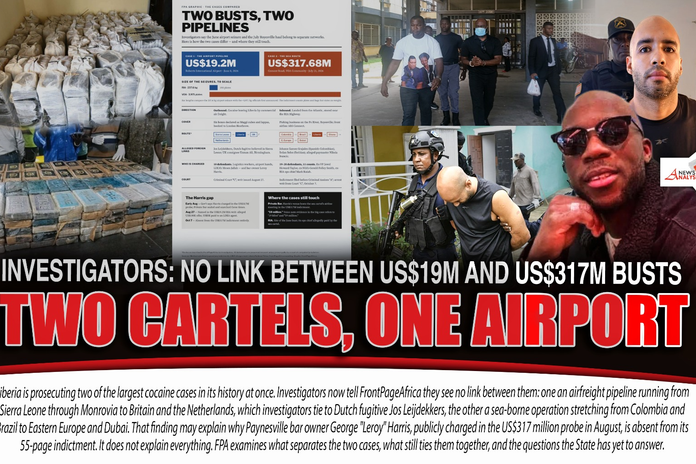
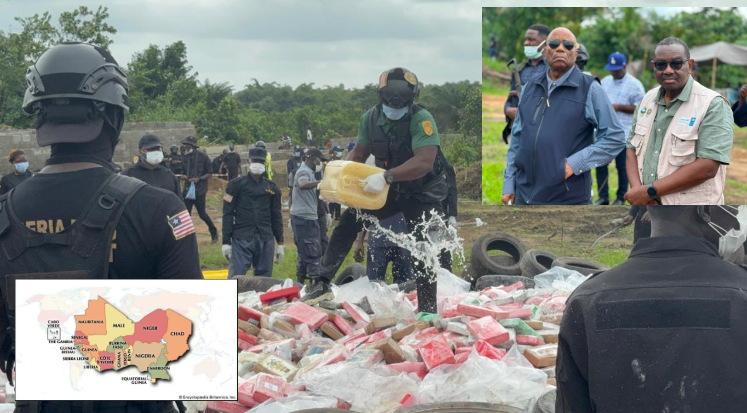
In July, Liberian security forces raided a property in Duazon, Margibi County, and pulled out nearly 4 metric tons of cocaine — the largest seizure in the country’s history, with an estimated street value that authorities eventually put at US$336 million once the full haul was tallied and burned. Two foreign nationals, a Serbian and a dual Colombian-Spanish citizen, were arrested. It came weeks after a smaller but still significant 237-kilogram seizure at Roberts International Airport, drugs that had been hidden inside cargo declared as seasoning cubes and traditional cloth. Executive Protection Service Director Sam Gaye later posted defiantly on social media after a video circulated online purportedly showing cartel members threatening retaliation over the bust, telling them to come collect their cocaine at the burn site himself.
Three months earlier and roughly a thousand miles east, Nigerian counter-narcotics agents stormed a fortified compound deep inside Abidagba Forest in Ogun State and found what officials called the largest clandestine methamphetamine laboratory ever uncovered in the country — an industrial operation staffed in part by Mexican chemists brought in to run production. A month after that, they found a second one, in Oyo State, again run jointly by Nigerians and a Mexican national flown in specifically for his synthesis expertise. Both labs were producing crystal meth for both local distribution and export.
And in Ghana, French customs officers at the port of Dunkirk pulled nearly 3.9 tons of cocaine worth an estimated US$261 million out of a container of plastic waste that had shipped from Ghana’s ports — the second Ghana-linked cocaine seizure in France in a matter of months, and coming only weeks after Australian authorities intercepted 320 kilograms of methamphetamine, worth roughly US$208 million, hidden inside containers of charcoal that had also originated in Ghana.
Four countries, four record or near-record seizures, all within roughly the same few months. Taken individually, each is a law enforcement success story. Taken together, they describe a region absorbing a volume and sophistication of trafficking it has not seen since the height of the “narco-state” scares of the early 2010s.
A familiar playbook, updated for synthetics
What makes this wave notable is not just its scale but its character. West Africa’s role in the cocaine trade has traditionally been that of a transit corridor — a stopover point where South American cocaine, moved across the Atlantic on fishing vessels and cargo ships, gets broken down and re-routed toward Europe, taking advantage of weak customs enforcement, porous borders, and, in some documented cases, the cooperation of corrupt officials.
That transit role has not gone away; if anything, the volumes moving through it appear to be growing, with independent estimates suggesting that a substantial share of the cocaine reaching Europe now passes through the region.
But the discovery of two industrial-scale methamphetamine laboratories in Nigeria within a single month marks something new: West Africa is no longer only a hub the cartels move product through, but increasingly a place they manufacture it. Producing synthetic drugs locally, rather than shipping finished product from Latin America, cuts transport risk and cost for the trafficking networks and suggests a level of infrastructure investment — precursor chemical supply chains, technical expertise flown in from Mexico, protected production sites — that goes beyond opportunistic smuggling.
Where Washington’s attention has gone
The backdrop to this shift is a U.S. counter-narcotics posture that has, by its own public statements, narrowed its aperture. DEA Director Terry Cole has repeatedly and explicitly named Mexico’s Sinaloa Cartel and the Jalisco New Generation Cartel as the agency’s “number one priority,” framing the entire “Fentanyl-Free America” operation around dismantling those two organizations. The Trump administration has designated Mexican cartels as foreign terrorist organizations, tied continued security cooperation with Mexico to specific extradition and seizure targets, and, according to reporting, had a classified Pentagon directive prepared to explore military options against cartels in Latin America. It is an aggressive, resourced, high-profile campaign — aimed almost entirely at the Western Hemisphere.
It is worth being precise about what is and is not confirmed here. There is no public DEA announcement of an explicit policy to reduce operations in West Africa specifically — the shift in emphasis is inferred from where the agency’s leadership has publicly placed its priorities and rhetoric, not from a disclosed reallocation of West Africa personnel or budget. That distinction matters, and it is one worth an editorial follow-up query directly to DEA’s press office. What is not in dispute is the historical contrast: the region’s most-cited enforcement success story is now a decade and a half old.
When West Africa was a “no-go zone”
Between 2007 and roughly 2012, U.S. and Liberian authorities ran a series of joint operations that fundamentally altered the calculus for traffickers using West Africa as a route to Europe and the United States. The best-documented of these, Operation Relentless, was a multi-year undercover sting run by the DEA in coordination with the government of then-President Ellen Johnson Sirleaf. It culminated in May 2010 when Liberia transferred eight defendants — including a Nigerian cocaine broker, a Russian pilot accused of running cocaine shipments, and several West African nationals — to the Southern District of New York to face trafficking charges, the country’s first such extradition-style transfer in more than three decades. Sirleaf’s own son, then director of Liberia’s National Security Agency, worked undercover on the operation. Additional co-conspirators, including a Colombian national extradited from Colombia and a Sierra Leonean who pleaded guilty in a related case, were added to the prosecution over the following two years. Sentences for those convicted ranged into the decades.
Alongside Operation Relentless, parallel DEA-led operations during the same period dismantled trafficking networks with footholds in Sierra Leone, Guinea, and Guinea-Bissau — most infamously the 2013 sting that lured Guinea-Bissau’s former navy chief, José Américo Bubo Na Tchuto, onto international waters and into U.S. custody, exposing how deeply cocaine money had penetrated that country’s military leadership. The cumulative effect of these cases was real: for a period afterward, West Africa’s reputation among traffickers as easy territory noticeably cooled.
That reputation, on the evidence of this year’s seizures, has not survived Washington’s shift in focus intact.
Why thismatters beyond the seizure statistics
The risk that concerns regional security analysts is not simply that more drugs are moving through West Africa — it is what the money that comes with them can buy. The cocaine trade passing through the region has, in past assessments, been valued in the billions of dollars annually, sums that dwarf the national budgets of several of the countries it passes through. Money at that scale does not need to corrupt an entire government to do damage; it needs to find a handful of officials in the right positions; a customs officer, an airport commander, a police unit with authority over evidence.
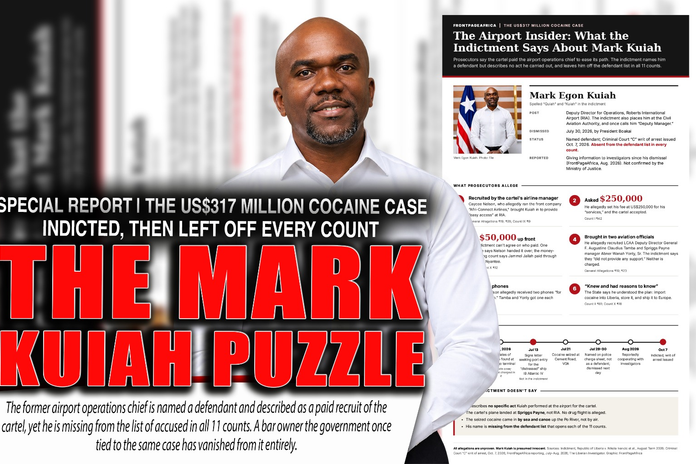
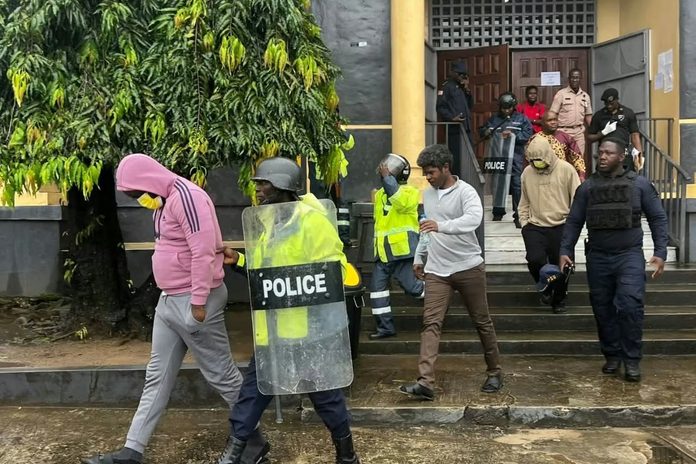
Liberia’s own case this year illustrates the mechanism in miniature. Within weeks of the Duazon seizure, Police Inspector General Gregory Coleman confirmed that officers had allegedly helped escort the cocaine after it entered the country: the chief of highway patrol and the head of the major crimes unit were charged, and a deputy police commander at Roberts International Airport became a suspect. A deputy police commissioner was separately dismissed after admitting he took a $10,000 bribe that compromised the investigation, though he was not accused of trafficking himself. President Boakai then moved further, ordering dismissals, suspensions, and criminal investigations against a wider list of officials across the police, the National Security Agency, Roberts International Airport, and the Liberia Drug Enforcement Agency — a response the Executive Mansion described as necessary to protect the integrity of institutions implicated by the country’s two largest drug cases, together worth close to $390 million.
That is precisely the infiltration risk worth watching closely, in Liberia and across the region: not a single dramatic scandal, but the slow, case-by-case erosion of the individuals a state relies on to keep organized crime out of its institutions in the first place.
The response so far
To their credit, the region’s governments have not been passive. Liberia’s police leadership has pursued and publicly charged its own implicated officers rather than quietly reassigning them, and President Boakai has since directed the country’s joint security apparatus to identify and dismantle trafficking networks operating in the country in their entirety, a mandate that, if sustained, would go beyond the current cases to the wider infrastructure enabling them. Nigeria’s drug agency has dismantled two industrial labs in as many months and is pursuing the international networks behind them. Ghana’s narcotics commission moved quickly to arrest suspects tied to the Dunkirk seizure and has reported thousands of kilograms of narcotics and tens of millions of tramadol tablets intercepted over the past two years, alongside a stated shift toward targeting trafficking networks’ financial infrastructure rather than only their shipments.
Whether that response is enough will depend on a factor largely outside any single West African government’s control: whether Washington, having concentrated its most intensive counter-narcotics resources on Mexico, chooses to reinvest attention in a region that spent the last decade believing that fight was already won.
Support Independent Journalism
Your support helps FrontPage Africa continue delivering independent, credible, and impactful journalism. Every contribution strengthens our ability to investigate, inform, and hold power accountable while keeping quality journalism accessible to our readers.
Support our journalism or subscribe to receive the latest FrontPage Africa stories and updates.