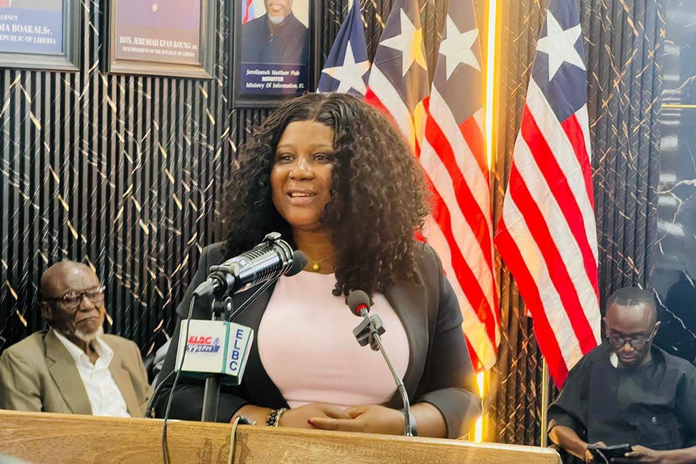
Monrovia — The Liberia Statistics and Geo-Information Services (LISGIS) and the State-run University of Liberia (UL) on Thursday, March 11, launched for the first time in Liberia a Bachelor of Science Degree in Statistics at the University of Liberia.
The Statistical program at the University of Liberia is supported by the World Bank under the Harmonizing and Improving Statistics in West Africa Project (HISWA).
Speaking at the UL’s Auditorium, LISGIS Director-General Prof. Francis Wreh lauded the University of Liberia for the partnership to establish for the first time an undergraduate degree in Statistics.
Prof. Wreh said, under the HISWA project, capacity building is a major component the development of Liberia.
He added that for this reason, the University of Liberia, which is a state-owned university, has been identified to spearhead the component.
“The signing of a Memorandum of Understanding (MOU) between the University of Liberia and the Liberia Institute of Statistics and Geo-Information Services signaled the beginning of the partnership, he said.
Within the partnership, both institutions are expected to work together to build the capacity of the National Statistical System (NSS) of Liberia, the LISGIS boss stated.
LISGIS DG said there has been the quest for a degree in Statistics since the establishment of the University of Liberia, first as Liberia College in 1862 and then as a full-fledged University in the 1950s.
“The collection, analysis, dissemination, and integration of adequate statistical data for development are one of the age-old problems in Liberia,” Prof. Wreh stated.
The LISGIS Director-General says prior to and after the civil war in Liberia (1989-2003), the issue of statistics in the country has been of concern to the Government, the development partners including the International Community. He added that very limited and scanty data were being generated to create room for planning and policymaking.
“Liberia had independence in 1847 but its first national census was held in 1962 (115 years), after which censuses and surveys have been held at irregular intervals,” he said.
Prof. Wreh added: “There was no statistical training institution until the certificate in statistics (CEST) program was established in 1980; a statistical act establishing the Liberia Institute of Statistics and Geo-Information Services (LISGIS) was lately legislated in 2004; the establishment of an undergraduate degree program is happening now in 2021.”
Also speaking, the president Dr. Julius Sarwolo Nelson praised LISGIS for partnering with the University of Liberia to develop a program that will seek the need for the development gap that will contribute to the forward march of Liberia.
“Today, LISGIS and the University of Liberia are launching this bachelor in Statistics is the fruits of this renewed partnership as we go forward to the future,” Dr. Nelson said.
The UL President also called on recent graduates and also individuals wanting to attend the university to explore the area of Statistics to help fill the gaps for population data collection that will contribute to decision-making in Liberia.
Adding up, the Chairman of the Mathematics Department at the University of Liberia Mr. Michael Gboneh said the country is confronted with immense human resources capacity gaps especially in mathematics and other mathematics-related fields as such the study of statistics essential.
“The purpose of the programs is to train students and researchers to carry out evidence-based research on extensive observations and experiment; collection and analysis of data in laboratories and social, economic, and public systems and organizations and to derive inferences about the behavior of such systems,” Gboneh said.
According to Gboneh, before a student can obtain a degree in Statistics, one must have completed 18 credits of General Educations Courses, nine credits of Elective Courses, 82 Major Compulsory Courses and 18 Mathematics Courses totaling 127 credits hours.
“The program will offer up to at least 20 scholarships at the Master’s and PhDs’ level. A modern computer lab fully air-cooled with 76 desktop and internet will be established to enable students to analyze data, build models, develop software and perform other computing processes,” Gboneh said.
Also, for her part, Naomi Flomo, the only female student studying Mathematics at the University of Liberia said while in High School, she desired to pursue an undergraduate degree in statistics but was disappointed that the program was not offered by the University of Liberia and other universities in and around the country.
That plan later on, changed and she took an alternative by pursuing a degree in General Mathematics at the University of Liberia. She added that Mathematics is the mother of statistics.
Flomo added: “My advent to this program has now brought closure to my longing for a degree in statistics.”
She said one cannot solve problems in politics, agriculture, Economic, Engineering, Business, and Health without the use of statistics.
“This program is a dream that comes through for many students at the University of Liberia,” student Flomo said.
Support Independent Journalism
Your support helps FrontPage Africa continue delivering independent, credible, and impactful journalism. Every contribution strengthens our ability to investigate, inform, and hold power accountable while keeping quality journalism accessible to our readers.
Support our journalism or subscribe to receive the latest FrontPage Africa stories and updates.