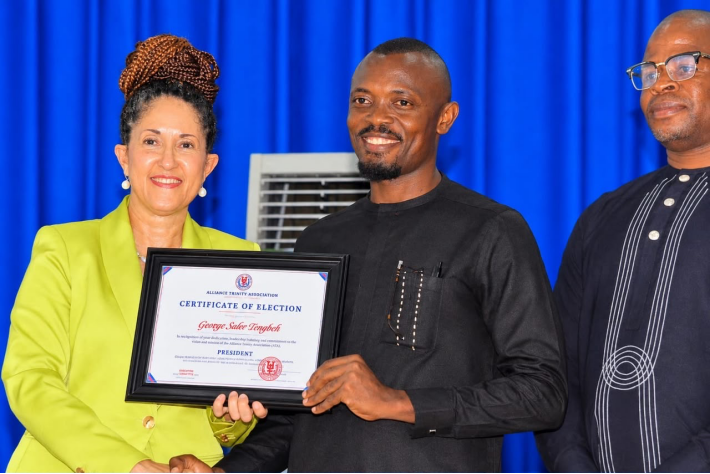
MONROVIA, Liberia — The newly elected President of the Adjunct Faculty Association of the University of Liberia (AFA-UL), George Sahr Tengbeh, has called for sweeping improvements in the treatment and working conditions of adjunct lecturers, demanding transparent employment contracts, predictable salary payments, fair course assignments, and independent audits of the university’s finances and personnel records.
By Patience M. Jones,[email protected]
Tengbeh made the demands Thursday, during his inaugural address at the University of Liberia’s Capitol Hill campus, where he challenged university authorities, faculty members, and administrators to determine whether their actions are advancing the institution or obstructing its progress.
Under the theme, “To Facilitate or to Obstruct: The Responsibility That Comes with Being a Faculty Member,” Tengbeh warned that internal divisions, personal interests, and institutional disagreements could undermine the university’s academic mission if stakeholders fail to prioritize cooperation and accountability.
He described the University of Liberia as a national institution and a bridge between education, opportunity, and national development, cautioning that those entrusted with its progress must not weaken its foundation through unnecessary conflicts.
“Are our actions FACILITATING the progress of the University of Liberia, or are they OBSTRUCTING it?” Tengbeh asked, challenging faculty members, administrators, associations, and student leaders to examine their contributions to the institution.
Adjunct Faculty Demand Dignity and Fair Treatment
A major focus of Tengbeh’s address was the treatment of adjunct faculty, whom he said deserve the same professional dignity and respect afforded to other educators, regardless of their employment classification.
Reflecting on his experience since joining the university in January 2025, Tengbeh recalled encountering attitudes suggesting that part-time lecturers were less deserving of recognition and respect.
He specifically condemned the expression that “part-timers do not have blood,” describing such language as unacceptable within an academic institution.
“Employment classification does not determine human worth. Neither does it erase one’s qualifications, professional experience, or contribution to education,” he declared.
According to Tengbeh, records of the association show that 348 adjunct faculty members hold one or more master’s degrees, while 16 possess doctoral degrees.
He argued that the qualifications and professional experience represented within the association constitute an important academic resource that the university should consider when making employment and professional development decisions.
However, he clarified that the association was not demanding automatic employment or preferential treatment but rather transparent opportunities based on qualifications, experience, performance, institutional needs, and available resources.
Demands Written Contracts, Predictable Payments
Tengbeh outlined several concerns affecting adjunct lecturers, including the handling of employment contracts, course assignments, remuneration, and opportunities for professional advancement.
He called on the university’s Human Resource Management Department to ensure that adjunct faculty members receive copies of their signed contracts, preferably before beginning academic work.
He also criticized what he described as a system in which course assignments could be influenced by personal relationships rather than professional standards.
The association’s president called for an end to what he characterized as lecturers “living at the mercy of the chairpersons,” insisting that course allocations should follow transparent and objective criteria.
On remuneration, Tengbeh maintained that payments should reflect lecturers’ qualifications, workload, and agreed contractual terms, while being made on a predictable schedule.
He further urged the university administration to establish a clearer framework for long-serving and qualified adjunct lecturers, including opportunities for professional development, research participation, international academic exchanges, and consideration for suitable academic positions.
Where the university cannot absorb all adjunct faculty members into its permanent workforce, Tengbeh proposed long-term contracts of at least one year as a measure to improve job security.
He also encouraged university leadership to include qualified adjunct lecturers in seminars, academic exchanges, and other professional engagements involving the university’s leadership.
Calls for Independent Audits of UL
In another significant part of his address, Tengbeh called for regular, independent, and comprehensive audits of the University of Liberia’s finances, personnel records, and faculty academic credentials.
He argued that accountability and transparency are essential to restoring and maintaining public confidence in the country’s oldest degree-granting institution.
According to him, such audits should not be viewed as attacks against individuals but as necessary measures for institutional improvement and responsible governance.
“Such exercises should not be understood as attacks on individuals. They are essential instruments of accountability, institutional improvement, and public trust,” he emphasized.
Tengbeh also called on the Board of Trustees and the University Senate to strengthen consultations with faculty members and students, particularly on decisions affecting their professional and academic interests.
He acknowledged the appointment of Dr. Layli Maparyan as President of the University of Liberia, expressing confidence in her ambition to improve the institution’s academic standing and competitiveness among leading African universities.
He assured the administration that AFA-UL stands ready to support reforms aimed at improving academic excellence, institutional accountability, and teaching and learning conditions.
However, he urged the university leadership to ensure that opportunities for research, doctoral development, and international academic engagement are extended to qualified adjunct faculty members.
Warns Against Students Becoming Victims of Faculty Disputes
Tengbeh also cautioned faculty associations and university administrators against allowing internal disagreements to disrupt students’ academic progress.
He described students as the primary reason for the university’s existence and insisted that their education must remain central to every institutional decision and negotiation.
“No institutional disagreement should unnecessarily interrupt your academic progress. Students must never become collateral damage in disputes among faculty members, administrators, or associations,” he said.
He encouraged students to remain disciplined and committed to academic excellence while exercising their right to participate in decisions affecting their education through appropriate channels.
The AFA-UL president also called for stronger student counselling and psychological support services, noting that students experiencing emotional, financial, and family challenges need accessible institutional support to remain focused on their studies.
Rejects Rivalry Between ULFA and AFA-UL
Addressing relations between the University of Liberia Faculty Association (ULFA) and AFA-UL, Tengbeh rejected suggestions that the two organizations should be viewed as competitors or enemies.
He maintained that although the associations have different organizational identities and responsibilities, they share a common interest in protecting the university’s academic mission.
“There is no fight between ULFA and AFA-UL. We are not enemies. We work in the same university, serve the same students, contribute to the same academic mission, and share an interest in the institution’s success,” he stated.
He explained that AFA-UL was established to represent adjunct faculty, advance their professional interests, and provide a constructive platform for engagement with university authorities.
Tengbeh further acknowledged the authority of the Board of Trustees, the university president, the Senate, and other legally established governance structures, promising that his association would respect institutional boundaries while advocating for its members.
He stressed that disagreement should not automatically be interpreted as hostility and that legitimate faculty concerns should not be dismissed simply because they challenge institutional decisions.
“We can disagree without becoming enemies. We can advocate without disrespecting authority,” he said.
Promises Firm but Diplomatic Leadership
As he assumed leadership of the association, Tengbeh pledged to pursue dialogue, professional negotiations, evidence-based advocacy, and accountability rather than turning every disagreement into a public confrontation.
However, he cautioned that his commitment to diplomacy should not be mistaken for weakness or a willingness to abandon the interests of adjunct faculty.
“I will not be a weak President,” he declared.
“Diplomacy does not mean surrendering principles. Friendliness does not mean abandoning responsibility. Understanding does not mean accepting injustice.”
He also called on his fellow elected officers to embrace teamwork, transparency, and accountability, stressing that the association’s mandate belongs to its entire membership rather than one individual.
Tengbeh concluded by urging faculty members, administrators, student leaders, and other stakeholders to work collectively to strengthen the University of Liberia, warning that history would ultimately judge them by their contributions rather than the positions they occupied.
“As the newly elected President of the Adjunct Faculty Association, I choose to facilitate. I invite every colleague, every administrator, every association, and every student to make the same choice,” he said.
He called on all stakeholders to protect and strengthen the university as an institution capable of preparing future generations of Liberians.
Support Independent Journalism
Your support helps FrontPage Africa continue delivering independent, credible, and impactful journalism. Every contribution strengthens our ability to investigate, inform, and hold power accountable while keeping quality journalism accessible to our readers.
Support our journalism or subscribe to receive the latest FrontPage Africa stories and updates.