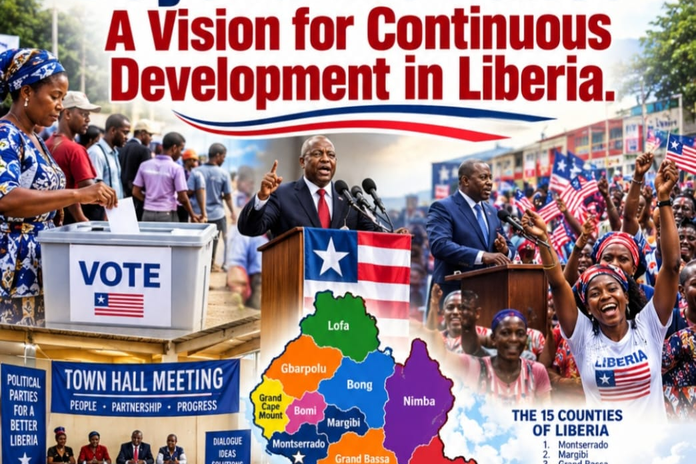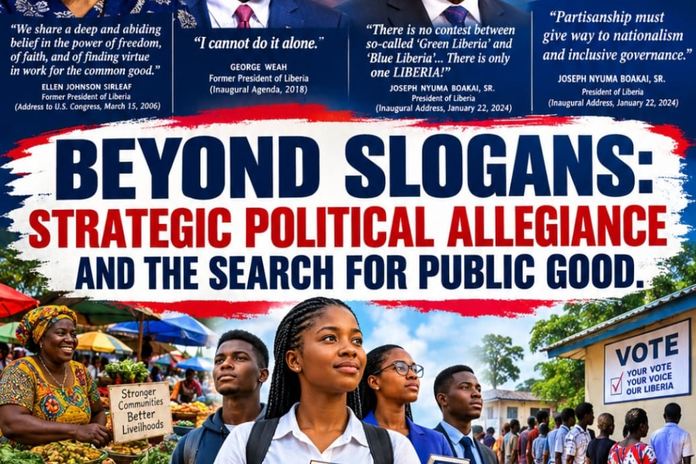
Since the inception of the JNB-Unity Party–led administration, one of the government’s major concerns has, without doubt, been focused on how to win the next election in 2029. From strategic political appointments to the recent December 6 homecoming program, where a million-dollar party headquarters was unveiled, along with plans to build similar expensive structures across the country; all these actions clearly signal that this government, like many before it, is more concerned about the next election than preparing a future for the next generation.
By Fedesco Tolbert, contributing writer
As I watched a significant portion of the program streamed from the Executive Mansion’s official page, especially seeing the hopeful young faces filling the crowd, several painful questions began to echo in my mind.
When will our leaders stop being politicians for once and start leading with dignity, compassion, patriotism, and a genuine commitment to solving the bread-and-butter issues affecting ordinary Liberians?
At what point will we finally witness a true paradigm shift in the governance of our beloved country; one that places people above politics, and the next generation above the next election?
When will we, the youth, the majority population—stop being used as political canopies, called upon only to provide shade and support during campaign and political rallies, only to be forgotten once the ballots are counted?
The sad reality is that while these celebrations were taking place, millions of young people, including little children were going to bed hungry. Thousands have dropped out of school with no hope of returning. Countless others have no access to quality education, safe communities, or reliable healthcare. This reality gripped me deeply and painfully shook me. And it is the reason I felt compelled to write this article.
When, just when will the future of the next generation become the true priority of our leaders?
Why Youth Employment Must Be Treated as a National Emergency:
Liberia has a population of about 5.73 million people, comprising an overwhelmingly young population. The median age is 18.8 years (Worldometer). According to the Liberia Institute of Statistics and Geo-Information Services (LISGIS), 44.5 percent of the population is under 15 years of age, while 41.7 percent falls within the 15–35 age range. In total, 74.5 percent of Liberians are under the age of 35. In a nation with such a youthful demographic profile, the creation of employment and the provision of opportunities for young people should not be treated as political favors or rewards for loyalists; rather, they should constitute an urgent national priority.
We do not need an economic expert to know that the lack of meaningful empowerment opportunities leaves our youth vulnerable to crime, drugs, and substance abuse. Youth development reduces economic dependency, strengthens human capital, stabilizes social conditions, and stimulates national development. As former President William R. Tolbert once said, “Young people should be considered and prioritized as an indispensable resource of any country that means wealth for its next generation.”
If our leaders truly believed this, youth employment, along with broader economic opportunities—should be treated as a national emergency, not a campaign slogan.
President JNB Pleads for More Time:
It is often said that an opposition party is a government in waiting. Therefore, when given the opportunity to lead, they should be fully prepared to serve. For a president who spent so many years in government before leading the nation, it is not only frustrating to see his administration mirroring the shortcomings of past governments, it is deeply disappointing. Hence, the struggle and potential failure of this government led by of a “veteran”, has made one thing clear: Experience in government alone does not guarantee effective leadership.
By all measures, President Boakai is among the most experienced leaders in Liberian history. Though Liberia does not have a Secretary of State position like the United States, President Boakai’s record of 12 years as Vice President and President of the Liberian Senate, places him among the most seasoned public servants. His political journey could be compared to President Thomas Jefferson of the United States, famously known as the “1-2-3 President” for serving as Secretary of State, Vice President, and later President.
And as the Biblical principle teaches: “To whom much is given, much is expected.”
Yet despite JNB decades of experience, the President still pleads for more time to solve Liberia’s fundamental challenges that he should have prepared for long time ago. What is even more concerning is that, after nearly two years in office, this administration appears uncertain about what should truly be prioritized. Many of its so-called “rescue” policies are buried in fine prints, understood only by the educated few, while ordinary citizens continue to see no real improvement in their daily lives.
Comparing Boakai’s “One County, One Party Headquarters” to Ghana’s One District, One Factory Development Model:
Ghana’s One District, One Factory (1D1F) policy, launched on August 25, 2017 under former President Nana Dankwa Akufo-Addo, is a powerful example of visionary and prepared leadership. Its goal was to spark nationwide industrialization by building factories in each district—creating jobs, promoting local manufacturing, and reducing dependence on imports. In contrast to JNB’s request for more time, this impressive economic development strategy was implemented only a few months after the former Ghanaian president took office.
According to GhanaStar and the Ghanaian Times, by mid-2023 a total of 126 factories were operational, generating more than 160,000 jobs. By late 2021, 106 factories had been completed, resulting in nearly 150,000 jobs. Furthermore, between 2017 and 2020, an estimated 1.5 to 3.2 million jobs were created nationwide. Unlike Liberia’s “One County, One Party Headquarters” policy, which is aimed at strengthening political influence for the next election, Ghana’s 1D1F initiative was designed to strengthen its next generation.
While our government focuses on building political offices, our neighbors like Ghana and Burkina Faso focus on building industrial futures for their young people. The 1D1F model in Ghana, helped reduced rural-urban migration, increased incomes, expanded agro-processing, empowered unemployed youth, and decentralized economic growth. This evidence is clear: strategic investment, not political celebration, builds nations.
Conclusion:
To the government and the ruling party:
A party’s true headquarters is not made of concrete, but of its children’s dreams.
Liberia’s youth are crying, not for more party offices, but for employment opportunity.
Not for more political speeches, but for hope. Not for promises of the next election, but for a future worth living. Mr. President, the next generation carries the heartbeat of this nation. Please prioritize their education, their jobs, their potential, and their lives. Because if we fail them today, there will be no Liberia to lead tomorrow.
About the writer
Fedesco Cisco Tolbert is an activist, former student leader, and a doctoral candidate at the prestigious George Washington University’s School of Engineering and Applied Science. He is also a prominent resident of Electoral District #10, Montserrado County.
Support Independent Journalism
Your support helps FrontPage Africa continue delivering independent, credible, and impactful journalism. Every contribution strengthens our ability to investigate, inform, and hold power accountable while keeping quality journalism accessible to our readers.
Support our journalism or subscribe to receive the latest FrontPage Africa stories and updates.