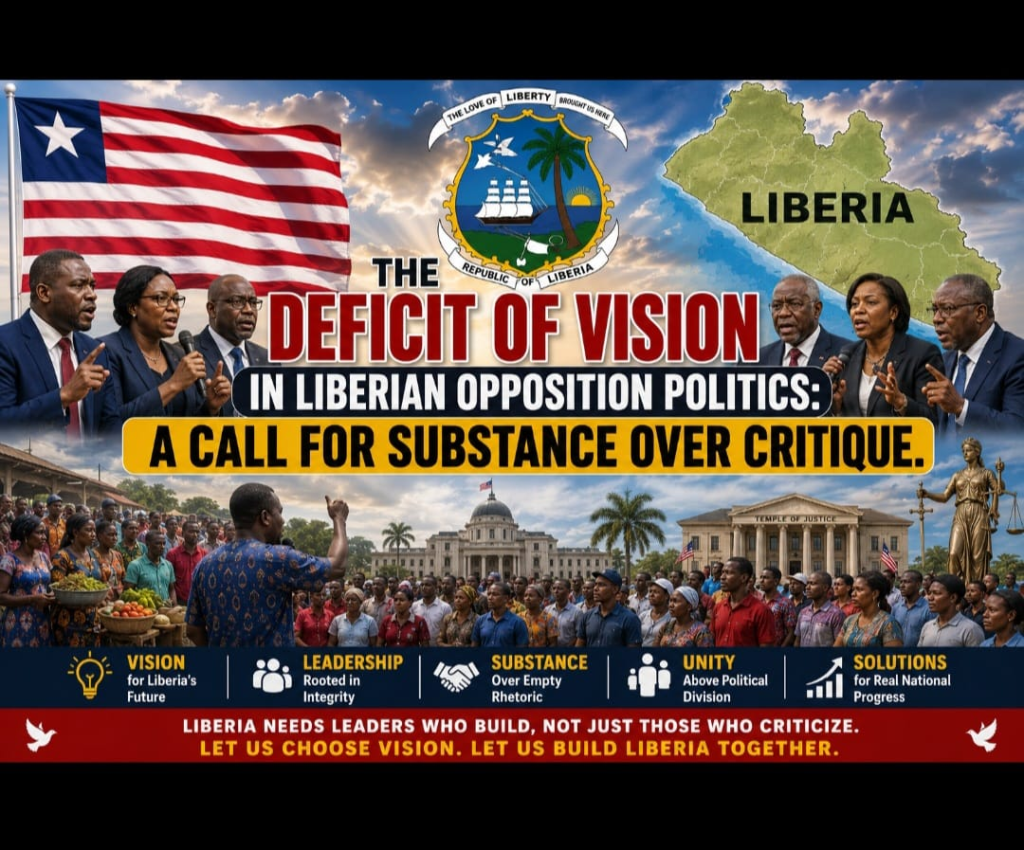
Liberian opposition politics has historically suffered from a reliance on reactive critique rather than proactive policy formulation. Rather than detailing rigorous, costed blueprints for economic diversification, infrastructural maintenance, or institutional reform, opposition platforms often reduce national discourse to emotive grievances.
The Trap of Perpetual Opposition: Parties frequently mistake opposition for obstruction, defaulting to condemnation of incumbent policy without establishing empirical counter-proposals.
Substance Deficit: Manifesto documents are regularly overshadowed by personality-driven politics, sidelining critical debates on domestic revenue mobilization, educational overhaul, and job creation.
The Path Forward: True democratic maturity in Liberia requires opposition groups to transition from generalized critique to substantive, visionary alternative governance that respects the complexities of national development.
President Joseph Nyuma Boakai: Emphasized that the opposition must remain constructive, stating that “opposition should not become a destructive force against national progress,” while noting that governance requires tangible execution rather than perpetual fault-finding.
Former President Ellen Johnson Sirleaf: Characterized true political leadership through a lens of institutional accountability, noting that “politics is politics,” but governance demands moving past noise to secure long-term socioeconomic stabilization.
Former President George Weah: Challenged critics during his tenure by questioning the substantive alternatives presented by his rivals, pointedly asking what structural shifts they genuinely offered beyond rhetoric.
Domestic Critics & Analysts: Observers and local actors (such as historical critiques referencing figures like Dr. Togba-Nah Tipoteh) frequently highlight a “messaging crisis” where opposition parties lean heavily into populist critique while suffering from a structural deficit of clear, executable policy roadmaps.
United Nations: Multilateral messaging consistently underscores that sustainable post-conflict peace in Liberia relies on functional state-capacity building and substantive policy discourse rather than cyclical political antagonism.
By: Austin S Fallah – A True Son of the Planet Earth Soil: [email protected]
In the arena of politics, a compelling message is crucial to incite hope, foster ambition, and motivate progress among the electorate.
The upcoming 2029 elections in Liberia present a critical opportunity for opposition parties to outline transformative visions that resonate with the daily realities of the Liberian people.
Yet, as Liberian opposition political parties gear up for this pivotal moment, a glaring deficiency in both messaging and strategy becomes apparent, notably the prevalence of relentless criticism devoid of constructive alternatives.
This dynamic, far from galvanizing support, creates a profound disconnect with the populace, swaying voters toward the promising trajectory of social and economic development championed by the Unity Party led by President Joseph Nyuma Boakai and Vice President Jeremiah Kpan Koung, and their coalition.
Opposition criticism, characterized by its focus on fault-finding rather than solution-oriented engagement, is equivalent to empty rhetoric.
With the Unity Party steadily advancing development initiatives, the inability of opposition parties to articulate a coherent and compelling message serves only to highlight their weaknesses and stoke political envy.
Criticism, particularly when focused solely on lamenting the status quo, fails to provide a roadmap for a better future.
It lacks the substance that Liberians rightfully seek in their leaders.
In essence, stakeholders in contemporary Liberian politics must remember that critical discourse without actionable solutions not only undermines their argument but also reflects poorly on their commitment to serving the populace.
The situation is further complicated by pressing national issues, such as the growing drug crisis, which requires an urgent and thoughtful response.
Critics of the current administration often focus on highlighting the adverse implications of substance abuse without acknowledging that these challenges have deep roots in previous governmental structures.
A genuine political platform should not only provide critique but should also cultivate preventative and corrective solutions that confront the very issues they decry.
The abundance of commentary surrounding drug issues, without practical plans to tackle them, demonstrates a lack of substantive engagement with one of Liberia’s most pressing challenges.
Indeed, the problem of drug abuse among the youth threatens to erode the nation’s future.
The cultural construct of youth in Liberia, which embodies potential, innovation, and leadership, hinges painstakingly on the capacity of political leaders to shape an environment conducive to growth and creativity.
The opposition must rise to the occasion; they must propose well-researched, innovative strategies for tackling substance abuse.
These strategies could include engaging with community leaders to foster prevention programs, supporting educational initiatives that equip young people with critical thinking skills, and advocating for rehabilitation systems that genuinely aid those affected by addiction.
The absence of such discourse reinvigorates the argument that opposition merely engages in political envy (by what their so-called supporters are spewing daily on social media), a spectacle void of real responsibility.
Balancing criticism of the Unity Party with concrete proposals positions the opposition as allies in the nation-building endeavor rather than mere detractors.
In the biblical allegory of Judges 9:8–15, we see a resemblance to the political climate in Liberia: a tale of trees seeking a king to lead them, wherein the noble and wise do not rise to the occasion while those devoid of substance attempt to seize power.
The trees aspired for leadership but ended up productive under the reign of the bramble, an empty figure that could not provide shade or sustenance.
The Liberian opposition, much like those trees, risks not only failing to fulfill their ambitions but also sacrificially handing over the welfare of the nation to ineffective leaders more capable of gestures than genuine support.
As Liberians contemplate the future of their nation, opposition parties must undergo a critical self-assessment.
Relying solely on criticism undermines their credibility and fails to address the holistic needs of the population.
Campaigns should pivot toward visionary leadership that outlines how they plan to address the Root causes of economic challenges, drugs, drug cartels, social dilemmas, and a stagnant political environment.
Voters, especially the youth who embody the future, are yearning for a narrative that encompasses hope, innovation, and tangible opportunities, not just a critique of the present.
Furthermore, the role of the Unity Party under President Boakai and Vice President Koung, and the coalition, should not be misunderstood as merely an advantage in the political landscape but should instead be viewed comprehensively as a testament to the establishment of stability and development amidst historical adversity.
They have made strides in the infrastructure sector, fostered dialogue, and injected economic viability into various facets of public life.
The opposition’s discourse should consider participating in such discussions rather than standing aloof in criticism.
To effectively rally the Liberian populace and cement a viable foundation(not divide the Liberian people through spewing empty good-for-nothing slogans and tautologies coming out of the mouths of the so-called uneducated elements, weak, empty-headed walking soldiers turn internet social media politicians)for opposition leadership, they must recognize the importance of inclusivity and listening to the needs and aspirations of the people.
Collaborative strategies that promote transparency, effective governance, and long-term plans can rally the nation behind collective goals.
Engaging in dialogue with citizens may unearth enlightening perspectives and innovative solutions that lie dormant within communities.
In doing so, the opposition must boldly emphasize education as a central tenet of national advancement.
Education has been the bedrock upon which societies thrive; thus, prioritizing educational reform will yield fruitful results for the youth in combating substance abuse.
Investment in the educational landscape results in a more skilled, informed, and resilient citizenry, arguably the most crucial asset for the future of Liberia.
Civic engagement programs that encourage youth participation in governance, advocacy for better educational curricula, and access to essential resources will signal a commitment to nurturing Liberia’s future leaders.
Moreover, health initiatives should not be relegated to the shadows of the political limelight.
Modern healthcare infrastructure is a critical component in the fight against substance abuse.
Bringing the opposition’s focus to developing healthcare campaigns that address addiction holistically, drug cartels with clean hands, if they do, not just through law enforcement, can provide comprehensive solutions that resonate with many voters.
Ensuring that treatment facilities are adequately funded, accessible, and equipped to handle cases of addiction stands to transform lives and potentially reshape the socio-political landscape of the nation.
The landscape of Liberian politics in the lead-up to the 2029 elections is ripe for a much-needed transformation focused on solutions rather than mere criticism.
Political critics must transcend empty rhetoric, good-for-nothing loud noise tautologies, and cultivate a vision that addresses the needs of their constituents, citizens of Liberia.
Amidst persistent social and economic challenges, particularly concerning substance abuse, the opposition must strive to articulate constructive solutions rather than merely denouncing the current state of affairs.
Benefiting from a rich history that fosters resilience, Liberia’s future hinges on its leaders’ ability to navigate challenges with vigor and creativity.
By embracing inclusivity, prioritizing education, and committing to collectively shaped national policies, the opposition can position itself not merely as detractors but as problem solvers, key players in crafting a prosperous future for Liberia.
The vital question before them is: Will they summon the vision and courage that the nation sorely needs, or will they continue down a path marked by discontent, bereft of clear purpose?
The answer lies in their ability to pivot from criticism to solution, to cultivate a resounding message of hope and renewal for the Liberian people.
Liberian opposition politics has historically suffered from a reliance on reactive critique rather than proactive policy formulation. Rather than detailing rigorous, costed blueprints for economic diversification, infrastructural maintenance, or institutional reform, opposition platforms often reduce national discourse to emotive grievances.
The Trap of Perpetual Opposition: Parties frequently mistake opposition for obstruction, defaulting to condemnation of incumbent policy without establishing empirical counter-proposals.
Substance Deficit: Manifesto documents are regularly overshadowed by personality-driven politics, sidelining critical debates on domestic revenue mobilization, educational overhaul, and job creation.
The Path Forward: True democratic maturity in Liberia requires opposition groups to transition from generalized critique to substantive, visionary alternative governance that respects the complexities of national development.
President Joseph Nyuma Boakai: Emphasized that the opposition must remain constructive, stating that “opposition should not become a destructive force against national progress,” while noting that governance requires tangible execution rather than perpetual fault-finding.
Former President Ellen Johnson Sirleaf: Characterized true political leadership through a lens of institutional accountability, noting that “politics is politics,” but governance demands moving past noise to secure long-term socioeconomic stabilization.
Former President George Weah: Challenged critics during his tenure by questioning the substantive alternatives presented by his rivals, pointedly asking what structural shifts they genuinely offered beyond rhetoric.
Domestic Critics & Analysts: Observers and local actors (such as historical critiques referencing figures like Dr. Togba-Nah Tipoteh) frequently highlight a “messaging crisis” where opposition parties lean heavily into populist critique while suffering from a structural deficit of clear, executable policy roadmaps.
United Nations: Multilateral messaging consistently underscores that sustainable post-conflict peace in Liberia relies on functional state-capacity building and substantive policy discourse rather than cyclical political antagonism.
By: Austin S Fallah – A True Son of the Planet Earth Soil: [email protected]
In the arena of politics, a compelling message is crucial to incite hope, foster ambition, and motivate progress among the electorate.
The upcoming 2029 elections in Liberia present a critical opportunity for opposition parties to outline transformative visions that resonate with the daily realities of the Liberian people.
Yet, as Liberian opposition political parties gear up for this pivotal moment, a glaring deficiency in both messaging and strategy becomes apparent, notably the prevalence of relentless criticism devoid of constructive alternatives.
This dynamic, far from galvanizing support, creates a profound disconnect with the populace, swaying voters toward the promising trajectory of social and economic development championed by the Unity Party led by President Joseph Nyuma Boakai and Vice President Jeremiah Kpan Koung, and their coalition.
Opposition criticism, characterized by its focus on fault-finding rather than solution-oriented engagement, is equivalent to empty rhetoric.
With the Unity Party steadily advancing development initiatives, the inability of opposition parties to articulate a coherent and compelling message serves only to highlight their weaknesses and stoke political envy.
Criticism, particularly when focused solely on lamenting the status quo, fails to provide a roadmap for a better future.
It lacks the substance that Liberians rightfully seek in their leaders.
In essence, stakeholders in contemporary Liberian politics must remember that critical discourse without actionable solutions not only undermines their argument but also reflects poorly on their commitment to serving the populace.
The situation is further complicated by pressing national issues, such as the growing drug crisis, which requires an urgent and thoughtful response.
Critics of the current administration often focus on highlighting the adverse implications of substance abuse without acknowledging that these challenges have deep roots in previous governmental structures.
A genuine political platform should not only provide critique but should also cultivate preventative and corrective solutions that confront the very issues they decry.
The abundance of commentary surrounding drug issues, without practical plans to tackle them, demonstrates a lack of substantive engagement with one of Liberia’s most pressing challenges.
Indeed, the problem of drug abuse among the youth threatens to erode the nation’s future.
The cultural construct of youth in Liberia, which embodies potential, innovation, and leadership, hinges painstakingly on the capacity of political leaders to shape an environment conducive to growth and creativity.
The opposition must rise to the occasion; they must propose well-researched, innovative strategies for tackling substance abuse.
These strategies could include engaging with community leaders to foster prevention programs, supporting educational initiatives that equip young people with critical thinking skills, and advocating for rehabilitation systems that genuinely aid those affected by addiction.
The absence of such discourse reinvigorates the argument that opposition merely engages in political envy (by what their so-called supporters are spewing daily on social media), a spectacle void of real responsibility.
Balancing criticism of the Unity Party with concrete proposals positions the opposition as allies in the nation-building endeavor rather than mere detractors.
In the biblical allegory of Judges 9:8–15, we see a resemblance to the political climate in Liberia: a tale of trees seeking a king to lead them, wherein the noble and wise do not rise to the occasion while those devoid of substance attempt to seize power.
The trees aspired for leadership but ended up productive under the reign of the bramble, an empty figure that could not provide shade or sustenance.
The Liberian opposition, much like those trees, risks not only failing to fulfill their ambitions but also sacrificially handing over the welfare of the nation to ineffective leaders more capable of gestures than genuine support.
As Liberians contemplate the future of their nation, opposition parties must undergo a critical self-assessment.
Relying solely on criticism undermines their credibility and fails to address the holistic needs of the population.
Campaigns should pivot toward visionary leadership that outlines how they plan to address the Root causes of economic challenges, drugs, drug cartels, social dilemmas, and a stagnant political environment.
Voters, especially the youth who embody the future, are yearning for a narrative that encompasses hope, innovation, and tangible opportunities, not just a critique of the present.
Furthermore, the role of the Unity Party under President Boakai and Vice President Koung, and the coalition, should not be misunderstood as merely an advantage in the political landscape but should instead be viewed comprehensively as a testament to the establishment of stability and development amidst historical adversity.
They have made strides in the infrastructure sector, fostered dialogue, and injected economic viability into various facets of public life.
The opposition’s discourse should consider participating in such discussions rather than standing aloof in criticism.
To effectively rally the Liberian populace and cement a viable foundation(not divide the Liberian people through spewing empty good-for-nothing slogans and tautologies coming out of the mouths of the so-called uneducated elements, weak, empty-headed walking soldiers turn internet social media politicians)for opposition leadership, they must recognize the importance of inclusivity and listening to the needs and aspirations of the people.
Collaborative strategies that promote transparency, effective governance, and long-term plans can rally the nation behind collective goals.
Engaging in dialogue with citizens may unearth enlightening perspectives and innovative solutions that lie dormant within communities.
In doing so, the opposition must boldly emphasize education as a central tenet of national advancement.
Education has been the bedrock upon which societies thrive; thus, prioritizing educational reform will yield fruitful results for the youth in combating substance abuse.
Investment in the educational landscape results in a more skilled, informed, and resilient citizenry, arguably the most crucial asset for the future of Liberia.
Civic engagement programs that encourage youth participation in governance, advocacy for better educational curricula, and access to essential resources will signal a commitment to nurturing Liberia’s future leaders.
Moreover, health initiatives should not be relegated to the shadows of the political limelight.
Modern healthcare infrastructure is a critical component in the fight against substance abuse.
Bringing the opposition’s focus to developing healthcare campaigns that address addiction holistically, drug cartels with clean hands, if they do, not just through law enforcement, can provide comprehensive solutions that resonate with many voters.
Ensuring that treatment facilities are adequately funded, accessible, and equipped to handle cases of addiction stands to transform lives and potentially reshape the socio-political landscape of the nation.
The landscape of Liberian politics in the lead-up to the 2029 elections is ripe for a much-needed transformation focused on solutions rather than mere criticism.
Political critics must transcend empty rhetoric, good-for-nothing loud noise tautologies, and cultivate a vision that addresses the needs of their constituents, citizens of Liberia.
Amidst persistent social and economic challenges, particularly concerning substance abuse, the opposition must strive to articulate constructive solutions rather than merely denouncing the current state of affairs.
Benefiting from a rich history that fosters resilience, Liberia’s future hinges on its leaders’ ability to navigate challenges with vigor and creativity.
By embracing inclusivity, prioritizing education, and committing to collectively shaped national policies, the opposition can position itself not merely as detractors but as problem solvers, key players in crafting a prosperous future for Liberia.
The vital question before them is: Will they summon the vision and courage that the nation sorely needs, or will they continue down a path marked by discontent, bereft of clear purpose?
The answer lies in their ability to pivot from criticism to solution, to cultivate a resounding message of hope and renewal for the Liberian people.
Support Independent Journalism
Your support helps FrontPage Africa continue delivering independent, credible, and impactful journalism. Every contribution strengthens our ability to investigate, inform, and hold power accountable while keeping quality journalism accessible to our readers.
Support our journalism or subscribe to receive the latest FrontPage Africa stories and updates.