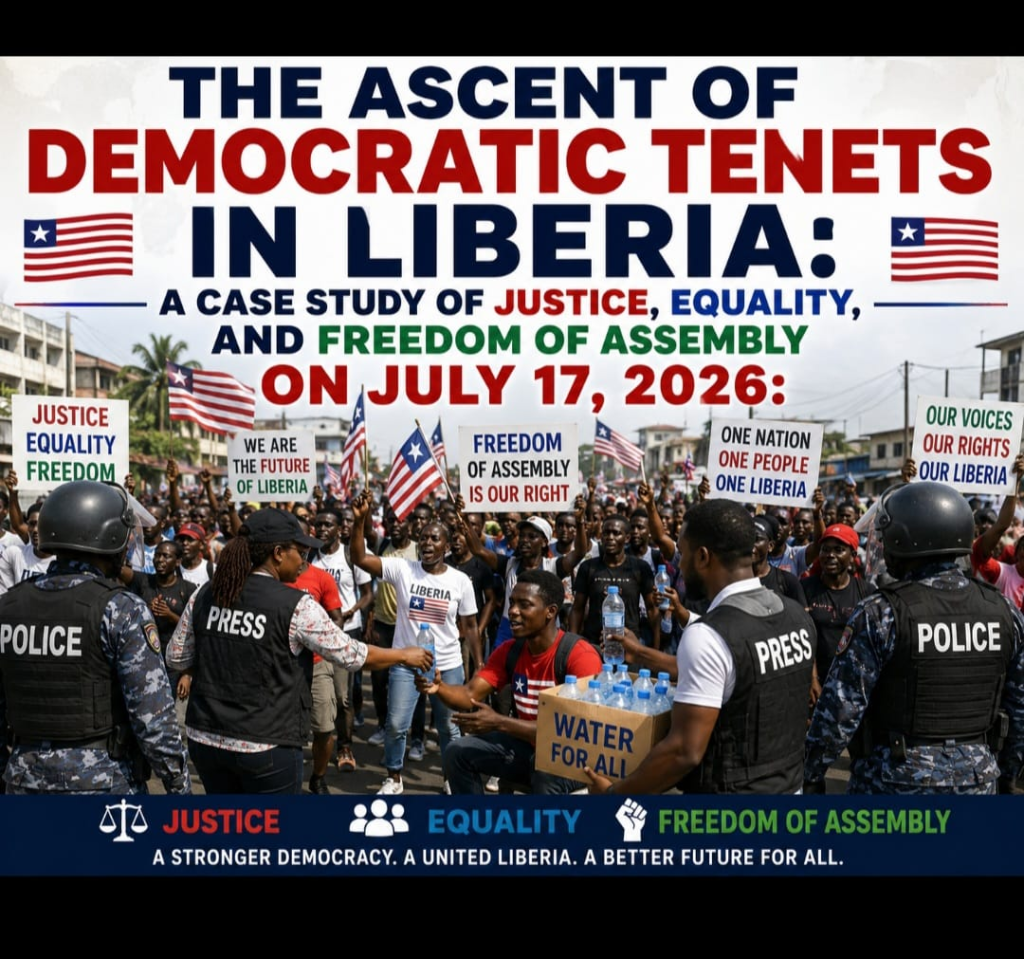
The distribution of water by the state radio station, ELBC staff (Journalists) to demonstrators was a sign that democratic tolerance is at its best in Liberia.
“Think Liberia,Love Liberia,Build Liberia.” – President Joseph Nyuma Boakai, official governing slogan since taking office in 2024. The Executive Mansion
“I believe serving at the highest level is an obligation; it means that through you, others would be blessed.” —President Joseph Nyuma Boakai.
Former President Ellen Johnson Sirleaf: “The size of your dreams must always exceed your current capacity to achieve them.”
“If your dreams do not scare you, they are not big enough.”
“The success of democracy depends upon citizens who are willing to participate and defend it.” (Paraphrased from her numerous democracy speeches; use her published speeches for exact wording).
Former President George Manneh Weah: “The power of the people is stronger than the people in power.” (Frequently cited in his democratic transition remarks). During the 2023 transition, President Weah emphasized respect for the will of the Liberian people by peacefully conceding the election, reinforcing Liberia’s democratic tradition.
Former President of South Africa Nelson Mandela: “To deny people their human rights is to challenge their very humanity.”
“Freedom can never be taken for granted.”
Former UN Secretary-General Kofi Annan: “Good governance is perhaps the single most important factor in eradicating poverty and promoting development.”
“There is no development without security and no security without development.”
Former US President John F. Kennedy: “The rights of every man are diminished when the rights of one man are threatened.”
Former Baptist Minister and Leader of the American Civil Rights Movement,Martin Luther King Jr.:
“Injustice anywhere is a threat to justice everywhere.”
Former US First Lady Eleanor Roosevelt:
“Justice cannot be for one side alone, but must be for both.”
United Nations – Universal Declaration of Human Rights (1948)
Article 20: “Everyone has the right to freedom of peaceful assembly and association.”
By: Austin S Fallah – A True Son of the Planet Earth Soil: [email protected]
As the world enters the latter half of the 21st century, the fight for democracy, justice, and equality remains a significant concern for many nations, particularly those with a tumultuous political history.
Liberia, a country often marked by instability, civil strife, and emerging democratic ideals, stands at a pivotal moment in its history.
On July 17, 2026, Liberia exemplified the convergence of these democratic tenets through the unencumbered exercise of freedom of assembly, embodied by the semblance of peaceful demonstrations permitted by the state.
In this disquisition, I seek to analyze the implications of this event within the broader spectrum of Liberia’s democratic evolution, focusing on the roles played by the Liberian National Police and the legal framework supporting these democratic processes, and drawing parallels to societal values illustrated in the adage about the fly on a cup of coffee versus a bowl of rice.
The Importance of Freedom of Assembly:
The freedom of assembly is a cornerstone of any democratic society, enabling individuals and groups to express their opinions, advocate for justice, and effect change.
On July 17, 2026, Liberia’s government displayed a profound commitment to these democratic values by granting a permit for a demonstration.
This act was more than a formality; it represented a fundamental recognition of the populace’s rights and a commitment to fostering an environment where citizens could freely express their grievances and aspirations.
The ability to protest civilly reflects a society that understands and values the principles of justice and equality.
For Liberia, a nation that has experienced episodes of violence and oppression, this moment marked a significant milestone.
The government’s facilitation of peaceful assembly indicated a shift towards valuing citizens’ input in governance, and a rejection of past practices that stifled dissent and muted voices.
Such a democratic culture must be cultivated over time, with heavy reliance on reinforcing constitutional values and the rule of law.
The Role of the Liberian National Police:
A crucial component of this democratic manifestation was the role of the Liberian National Police (LNP).
Their professionalism and ability to maintain security during that demonstration are commendable.
They played a pivotal role in ensuring that the rights to free assembly were respected and protected without devolving into chaos or violence.
It is essential to recognize that, in a democratic context, the police force must balance the people’s right to protest with the obligation to maintain public order and safety.
Critics often express concern that police intervention during protests might infringe upon constitutional rights.
However, in Liberia’s case, protecting life and property is a fundamental responsibility of the police.
The police were tasked with preventing protesters from entering sensitive government locations, such as the Executive Mansion, the Capitol building, and courthouses.
This measure, rather than being a violation of rights, is akin to a precautionary measure, ensuring the integrity of state institutions while providing the space necessary for citizen expression.
In essence, the LNP’s actions highlighted a nuanced understanding of democratic principles, wherein maintaining order does not equate to oppression.
Current global discourse emphasizes law enforcement’s responsibility to facilitate peaceful expression, as Liberia’s police force did on that significant day, 17 July, 2026.
Thus, the LNP’s professionalism represented a promising step toward solidifying Liberia’s democratic framework.
Justice, Equality, and the Societal Parable:
The proverb regarding the fly on a cup of coffee versus a bowl of rice offers a profound metaphor for understanding societal values and individual agency within Liberia’s democratic landscape.
The notion that a fly’s presence in coffee requires discarding the entire drink, whereas in rice it can be removed, serves as a powerful commentary on how society perceives value and worth.
In a functioning democracy, the value of each citizen is paramount.
Those who understand their worth in society, much like a bowl of rice that maintains its integrity despite a fly, become resilient agents of change.
They refuse to be easily influenced or misled by hooligans and destructive individuals, engaging in the democratic process with an acute awareness of their rights and responsibilities.
Conversely, individuals who lack this understanding risk being discarded like the coffee, drowned out by the cacophony of societal woes and unrecognized potential.
As Liberia embraces democracy, it is crucial to elevate the value of each citizen’s voice.
Through civic education and active participation in the political landscape, the populace can learn the importance of their contribution to democracy.
The citizenry needs to understand that their participation in governance, advocacy, and assembly is not only a right but also a civic duty that fortifies the nation’s social fabric.
Constitutional Safeguards for Democracy:
Liberia’s constitutional framework serves as the legal backbone for protecting democratic rights and freedoms.
The Constitution enshrines fundamental rights, including freedom of speech, assembly, and equal protection under the law.
However, the implementation of these rights depends largely on the society’s commitment to uphold them and the government’s willingness to enforce them without bias.
Given Liberia’s historical challenges, notably the echoes of civil war and dictatorship, the restoration of democratic norms also requires continuous vigilance from citizens and positive civil society.
Active engagement and accountability are necessary to ensure that the principles of justice and equality are not merely words inscribed in the Constitution but are actively practiced and defended in daily life.
Democracy is not static; it requires active cultivation. For Liberia, the developments on July 17, 2026, signify a forward trajectory.
However, this event must catalyze ongoing conversations about justice, equality, and citizens’ roles in governance.
The Path Forward:
Liberia’s journey towards fully realizing its democratic potential will undoubtedly be filled with challenges and triumphs.
The events of July 17, 2026, provide a foundational moment for citizens to reflect on their roles within this nascent democratic society.
As individuals elevate their understanding of their worth, engage in dialogue, and advocate for justice rather than hooliganism and good-for-nothing, empty tautologies, they contribute to a vibrant civic culture that enables democracy to flourish.
The police and state security forces must continue to prioritize their role in supporting democratic processes while standing firm against those seeking to undermine them.
Moreover, reform within these institutions to ensure professionalism and accountability is critical to preserving public trust.
Liberia’s future hinges upon its commitment to, and citizen engagement with, the tenets of democracy through justice and equality, with non-violent freedom of assembly serving as a crucial outlet for citizen engagement.
By fostering an environment where individuals can peacefully express their dissent and support government initiatives, Liberia can embody the true spirit of democracy.
The reflection of societal values within the metaphor about the fly reminds us of the necessity for individuals to recognize their worth and potential.
In this way, the collective advancement of democracy ensures that Liberia remains steadfast in its dedication to jjustice equality, and the flourishing of its people in the second half of the 21st century.
Support Independent Journalism
Your support helps FrontPage Africa continue delivering independent, credible, and impactful journalism. Every contribution strengthens our ability to investigate, inform, and hold power accountable while keeping quality journalism accessible to our readers.
Support our journalism or subscribe to receive the latest FrontPage Africa stories and updates.