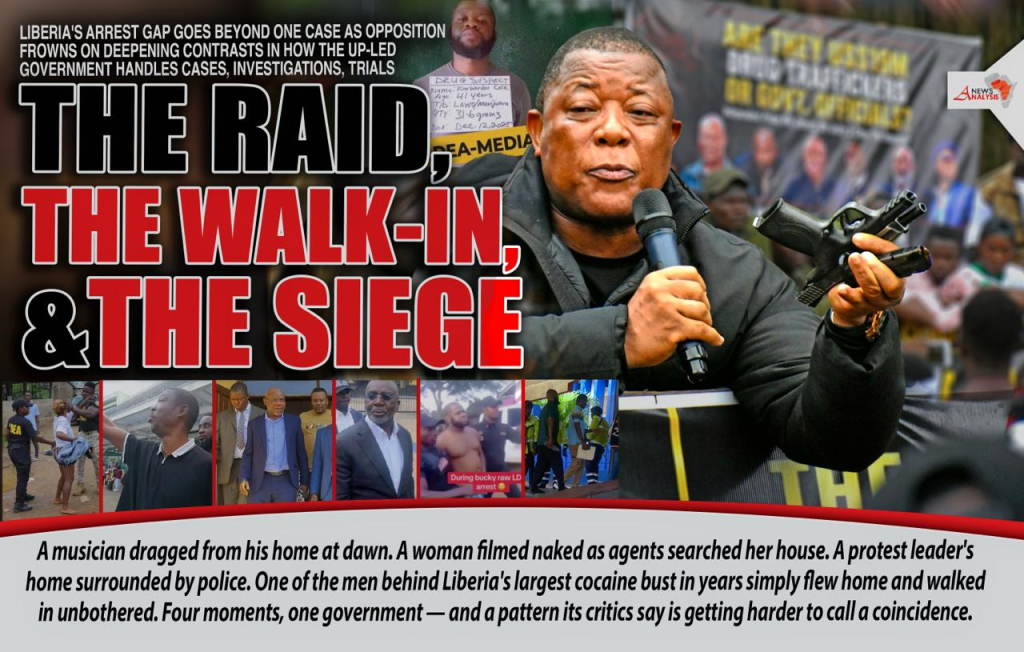
Monrovia — At dawn on a Friday in December, officers of the Liberia Drug Enforcement Agency forced their way into a house on Duport Road. A Facebook Live stream, shot by someone inside, caught the whole thing: raised voices in English and Gio, agents pushing past residents who tried to block the door, and then the hipco and trapco artist Karwoudou Cole — known across Monrovia’s youth scene as Bucky Raw — on his knees on the floor, untying black plastic bags stuffed with cash while officers stood over him demanding explanations. A second bag held what agents said was marijuana. By the time the clip had circulated through the city, Bucky Raw was already in custody, and by Monday, fans and family were chanting “Free Bucky” outside the Paynesville Magisterial Court.
By Rodney D. Sieh, [email protected]
Seven months later and a few miles away, a very different kind of arrest was unfolding — or rather, refusing to. Paul J. King, operations manager of Global Logistics Services and the central suspect in the largest cocaine bust in Liberia’s recent history, simply flew home. He walked off a plane at Roberts International Airport and surrendered. There was no raid, no livestream, no crowd. When police finally did face the cameras to announce his arrest, reporters had been camped outside Liberia National Police headquarters for most of a day, watching a promised briefing slide from hour to hour, before Inspector General Gregory Coleman took the podium at eight that evening — a full day after he’d told the Senate, under sharp questioning about why no one had been arrested in the US$19 million case, that action was coming.
Then came a viral video showing LDEA officers breaking into a residence during a drug operation and filming a naked female occupant. The footage, alongside an earlier case of a female suspect being assaulted in custody, drew widespread condemnation from civil rights groups. Women’s rights organizations, including the Women NGOs Secretariat of Liberia (WONGOSOL), condemned the LDEA’s actions as a degrading, inhumane, and unacceptable violation of a citizen’s dignity and privacy. Embarrassed, the LDEA reaffirmed a zero-tolerance policy for abuse of authority and confirmed that over 110 officers are undergoing intensive training to improve professionalism and accountability.
Two arrests. Two suspects accused of serious crimes, treated in visibly different ways. And now a raid that never touched a suspect at all, but still left a citizen humiliated on camera. Three episodes, one deepening question about how this government decides who gets a hard hand and who gets a quiet one.
A pattern, or a coincidence?
It’s the kind of contrast that’s hard to unsee once it’s pointed out, and Liberia’s opposition and civil society critics have been pointing it out loudly. The country is still working through the fallout of the RIA seizure — 237.6 kilograms of cocaine, valued at more than US$19 million, intercepted at the airport in early July. Nearly all of the principal suspects, including the man authorities allege orchestrated the scheme, fled the country before warrants could be executed against them. Opposition leader Alexander Cummings has called the investigation “secretive, slow, and seemingly compromised.” Senator Edwin Snowe has alleged that members of President Joseph Boakai’s own family occupied office space in the building linked to the bust. Former President George Weah went furthest, warning that Liberia risks becoming a “narco state” and accusing the government of shielding people connected to the case.
Against that backdrop, every other arrest the Boakai administration makes gets read through the same lens.
Take Mulbah Morlu, chairman of the civil-society group STAND, who organized the July 17 “Boakai Must Lead or Leave” protest on Capitol Hill — itself a demonstration explicitly about the government’s unresolved handling of the drug case. Morlu says protesters detained an armed man sent to disrupt the march and recovered a firearm from him. Inspector General Coleman tells a different story: that the weapon was a government-issued pistol stolen from a police officer assaulted earlier that day, and that Morlu now has it. Within hours, the LNP had declared Morlu “armed and dangerous,” instructed officers not to approach him alone, and by Saturday morning had surrounded his residence — timed just ahead of a scheduled court appearance where Morlu says he intended to hand the weapon over publicly, in front of witnesses. Morlu didn’t hold back in response, accusing Coleman of using the machinery of state security to intimidate a political opponent while dragging his feet on suspects with money and connections.
For Morlu, the treatment meted against him by the police is pure hypocrisy. “The Boakai administration rushed to deploy dozens of armed police around my home and falsely branded me “armed and dangerous” for confiscating a weapon from an intruder who could have disrupted a peaceful protest and put citizens lives at risk. Yet those linked to the US$19 million cocaine scandal have not faced the same force directed at me, Bucky Raw, or ordinary citizens. If this government can mobilize such excessive force against its critics overnight, it must hit the cocaine cartel ten times harder. No sacred cows. July 17 was not the end, but the beginning of resistance, and this movement will not rest until the cocaine cartel falls.”
There’s an echo here of an older grievance, too. Former Finance Minister Samuel Tweah, acquitted in May of charges tied to an alleged $6.2 million scheme, has since written to the UN Secretary-General, the EU, ECOWAS, and members of the U.S. Congress, alleging that the government’s continued efforts to challenge his acquittal are part of a broader pattern — one that also touches the pretrial detention of former House Speaker Jonathan Fonati Koffa on arson and conspiracy charges tied to the 2024 Capitol fire, a case the opposition CDC has branded a matter of “political prisoners.”
That grievance sharpened considerably Sunday, when Tweah said Vice President Jeremiah Koung had personally instructed Judge Ousmane Feika to overturn his acquittal on grounds of “jury misconduct” — despite what Tweah described as the judge’s own finding of no evidence linking him or his lawyers to any wrongdoing. In a lengthy statement posted to Facebook, Tweah said the matter had deadlocked the government for weeks, with figures inside the administration and on the Supreme Court bench warning that overturning a jury verdict — particularly so soon after Abdullah Kamara’s own unanimous acquittal — would amount to “witch hunting and cherry picking in corruption cases.” Tweah quoted Koung as replying that winning the next election mattered more to the government than protecting the rule of law. He said the final decision was passed to Feika last Thursday following a national security assessment, with a ruling expected Monday. Tweah maintained the outcome wouldn’t change his own status — nine jurors, he said, had already made him “a free man” — and vowed to “submit to no bogus political trial” if Feika ruled against him. Neither Koung’s office nor the judiciary had responded to the allegation by press time.
The government’s answer
None of this, officials would say, adds up to a policy. The manner of an arrest, in their telling, follows the suspect’s own conduct — flight risk, resistance, the need to secure evidence before it disappears — not who they’re friendly with. King’s arrest didn’t need a raid because he chose to surrender. Morlu’s home was surrounded, by that logic, because police believed a stolen firearm was in play, not because he organized a protest. The Unity Party has publicly insisted there will be “no sacred cows” in the drug probe, regardless of political affiliation, and credits its own security institutions for making the original seizure in the first place.
It’s a coherent defense, on its own terms. It’s also one that critics find increasingly hard to credit, precisely because it has to be repeated so often, in response to so many separate cases, each time framed as an unfortunate coincidence rather than a pattern. Representative Taa Wongbe put the skeptics’ version of the argument bluntly: had the cocaine case implicated the opposition instead of unnamed, well-connected figures, he said, “we would see faces scattered across every front page.”
What isn’t proven
It’s worth being honest about the limits of what’s actually been established. No one has produced hard evidence that arrest tactics are being ordered from the presidency, or that the manner of King’s low-drama surrender was choreographed rather than simply how he chose to come home. The Bucky Raw raid may well reflect standard LDEA procedure for suspected drug offenses — non-bailable under Liberian law, executed under what officers say was a court-sanctioned warrant — rather than any particular animus toward him, though his history as a vocal critic of the drug crisis and past deportation from the U.S. have fed speculation regardless. The Morlu standoff was still unresolved at press time. What’s demonstrable is the optics gap itself: a visibly rougher hand for a musician, a protest leader, and a woman searched in her own home than for the operations manager at the center of a $19 million trafficking case. What that gap means — bias, bureaucratic reality, or something in between — is the argument Liberia is now having with itself.
What to watch
The next few weeks, not the next press conference, will decide who’s right. If the warrants against the fled drug suspects are finally executed, if the courts hold the line on Tweah’s acquittal, if Morlu walks into court and walks back out a free man — the government’s “equal treatment” defense stands. If any one of those quietly stalls instead, the “double standard” charge stops being an accusation and starts looking like a diagnosis. Liberia isn’t waiting on more statements. It’s waiting to see who the state reaches for next, and how.
Support Independent Journalism
Your support helps FrontPage Africa continue delivering independent, credible, and impactful journalism. Every contribution strengthens our ability to investigate, inform, and hold power accountable while keeping quality journalism accessible to our readers.
Support our journalism or subscribe to receive the latest FrontPage Africa stories and updates.