The greatest realization any human being can have is that no matter how far one travels, it is a responsibility to look back at the place where one first began to bloom into prominence.
By Azaiouris Y. Zeon
In the contemporary landscape of Liberian literature, there have been very few writers in exile who have intentionally returned, physically or intellectually, to invest in the struggling yet hopeful community of young and emerging writers back home.
Among such figures are Dr. Patricia Jabbeh Wesley, through the Young Scholars of Liberia Literary Program; Jeremy Teddy Karn, through Pepper Coast Magazine and the Pepper Coast Library Project; and Vamba Sherif, through Writing Destiny. These individuals have shared their victories, knowledge, and generosity with those of us still finding our literary footing.
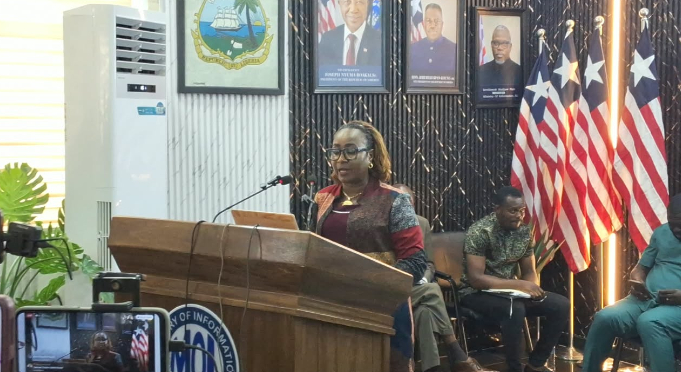
On January 25, 2026 at about 9:00 PM Liberian time, Vamba Sherif arrived in Liberia from the Netherlands via Roberts International Airport. He announced his arrival in our WhatsApp chatroom—a small circle of selected young and emerging Liberian writers who had waited weeks to welcome him and attend his workshop along UN Drive at Forte and Kpoto Bookstore in Monrovia.
I was overwhelmed with joy. Someone so acclaimed and admirable, whom I had watched and studied across social media, was coming before my very eyes, not merely as a celebrated writer, but as a teacher and literary icon.
In an interview with Nathalie Carré (Borderland, 2012), Sherif revealed that he was born in northern Liberia, in Kolahun, Lofa County. He spent much of his youth as a refugee across Kuwait, where he completed secondary school, then Syria, and eventually the Netherlands.
He fled Kuwait during the First Gulf War, settled briefly in Syria, and later relocated to the Netherlands, where he pursued a law degree and began cultivating his literary talent. Today, Sherif serves as a lecturer in African literature, postcolonial theory, and literary criticism at Leiden University (Guernica Magazine, 2025).
He has also contributed journalistic work to The New York Times, the French magazine Long Cours (a subsidiary of L’Express), the German publication Kultur Austausch, and Dutch newspapers such as Trouw, De Volkskrant, and OneWorld.
“I’m attached to this city because it has made me who I am.”
—Orhan Pamuk, Istanbul: Memories & the City
The workshop itself felt like a provocative sermon, an awakening. It generated a new layer of consciousness about the urgency and peculiarity of writing in this contemporary dispensation. It was both an evangelism and a reimagining of Liberian literature through a practical and communal lens.
Sherif emphasized that the strength and endurance of literature across regions depend on the interaction between writers and readers. Stability and muscularity in literature are sustained by the community. And this insight forced a long and necessary reflection: what do we lack in contemporary Liberian literature? An active literary community.
We do not lack the ability to curate one. Perhaps we have yet to discover the power, urgency, and beauty of community as a storytelling mechanism. Or perhaps we understand its power, but our literary vision remains superficial.
It may also be that we lack capital, human, intellectual, media, financial, to build such structures. But that conversation deserves its own space. At the workshop, Sherif reached into my soul. He shared that his first novel, The Land of My Fathers, written at age twenty-five while he was a third-year law student, was a direct correction of historical misconceptions propagated by Western narratives about Black people like himself. His work, he explained, consistently seeks to correct distortions of history. And in that same spirit, he sought to correct our knowledge, our discipline, and our understanding of the writing process.
He spoke in questions, provocative, unsettling questions. What does it mean to write? What does it mean to live as a writer? What does responsibility look like on the page? His rhetorical style forced introspection. It unsettled me in the best way possible—causing me to reassess my craft, my thinking, and even my living.
Language carries vibration. It anchors you and sets you into oscillation at once. Sherif’s voice, as he read from his works, possessed an immense musicality that resonated deeply within the eardrum. It reminded me of Yusef Komunyakaa reading “Ode to the Drum” that sacred rhythm produced from the human voice, where poetry becomes percussion.
Sherif encouraged us to read widely and rigorously. He introduced us to writers whose works unsettle and clarify: Gabriel García Márquez, master of magical realism and author of One Hundred Years of Solitude; Ernest Hemingway, the American novelist known for his precision and restraint; Orhan Pamuk, the 2006 Nobel Laureate in Literature; and many others. His advice was simple and emphatic:
“Read, read, read, read.”
There is no better path to becoming a good writer than spending time in the company of other good writers.
This reflection would be incomplete without gratitude. On behalf of the young and emerging Liberian writers who gathered in that room, I extend my deepest appreciation to Vamba Sherif for sharing his gift, his grit, and his generosity. He challenged us not merely to write, but to study, to question, and to engage the world critically with the powerful instrument in our hands: the pen.
Now is the moment to think beyond ourselves, to mobilize and cultivate stronger literary communities that will outlive those fading into age. Now is the time to reimagine the urgency and purpose of literature in Liberian
society and to explore how it can advance human capital development in our nation.
NOW is the time!
Support Independent Journalism
Your support helps FrontPage Africa continue delivering independent, credible, and impactful journalism. Every contribution strengthens our ability to investigate, inform, and hold power accountable while keeping quality journalism accessible to our readers.
Support our journalism or subscribe to receive the latest FrontPage Africa stories and updates.