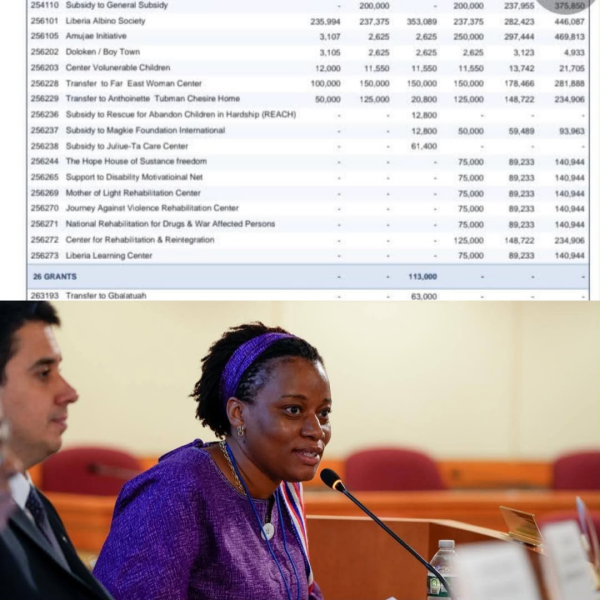
MONROVIA — While women-led organizations across Liberia struggle to secure funding to sustain programs supporting survivors of gender-based violence, empowering rural women, and advancing gender equality, concerns are mounting over the government’s reported allocation of
By Patience M. Jones,[email protected]
US$250,000 in public funds to the Amujae Initiative associated with former President Ellen Johnson -Sirleaf.
The funding decision has sparked questions about the government’s priorities and whether sufficient consideration is being given to local women’s rights organizations that work directly with vulnerable women and girls but continue to face financial challenges.
Among the organizations whose work highlights the importance of sustained investment in the women’s movement is the Women NGOs Secretariat of Liberia (WONGOSOL), a national network of women-led organizations that has continued to advance women’s economic empowerment, gender equality, advocacy, and community-based development.
Through its Liberia Fight FGM Project, supported by the United Nations Trust Fund to End Violence Against Women, WONGOSOL has implemented interventions across Bomi, Bong, Gbarpolu, Grand Cape Mount, Margibi, and Montserrado Counties.
The initiative has supported 365 women through vocational skills development, business management training, and Village Savings and Loan Association (VSLA) initiatives.
Its livelihood interventions have also included the provision of agricultural materials and tools to women engaged in farming, particularly survivors in Bong County, alongside support for soap-making, tailoring, and baking businesses.
Beyond economic empowerment, WONGOSOL continues to advocate for women’s access to land, agricultural resources, finance, markets, and technology, while promoting women’s leadership in climate justice, environmental protection and sustainable livelihoods.
These interventions reflect the work of women’s organizations across Liberia that continue to engage communities, support survivors, advocate for policy reforms, and create opportunities for women and girls despite persistent funding constraints.
Yet, questions remain about why organizations carrying out such grassroots interventions continue to struggle for financial support while public resources are reportedly being directed toward an initiative associated with a former head of state.
‘Why Are Taxpayers Funding the Amujae Initiative?’
Raising concerns about the allocation, Madam Fenny Louise Taylor-Diggs, Program Manager at Medica Liberia, questioned why taxpayers’ money was being committed to the Amujae Initiative while women’s rights organizations continue to struggle to finance their operations.
In a statement shared on her Facebook account, Taylor-Diggs challenged the government’s decision to allocate US$250,000 to the initiative, questioning its demonstrated impact on the lives of Liberian women and the justification for prioritizing it over organizations working directly with women and girls.
She argued that women’s rights organizations are at the forefront of preventing and responding to sexual and gender-based violence (SGBV), advocating for women’s rights, and promoting gender equality, yet many continue to face difficulties securing the resources necessary to sustain their work.
Taylor-Diggs described the allocation as a misplacement of public priorities, questioning whether an initiative associated with a former president should receive government funding when grassroots women’s organizations are struggling to maintain essential services.
She also questioned whether the Amujae Initiative, which is associated with former President Sirleaf, should be financed through taxpayers’ money or through private fundraising and other independent funding arrangements.
Her concerns extend beyond the amount allocated to the broader issue of accountability in public spending, particularly when government resources are limited and several organizations working on critical social issues remain financially constrained.
Taylor-Diggs further questioned what measurable public benefits taxpayers would receive from the expenditure and whether the initiative should be treated as a government program deserving priority in the national budget or as a leadership initiative that should independently mobilize resources.
The Struggle Behind Women’s Rights Advocacy
For organizations such as WONGOSOL and other women’s rights groups, securing funding is not simply an administrative challenge. It directly affects their ability to reach vulnerable communities, support survivors, sustain livelihood programs, and continue advocating for policies that protect women’s rights.
Their work often extends to communities where women face economic exclusion, limited access to education, gender-based violence, harmful traditional practices and inadequate opportunities to participate in decision-making.
Without consistent financial support, sustaining these interventions becomes increasingly difficult, particularly for organizations that depend on development partners and project-based funding.
The concerns raised by Taylor-Diggs therefore bring renewed attention to the relationship between government budget priorities and the sustainability of Liberia’s women’s rights movement.
While investing in women’s leadership and advancing women’s participation in governance remain important national objectives, questions are being raised about how public resources are distributed and whether grassroots organizations receive adequate consideration.
The debate also raises an important question about the government’s commitment to strengthening institutions and organizations that have spent years working to advance women’s rights across the country.
A Question of Public Accountability
At the heart of the controversy is not whether women’s leadership deserves investment, but whether public funding decisions sufficiently consider the organizations and communities that depend on sustained interventions.
Taylor-Diggs is calling for greater scrutiny of the US$250,000 allocation, particularly regarding the initiative’s public value, measurable outcomes, and justification for receiving taxpayers’ money.
Her concerns underscore a broader challenge facing Liberia’s women’s movement: ensuring that government commitments to gender equality are reflected not only in policy statements and national strategies but also in budgetary allocations that support the organizations doing the work.
As Liberia continues to pursue women’s empowerment, the question remains whether public investment will adequately reach grassroots organizations supporting women and girls or whether those organizations will continue to depend on uncertain funding while struggling to sustain their programs.
For the women whose livelihoods, safety, economic independence, and access to justice depend on these interventions, the funding debate is more than a disagreement over a budget allocation. It is a question of whether the work being done in their communities will have the resources to continue.
Support Independent Journalism
Your support helps FrontPage Africa continue delivering independent, credible, and impactful journalism. Every contribution strengthens our ability to investigate, inform, and hold power accountable while keeping quality journalism accessible to our readers.
Support our journalism or subscribe to receive the latest FrontPage Africa stories and updates.