GREENVILLE, Sinoe County — The administration of the Sinoe County Community College (SCC) says enrollment has grown from just 35 students in late 2022 to more than 300, but the institution continues to face serious space, staffing and funding constraints as it seeks to expand into a full bachelor’s-degree-granting college.
By Franklin Doloquee
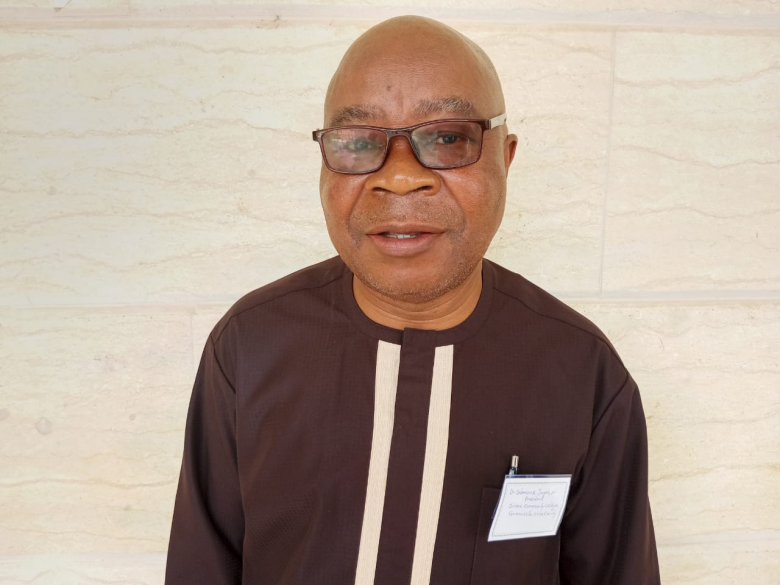
Dr. Solomon K. Jarpah Sr., President of the College, made the disclosure during an interview with FrontPageAfrica recently.
He said the rapid increase in enrollment reflects an aggressive recruitment campaign that took college officials into high schools, communities and districts across Sinoe County.
The growth, he said, is encouraging, but it has also exposed the college’s limited infrastructure and the urgent need for sustained investment in classrooms, qualified faculty and academic programs.
Growing Student Population
Dr. Jarpah said that when he assumed leadership of the institution two years ago, student enrollment stood at only 35 students during the latter part of 2022.
He attributed the low figure to limited awareness about the college, dissatisfaction with conditions at the institution and competing economic opportunities for young people.
“Most of them are involved with gold-mining activities,” he said. “When they graduate from high school, they either go to the gold-mining camp or they ride motorbike. So, there is low interest when it comes to students having the desire to pursue higher education.”
To reverse the trend, Dr. Jarpah said he personally visited high schools in Greenville and surrounding districts, sought permission from school administrators and spoke directly with students and parents.
The college also extended its outreach beyond Greenville to communities where high schools are located.
The strategy has yielded results. The college now has more than 300 students, according to Dr. Jarpah, who said the number should be even higher given the number of high schools in Greenville expected to feed the institution.
The college’s outreach drive has previously included visits to schools such as St. Paul Episcopal Parish High School, St. Joseph Catholic High School, Grary Hall Christian High School and Seebeh High School.
During those engagements, the administration promoted free tuition and SCC’s position as Sinoe County’s only higher-learning institution.
For many students in Sinoe County, the college represents one of the few opportunities to pursue post-secondary education without traveling to Monrovia or other parts of Liberia.
Its expansion is, therefore, seen by local education advocates as important not only for individual students, but also for the county’s long-term human-resource development.
Space Remains a Major Challenge
Despite the enrollment increase, Dr. Jarpah mentioned that the college is struggling with inadequate classroom space.
The institution currently operates from a building provided by Senator Chea, which contains eight classrooms.
The administration has also constructed a makeshift structure to create additional classroom space.
“We are challenged with space because the students are increasing,” he said.
He also disclosed that Vice President Jeremiah Koung has promised to construct a 10-classroom building for the college.
Dr. Jarpah said brick-molding for the project is ongoing and near completion.
“If it is completed, it will be a great help,” he said. “It will relieve us of the burden of not having space.”
‘‘The need for a permanent campus has also drawn legislative attention. The House of Representatives has been considering a proposal to increase the college’s 2027 budget to US$1.2 million to support construction of its own campus and improve learning conditions. The college has operated from the Sinoe Multilateral High School building since admitting its first students in 2017.’’
A permanent campus, administrators say, would allow the college to expand its classrooms, laboratories, administrative offices, library facilities, and student-support services.
It would also reduce the pressure on facilities currently shared with the high school.
Cordial Relationship With Lawmakers
Dr. Jarpah described the college’s relationship with the Sinoe County Legislative Caucus as cordial and productive.
“We are moving along. We have discussions, and whenever we have problems, we go to them to see how they can help us, especially by pushing our case when it comes to the budget,” he said.
He said the caucus has been supportive in advocating for increased budgetary allocation, particularly as the college seeks to construct additional facilities and improve the learning environment.
The college was established by an Act of the Legislature in 2015 and began admitting students in 2017.
It has since produced graduates serving in schools, government institutions, financial establishments, and other sectors across Liberia.
Lawmakers’ support, according to the college administration, will be critical as SCC seeks to move from a small community college into an institution capable of offering more advanced academic programs.
Diaspora Engagement
Beyond government support, the SCC administration is also reaching out to Sinoeans living abroad.
Dr. Jarpah said he traveled to the United States in July and August, where he met with the leadership of Sinoe citizens in the U.S. and presented the college’s needs.
“They promised that they will do whatever in their power to see how they can help the college,” he said.
He said diaspora support could be critical in addressing gaps in infrastructure, learning materials, faculty development, scholarships, and technology.
The administration believes that Sinoeans in the diaspora can play an important role in strengthening the institution through financial contributions, professional mentorship, and partnerships with universities abroad.
Push for Bachelor’s-Level Programs
A central priority for the administration is elevating the college from its current associate-degree level to a bachelor’s-degree-granting institution.
Dr. Jarpah argued that students should not have to leave Sinoe County after earning an Associate of Arts degree in order to complete a bachelor’s program elsewhere.
“Right now, it is on an A.A. level,” he said. “But what good will it do when a student graduates with an A.A. degree and they have to go elsewhere to get their full bachelor’s degree.”
To achieve that goal, he said the college urgently needs more faculty members holding master’s degrees. According to Dr. Jarpah, most of the current teaching staff hold bachelor’s degrees, a situation he said limits the institution’s ability to expand its academic offerings.
“We want to elevate the school to a bachelor’s level, and the only way we can do that is we need more master’s degree holders,” he said.
The college currently offers associate degrees in Business and Public Administration and General Education. Public Health and Nursing programs have been planned, but were not yet fully operational during earlier outreach efforts.
Expanding into bachelor’s-level education would require not only more qualified lecturers, but also stronger curriculum development, improved libraries and laboratories, better internet access, and sustained funding. Education officials have previously noted that Liberia’s higher-education system includes associate, bachelor’s, and master’s degree levels, with associate programs generally lasting two years.
Appeal for Investment
Dr. Jarpah concluded by appealing to the national government, through the Legislature, to increase the college’s budget so it can build more facilities that enhance learning.
He also encouraged Sinoeans residing in Monrovia and elsewhere to return home and contribute to the development of the college.
“We are looking for master’s degree holders,” he said. “We want to increase and elevate the institution.”
As enrollment continues to climb, Dr. Jarpah said sustained investment in classrooms, qualified faculty and degree programs will determine whether the Sinoe Community College can become a stronger center of higher education for young people in southeastern Liberia.
For now, the college’s growing student population is a sign of progress. But administrators warn that without adequate space, funding and academic capacity, the institution may struggle to meet the expectations of the very students it has worked so hard to attract.
Support Independent Journalism
Your support helps FrontPage Africa continue delivering independent, credible, and impactful journalism. Every contribution strengthens our ability to investigate, inform, and hold power accountable while keeping quality journalism accessible to our readers.
Support our journalism or subscribe to receive the latest FrontPage Africa stories and updates.