Monrovia — Gbarpolu County Senator Amara Konneh has urged the Ministry of Justice and security authorities to publicly release documentary evidence surrounding the procurement and assignment of a fleet of vehicles to the Liberia National Police, warning that transparency is essential to protecting the government’s credibility amid allegations linked to Liberia’s ongoing drug investigation.
By Gerald C. Koinyeneh, [email protected]
Senator Konneh, Chairman of the Senate Public Accounts Committee, said authorities should not rely solely on verbal denials to counter allegations made by activist Martin K. N. Kollie concerning the source of vehicles being used by senior security and government officials.
Instead, he called for the publication of the complete “paper trails” showing how the vehicles were procured, paid for, registered and assigned.
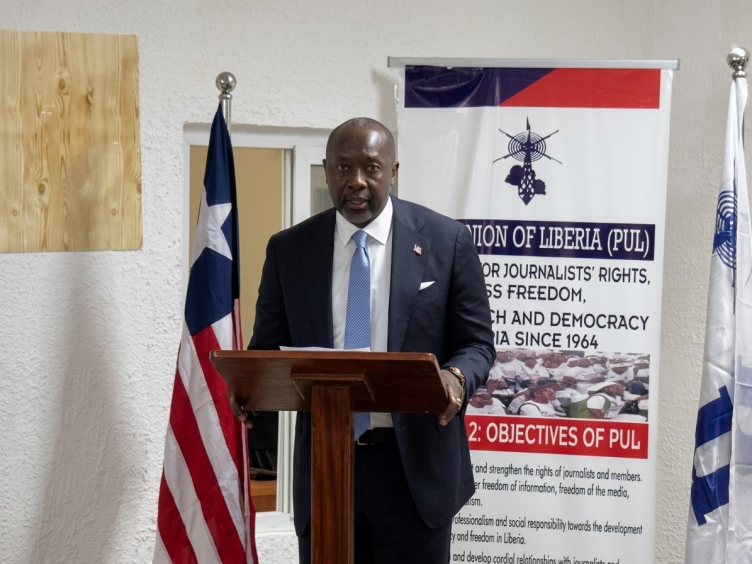
The senator made the remarks at the Edward Wilmot Blyden Intellectual Forum, organized by the Press Union of Liberia, where he addressed emerging public financial-management concerns and the broader implications of the country’s escalating drug-trafficking investigation.
Kollie recently alleged that Police Inspector General Gregory Coleman received money from drug cartels and used the funds to procure vehicles for the police, including a vehicle allegedly given to Justice Minister Cllr. N. Oswald Tweh.
The Ministry of Justice has categorically rejected the allegation, describing it as false and unsupported by facts.
According to the ministry, it formally requested a suitable official vehicle for the Justice Minister from the Inspector General of Police on November 10, 2025, because the ministry had no budgetary allocation at the time to purchase a new vehicle.
The ministry said the Liberia National Police subsequently assigned a white Toyota Land Cruiser Prado, identified as GSA-LNP-03-14, from a fleet procured by the Government of Liberia from Dutch Health BV for the police.
The ministry said the broader procurement, valued at approximately US$1.5 million, included pickups, jeeps, motorcycles and ambulances, with ten Toyota Land Cruiser Prado vehicles among the jeeps.
It maintained that the vehicle assigned to Minister Tweh is government property, purchased with government funds and assigned for official use—not a personal gift from the Inspector General, a drug cartel, a private individual or a criminal suspect.
But Senator Konneh said the government could easily settle the controversy by producing the records supporting its explanation.
“The one good solution in this matter is for the task force to publish in one press package” the relevant procurement and financial documents, he said.
He specifically pointed to the Public Procurement and Concessions Commission (PPCC) approval process, General Services Agency (GSA) asset-registration records and Ministry of Finance voucher-payment records as documents that could establish the origin and ownership of the vehicles.
Konneh also referenced Section 40 of Liberia’s Public Financial Management Law, which requires government agencies to submit annual procurement plans and subject procurement activities to the applicable approval process.
As Chairman of the Senate Public Accounts Committee, he said security officials facing allegations should voluntarily make the records available as a means of putting the controversy beyond dispute.
“I encourage our colleagues in the security sector who have been accused to show these documents as a bulletproof,” Konneh said.
The senator emphasized that he was not declaring the allegations against the police or government officials to be true, stressing that the claims “may be false.”
But he warned that in a high-profile drug case, perception itself can undermine the government’s position, particularly when the country is under scrutiny over its handling of allegations of transnational narcotics trafficking.
“In a drug case such as this, perception is dangerous for a successful outcome,” Konneh cautioned.
He said authorities should understand that information appearing in local and social media can eventually become part of the evidentiary trail used by foreign governments and international institutions when assessing cases, sanctions or broader security concerns.
“Most of the evidence comes from the local media and social media that people go there and gather their evidence,” he said.
For Konneh, therefore, dismissing the controversy as a minor social-media dispute could prove costly.
“You may be investigating and thinking that this is a minor issue,” he warned, “but this issue, if we don’t confront it right now and be brave and publish any documents that we have relating to these police vehicles, it will be a problem for us.”
Konneh’s intervention comes as the Liberian government faces mounting scrutiny over the investigation into massive cocaine seizures and allegations of possible links between narcotics networks and individuals within or around the country’s security and political establishment.
The Ministry of Justice has defended its handling of the investigation and said its focus remains on combating illicit drugs and dismantling criminal networks operating in Liberia.
The ministry has also urged the public to exercise caution in treating social-media allegations as established facts, arguing that information from unnamed sources may be incomplete, inaccurate or deliberately misleading.
But Senator Konneh’s position is that documentary transparency can resolve the dispute more effectively than competing public statements.
He said releasing the procurement records would help authorities “bulletproof” their position and demonstrate that public resources, rather than illicit funds, were used to acquire the vehicles.
“We want our government to win this case,” Konneh said.
For the senator, the issue is bigger than the ownership of a single official vehicle. He argues that producing the procurement and financial records now could help protect Liberia’s credibility, strengthen the government’s drug-trafficking case and prevent questions over the vehicles from becoming a vulnerability in future legal or international proceedings
Support Independent Journalism
Your support helps FrontPage Africa continue delivering independent, credible, and impactful journalism. Every contribution strengthens our ability to investigate, inform, and hold power accountable while keeping quality journalism accessible to our readers.
Support our journalism or subscribe to receive the latest FrontPage Africa stories and updates.