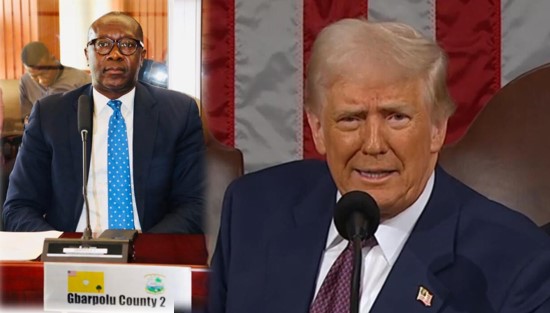
Monrovia – Senator Amara Konneh has pushed back against remarks made by U.S. President Donald Trump during his State of the Union address, calling on the American leader and billionaire Elon Musk to stop portraying Liberia in a negative light.
By Gerald C. Koinyeneh [email protected]
Following President Trump’s address to Congress on Tuesday, Senator Konneh—who previously served as Liberia’s Minister of Planning and Economic Affairs and later as Minister of Finance and Development Planning—took to his Facebook page to express his concerns. He criticized the way Liberia has been singled out in Trump and Musk’s narratives about alleged corruption in the United States Agency for International Development (USAID).
Senator Konneh’s Response
In his statement, Senator Konneh noted that Liberia has been placed at the center of a debate fueled by President Trump and Musk regarding USAID’s role. He referenced Trump’s remarks in Congress, where the U.S. President highlighted the $1.5 million USAID spent on election monitoring in Liberia.
“As a government official watching from my home in Monrovia, his statement compounded the concern and disappointment I had already felt at how our nation has been portrayed in various social media posts from Trump and Musk,” Konneh wrote.
He explained that before Trump’s speech, both the former U.S. President and Musk had questioned USAID’s expenditure of $17 million and $1.5 million in Liberia. Their aim, he claimed, was to highlight corruption within USAID—alleging that American firms benefiting from these funds were making kickbacks to politically connected individuals in the U.S.—to justify Trump’s push to dismantle the agency.
Konneh emphasized that these funds do not go directly to the Liberian government but are instead routed through American contractors and organizations.
“U.S. funding in Liberia DOES NOT flow through our national budget. Rather, it is often channeled through companies based in Washington, D.C., Virginia, or Maryland, many of which directly implement various programs through their offices here in Liberia,” he wrote.
A Call for Balanced Representation
Reflecting on his tenure in the executive branch, Konneh recalled efforts to advocate for a more integrated approach to development assistance. His team pushed for USAID and other international partners to allow Liberians to implement these projects instead of relying heavily on foreign contractors. However, he said, American officials rejected the proposal, citing legal restrictions.
While acknowledging the need for transparency in foreign aid, Konneh argued that Liberia was being unfairly targeted in Trump’s rhetoric. He pointed out that other countries receiving far more USAID assistance—many with worse governance and human rights records—were not facing the same scrutiny.
According to U.S. government data, the United States allocated $68 billion for international aid in 2023, with USAID managing over 60% of that budget. Ethiopia alone received over $1.7 billion in aid, despite facing serious allegations of human rights abuses.
“I stand to be corrected, but I don’t think President Trump and Mr. Musk have mentioned Ethiopia much in arguing for their policy on USAID,” Konneh remarked.
He listed Somalia, the Democratic Republic of Congo (DRC), Nigeria, Kenya, South Sudan, Uganda, Mozambique, Tanzania, South Africa, Zambia, and Malawi as other top recipients of USAID funding—each receiving over $400 million in 2023. Liberia, by contrast, ranked 51st with $159.8 million, according to the Institute for Security Studies.
Demanding Accountability
Konneh acknowledged that $1.5 million for election monitoring was significant but argued that the scrutiny Liberia was facing was disproportionate compared to other nations receiving much larger sums. He noted that despite Liberia’s struggles with corruption, the country ranked better than DRC, Mozambique, Nigeria, Somalia, South Sudan, and Uganda on Transparency International’s Corruption Perceptions Index (CPI).
To counter the negative perception and potential damage to Liberia’s reputation, Konneh called for full accountability on how USAID funds have been spent in the country. He urged the Liberian government to engage the U.S. Embassy on the matter.
“We owe it to our country and our ‘traditional’ bilateral relationship. The Executive Branch should muster the courage to engage the U.S. Embassy on this matter constructively,” he asserted.
Konneh concluded by emphasizing that Liberia is still in the process of nation-building and does not deserve to be treated as a global outcast.
“We are an imperfect republic still struggling with self-discovery and working to correct the structural deficiencies occasioned by our founding, culture, and divisive politics. Nevertheless, we don’t deserve to be treated like a pariah when our efforts to be a credible state are far better than the largest recipients of U.S. foreign assistance,” he stated.
Support Independent Journalism
Your support helps FrontPage Africa continue delivering independent, credible, and impactful journalism. Every contribution strengthens our ability to investigate, inform, and hold power accountable while keeping quality journalism accessible to our readers.
Support our journalism or subscribe to receive the latest FrontPage Africa stories and updates.