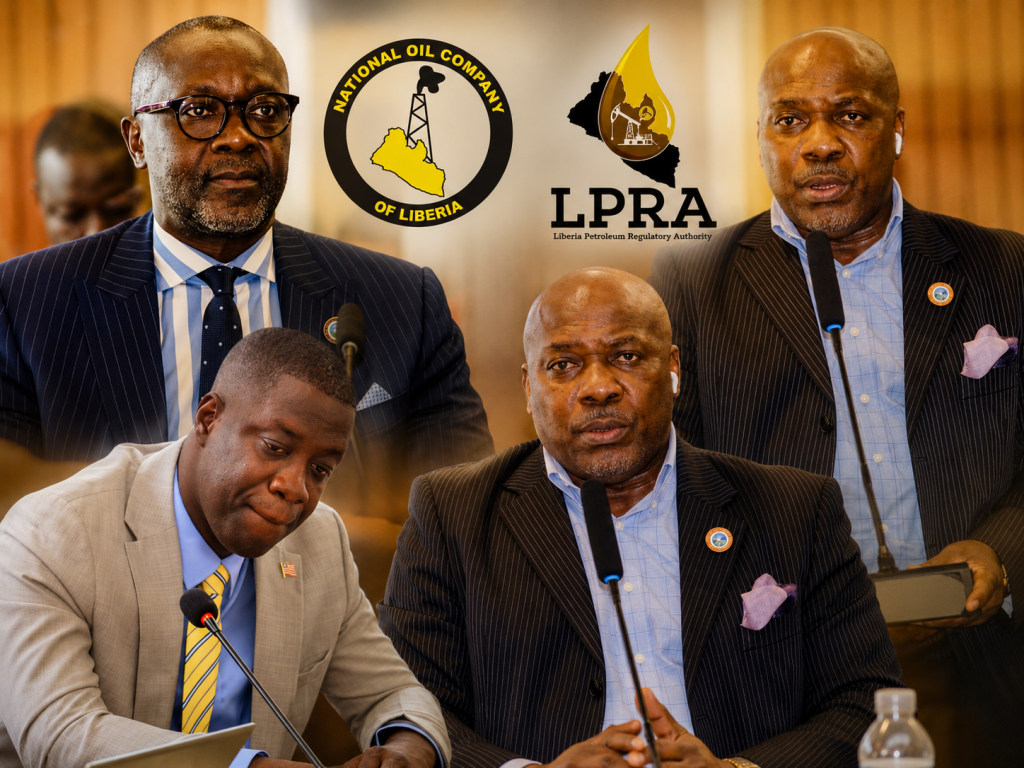
Monrovia – The Liberian Senate has opened an investigation into an escalating dispute between the Liberia Petroleum Regulatory Authority (LPRA) and the National Oil Company of Liberia (NOCAL) over the interpretation and implementation of the 2014 Petroleum (Exploration and Production) Act, amid allegations that NOCAL may have acted outside the law in signing agreements with foreign firms.
By Gerald C. Koinyeneh, [email protected]
The Senate’s intervention follows a communication jointly submitted by Senator Amara Konneh of Gbarpolu County and Senator Jonathan Boye Charles Sogbie of River Gee County, who warned that a growing jurisdictional conflict between the two institutions could undermine investor confidence, weaken regulatory oversight, and threaten the integrity of Liberia’s petroleum sector.
The lawmakers’ concerns were fueled by an investigative report published by FrontPage Africa, which revealed that NOCAL had signed offshore agreements with two foreign companies—GeoPartners and Searcher—allowing them to conduct petroleum reconnaissance activities in Liberia.
According to Senators Konneh and Sogbie, such activities require authorization from the LPRA under Section 11.1 of the Petroleum Law.
Following the Senate’s decision to investigate the matter, Senator Konneh took to social media, reiterating their call for the immediate suspension and review of the agreements.
“Today, my colleague Senator Jonathan Boye Charles Sogbie and I urgently called for the immediate suspension and investigation of NOCAL’s controversial oil contracts,” Konneh wrote.
He argued that the agreements allegedly permit the companies to conduct petroleum reconnaissance operations without obtaining the mandatory license from the LPRA.
“According to Section 11.1 of the Petroleum Law, such reconnaissance activities must be exclusively licensed by the LPRA,” Konneh stated, citing provisions that require companies seeking to conduct geological, geophysical, geochemical, and geotechnical surveys to first obtain a reconnaissance license from the regulatory authority.
Konneh further warned that the dispute extends beyond administrative disagreements and strikes at the heart of Liberia’s petroleum governance framework.
“When the Petroleum Law was enacted, it clearly defined the roles of both institutions,” he said. “NOCAL was established as a commercial state-owned enterprise, while LPRA was empowered to regulate upstream petroleum activities, including those involving NOCAL itself.”
According to the senator, the separation of powers was deliberately designed to prevent conflicts of interest, promote accountability, and align Liberia’s petroleum governance system with international best practices.
“Despite this clear legal framework, NOCAL claims its actions are lawful,” Konneh noted. “If this jurisdictional fight remains unresolved, it could set a dangerous precedent, weaken the rule of law in Liberia’s petroleum industry, and hinder future legislative reforms.”
NOCAL Defends Its Position
The allegations prompted a public response from Emmanuel Azango, a Vice President at NOCAL, who offered a legal interpretation of the Petroleum Law and the NOCAL Act.
In a detailed Facebook post, Azango argued that while Section 11 of the Petroleum Law generally allows a company to apply for a reconnaissance license, the law must be interpreted holistically rather than in isolation.
He pointed to Section 12 of the Petroleum Law and Sections 7(e) and 7(f) of the NOCAL Act, which assign NOCAL responsibilities including administering reconnaissance licenses on behalf of the regulatory authority, participating in technical evaluations, and managing petroleum-related data.
“These functions indicate legislative intent for NOCAL to operate primarily as an institutional participant and administrator rather than as a competing commercial applicant,” Azango wrote.
He further argued that allowing NOCAL to directly obtain reconnaissance licenses could create real or perceived conflicts of interest, as the company could potentially oversee processes in which it has a direct commercial stake.
According to Azango, such a situation could raise concerns regarding transparency, accountability, institutional independence, and investor confidence.
To avoid legal ambiguity, he recommended that both NOCAL and LPRA seek a formal legal opinion from the Ministry of Justice clarifying the relationship between Sections 11 and 12 of the Petroleum Law and defining the appropriate scope of NOCAL’s involvement in reconnaissance activities.
Konneh Fires Back
Senator Konneh responded swiftly, accusing NOCAL of attempting to divert attention from the central issue under investigation.
He clarified that neither he nor Senator Sogbie had challenged NOCAL’s authority to administer reconnaissance licenses once issued.
Instead, he said, the issue before the Senate is whether NOCAL can authorize or engage in reconnaissance activities without first obtaining approval from the LPRA.
“Granting or authorizing a reconnaissance license is entirely different from administering or supervising one,” Konneh argued.
He maintained that Section 11.1 gives the LPRA authority to approve reconnaissance licenses, while NOCAL’s administrative responsibilities only begin after such licenses have been granted.
“One step leads to the other,” Konneh wrote. “NOCAL’s role begins where LPRA’s ends.”
The senator accused NOCAL of repeatedly emphasizing its administrative authority while avoiding the fundamental question of whether it can legally bypass LPRA licensing requirements.
To support his argument, Konneh said he had produced an infographic outlining what he described as the seven-step process for obtaining a reconnaissance license, asserting that LPRA exercises authority over the first six steps while NOCAL’s role is limited to the final phase.
Konneh also signaled that the reconnaissance-license controversy may be only one aspect of a broader investigation.
“Once we are finished with the reconnaissance-license violation issue we have raised, we will then move to the next, more serious issue,” he stated.
He alleged that NOCAL may have illegally and unilaterally committed Liberia to fiscal terms in multiple engagement letters with foreign oil companies—an accusation that could significantly expand the scope of the Senate inquiry if substantiated.
High-Stakes Investigation
The Senate investigation now places Liberia’s petroleum governance framework under intense scrutiny, with lawmakers expected to determine whether NOCAL’s actions complied with the Petroleum Law and whether existing legislation clearly delineates the responsibilities of the country’s petroleum institutions.
The outcome of the probe could have far-reaching implications for regulatory authority, investor confidence, future oil exploration activities, and the overall management of Liberia’s potentially lucrative hydrocarbon resources.
For now, the dispute has evolved from a technical legal disagreement into a high-profile test of transparency, accountability, and the rule of law in Liberia’s emerging petroleum sector.
Support Independent Journalism
Your support helps FrontPage Africa continue delivering independent, credible, and impactful journalism. Every contribution strengthens our ability to investigate, inform, and hold power accountable while keeping quality journalism accessible to our readers.
Support our journalism or subscribe to receive the latest FrontPage Africa stories and updates.