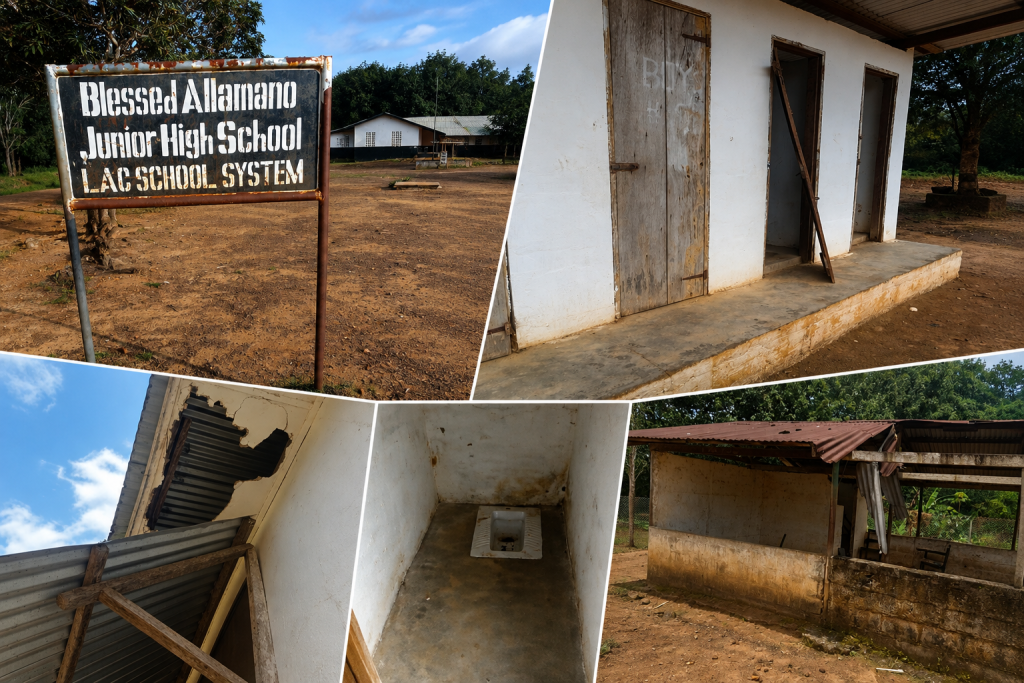
COMPOUND 3, GRAND BASSA COUNTY — Beneath rusted zinc roofs and ceilings marked by years of deterioration, children attending schools operated by the Liberia Agriculture Company (LAC) have been learning in conditions that parents and teachers say are unsafe, unhygienic and unfit for a modern learning environment.
By Gerald C. Koinyeneh, [email protected]
A FrontPage Africa investigation into schools across the LAC concession in Grand Bassa County found deteriorating classrooms, damaged doors and windows, cracked walls, failing ceilings, inadequate furniture and sanitation facilities in need of urgent attention.
The investigation also found concerns over overcrowding, limited learning equipment and the absence of a functional computer laboratory at St. Joseph High School in Estate One, regarded as the plantation’s leading secondary school.
LAC, one of Liberia’s oldest agricultural concessions, does not dispute that several of its schools require major rehabilitation.
In a response to FrontPage Africa, the company acknowledged that facilities at St. Joseph High School, St. Michael Elementary and Junior High School, Blessed Allamano Junior High School in Estate Four, and several satellite schools require attention.
But LAC says the conditions identified by the investigation are already being addressed through a phased rehabilitation program and that work is underway ahead of the reopening of schools in September.
The company says six schools — St. Joseph, St. Michael, Allamano, St. Francis, Estate Four and Division 4.1 Elementary — are expected to be completed by September 2026.
LAC, however, stopped short of guaranteeing that all identified rehabilitation works across its 11 schools will be completed before the new academic year begins.
That qualification has done little to reassure some parents and teachers, who say the deterioration has been visible for years and that repeated appeals for repairs have not produced improvements quickly enough.
Classrooms Falling Apart
During visits to several LAC-operated schools, FrontPage Africa observed aging classroom buildings showing visible signs of prolonged wear and inadequate maintenance.
At some facilities, classroom floors were bare and deteriorating. Doors were broken or damaged, windows required repair, and portions of ceilings appeared to be deteriorating.
Spider webs were visible across sections of classroom ceilings, while some roofing and ceiling materials appeared loose and in need of replacement.
The conditions were not isolated to a single campus.
Among the schools visited during the investigation were St. Joseph High School in Estate One, St. Michael Elementary and Junior High School, Blessed Allamano Junior High School in Estate Four, and several satellite schools spread across the concession.
Parents and teachers expressed concern that children are being asked to pursue their education in environments that do not adequately protect their health, safety or dignity.
One parent, whose identity is being withheld because of concerns about possible reprisals, said the problem has persisted for too long.
“This is not the kind of school environment any child deserves. Our children are expected to compete with students elsewhere, but look at where they are learning.”
Another parent raised particular concerns about sanitation facilities used by girls.
According to the parent, the poor condition of some bathrooms has forced girls to seek alternative places to relieve themselves.
“The girls are forced to use the bush because of the dirty condition of the bathrooms,” the parent said.
FrontPage Africa is withholding the identities of parents and teachers interviewed for this investigation because of concerns about possible reprisals.
Sanitation Concerns
The condition of sanitation facilities emerged as one of the most troubling findings.
Several schools rely on aging pit latrines, with some facilities requiring rehabilitation to meet acceptable standards of hygiene and safety.
Parents said inadequate sanitation presents particular challenges for female students, who require clean, private and functional facilities during the school day.
LAC acknowledged the concerns.
In its response, the company said all 11 schools have separate sanitation facilities for boys and girls but confirmed that upgrades and bathroom renovations are included in its rehabilitation plan.
Bathroom renovations are specifically planned for schools in Estate Four, Steward Camp, Flos Camp and Forest Camp.
The company said some of the work is expected to be completed before September.
Teachers Say Appeals Went Unanswered
Several teachers and residents told FrontPage Africa that concerns about deteriorating school facilities have been raised repeatedly through school administration and LAC’s management structures.
Two teachers residing in Queensville Camp, the main teachers’ residential area on the plantation, said requests for improvements to classrooms, sanitation facilities and other learning infrastructure have been made over the years.
They described the response as inadequate.
Teachers said they have raised concerns about broken facilities, deteriorating floors and windows, and other infrastructure problems, but improvements have not always followed quickly.
LAC rejected the characterization that teachers’ concerns have been ignored.
The company said teachers are often the first people to identify facility problems and that their reports form part of LAC’s assessment and prioritization process.
However, the company acknowledged that a request for repairs does not necessarily mean work can begin immediately.
LAC said it must assess the condition, determine the urgency, secure materials and coordinate logistics and resources before work can be undertaken.
The company cited Queensville as an example of a case where management responded.
According to LAC, 26 teachers had flagged problems involving tiles and window bars, and the company said the work was completed two weeks before its response to FrontPage Africa.
St. Joseph: Expansion Without Matching Infrastructure
At St. Joseph High School, FrontPage Africa found evidence of an institution that has grown academically without a corresponding expansion of some of its physical infrastructure.
The school was expanded into a full senior high school during the tenure of former LAC General Manager George Mensah, raising expectations that students on the plantation would have access to expanded educational opportunities.
But teachers say the enrollment growth has not been matched by sufficient investment in classrooms and learning facilities.
A teacher described classrooms as overcrowded and difficult to manage.
“It is not easy here, my brother,” the teacher said. “Some classrooms have over 100 students, and you can’t teach well. The classrooms are hot and dusty.”
The investigation found students using green-painted benches in classrooms, with concerns that limited seating capacity can force several students to share desks.
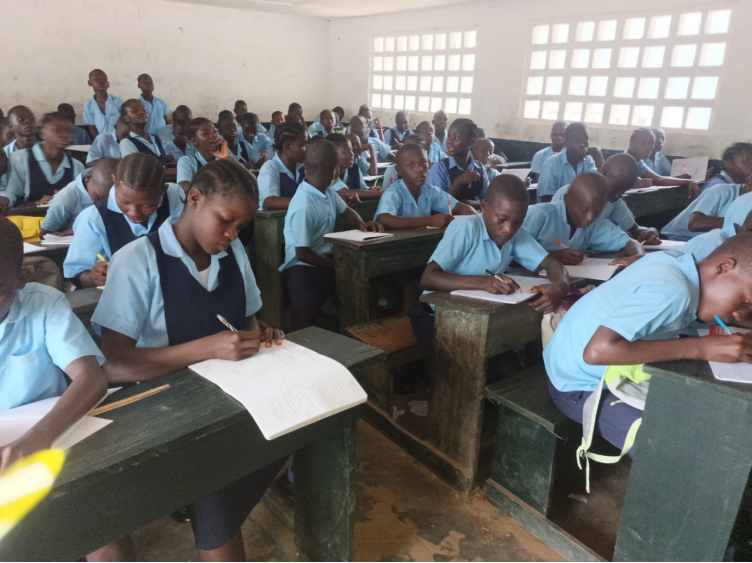
Teachers say overcrowding makes it difficult to provide individual attention and effectively manage classroom instruction.
The company says it plans to provide 170 new armchairs and repair 211 others across the school system. St. Joseph alone is listed for 134 new armchairs and 171 repairs.
The company also plans 92 new student desks and repairs to 161 desks across the schools.
Science Lab in Decline
The science laboratory at St. Joseph High School offers another indication of the challenges facing the school system.
FrontPage Africa observed that equipment acquired years ago appeared outdated, while some apparatus was in poor condition or no longer in active use.
For a senior secondary school, the condition raises concerns about students’ access to practical science education, particularly as they prepare for national examinations.
Teachers said the lack of adequate laboratory resources can undermine students’ ability to translate classroom theory into practical experience.
The problem extends beyond science.
The investigation found no functional computer laboratory at St. Joseph High School, raising questions about the ability of students to acquire basic digital skills.
As computers and digital literacy increasingly become essential to higher education and employment, teachers said students from the plantation risk being disadvantaged when competing with students from schools with better-equipped facilities.
LAC’s Rehabilitation Plan
LAC says the conditions identified by FrontPage Africa are not unknown to management.
The company said it conducts regular inventories and assessments covering classrooms, roofs, ceilings, doors, windows, furniture, sanitation facilities and electrical systems.
According to LAC, deficiencies identified through the assessments are tracked and prioritized according to urgency.
Its rehabilitation plan includes a range of general works across the 11 schools.
These include blackboard painting and general building painting, installation of window screens, repairs to cracked walls, office renovations, bathroom renovations, bookshelves, hand-pump maintenance, window canopies and aprons.
The company has also identified specific replacements and repairs.
Its plan includes 32 sheets of roofing zinc, 40 ceiling replacements, floor repairs at several schools, three door repairs and 15 door-frame replacements across seven schools.
LAC says St. Joseph requires the largest number of ceiling replacements, with 20 listed for replacement.
The company also identified six blackboards at St. Michael, two at Vijay Maira and one at St. Joseph for replacement.
According to LAC, some work can only be undertaken during school breaks, which is why rehabilitation projects have been scheduled for the current vacation period.
Can Everything Be Completed Before September?
With the new academic year expected to begin in September, the timing of the rehabilitation program is now central to the concerns raised by parents and teachers.
LAC said rehabilitation work is already underway in phases and that the company is prioritizing repairs affecting student safety and sanitation.
It said six schools — St. Joseph, St. Michael, Allamano, St. Francis, Estate Four and Division 4.1 Elementary — are expected to be completed by September 2026.
But the company acknowledged that it cannot guarantee that every identified project across the school system will be completed before schools reopen.
“Given the number of facilities across the school system, we cannot guarantee every identified project will be finished on that timeline,” LAC said, while emphasizing that rehabilitation will continue in phases until identified needs are addressed.
That admission is significant for parents who fear that the start of the school year could come before the rehabilitation program is fully implemented.
Some parents argue that the condition of the schools has existed for years and that a few weeks of rehabilitation during the vacation period may not be sufficient to address the accumulated problems.
Who Oversees the Schools?
The investigation also raises broader questions about the management structure of LAC’s education system.
Unlike school systems operated under a dedicated education management structure, LAC’s schools fall under the company’s Human Resources Department, which also controls the education budget.
Several residents and education stakeholders questioned whether that arrangement gives education sufficient institutional priority within the concession’s broader administrative structure.
They argued that education spending may compete with other corporate priorities, potentially delaying investments in classrooms, sanitation, equipment and other learning resources.
LAC did not indicate in its response that it plans to change the administrative structure.
Instead, it emphasized that its existing system allows the company to assess facility needs, prioritize repairs and allocate resources accordingly.
Questions for Government
The investigation also raises questions about the role of the Ministry of Education.
Parents, residents and school stakeholders interviewed said they could not recall frequent inspection visits by education authorities to assess the physical condition of schools across the plantation.
Regular inspection is critical not only for monitoring academic standards but also for assessing whether schools provide safe and appropriate environments for children.
The absence of visible government intervention, residents argue, creates the possibility that deteriorating infrastructure can persist for years without sufficient regulatory pressure for corrective action.
For parents, the issue is bigger than whether LAC eventually repairs the buildings.
They want greater accountability over the quality of education available to children living on a concession that has operated in Liberia for generations.
A Concession Dating to 1959
Established in 1959, LAC is one of Liberia’s oldest rubber-producing concessions.
Generations of Liberians have lived and worked on the plantation, and the company has remained an important economic institution in Grand Bassa.
But residents say the length of the company’s presence makes the state of some of its schools even more troubling.
Community members have for years called for greater investment in education and social services in concession communities.
Some have also raised concerns about the concession agreement itself, including calls for stronger local-content provisions and more clearly defined community development obligations.
Residents argue that communities hosting large-scale commercial operations should see tangible improvements in education, healthcare, infrastructure and other essential services.
They say successive governments have failed to adequately address these concerns.
“The Children Are the Ones Paying the Price”
For former LAC student Wremongar Joe, the deteriorating schools represent more than a maintenance problem.
He said the consequences are ultimately borne by children who have no control over the condition of the institutions in which they are expected to learn.
“For many parents, however, the issue extends beyond contracts and policy. It is about children,” Joe told FrontPage Africa.
“Every broken classroom door represents another reminder that students have been forgotten. Every overcrowded classroom limits a teacher’s ability to give individual attention. Every unusable science laboratory denies students practical learning. Every missing computer reduces opportunities in an increasingly digital world. Every neglected bathroom compromises children’s health and dignity.”
His assessment captures the central concern emerging from FrontPage Africa’s investigation: that the problem at LAC’s schools is not simply about aging buildings, but about whether children growing up on one of Liberia’s historic agricultural concessions are receiving the educational environment they need to compete beyond the plantation.
LAC Says It Welcomes Scrutiny
Despite the concerns raised by the investigation, LAC says it remains committed to improving the schools.
The company said the health, safety and dignity of students are a priority and encouraged parents, teachers and school administrators to continue reporting problems so they can be assessed and addressed.
For parents and teachers, however, the test will not be the rehabilitation plan on paper.
It will be the condition of the classrooms when students return in September.
If roofs are repaired, ceilings restored, bathrooms made usable, furniture replaced and learning facilities improved, LAC’s response will represent a meaningful intervention.
If students return to the same broken doors, deteriorating ceilings, overcrowded classrooms and inadequate sanitation facilities, the concerns uncovered by this investigation will remain unresolved.
For thousands of children on the LAC plantation, the new school year is therefore more than a return to classes.
It is a test of whether years of complaints about deteriorating schools will finally translate into visible change.
Support Independent Journalism
Your support helps FrontPage Africa continue delivering independent, credible, and impactful journalism. Every contribution strengthens our ability to investigate, inform, and hold power accountable while keeping quality journalism accessible to our readers.
Support our journalism or subscribe to receive the latest FrontPage Africa stories and updates.