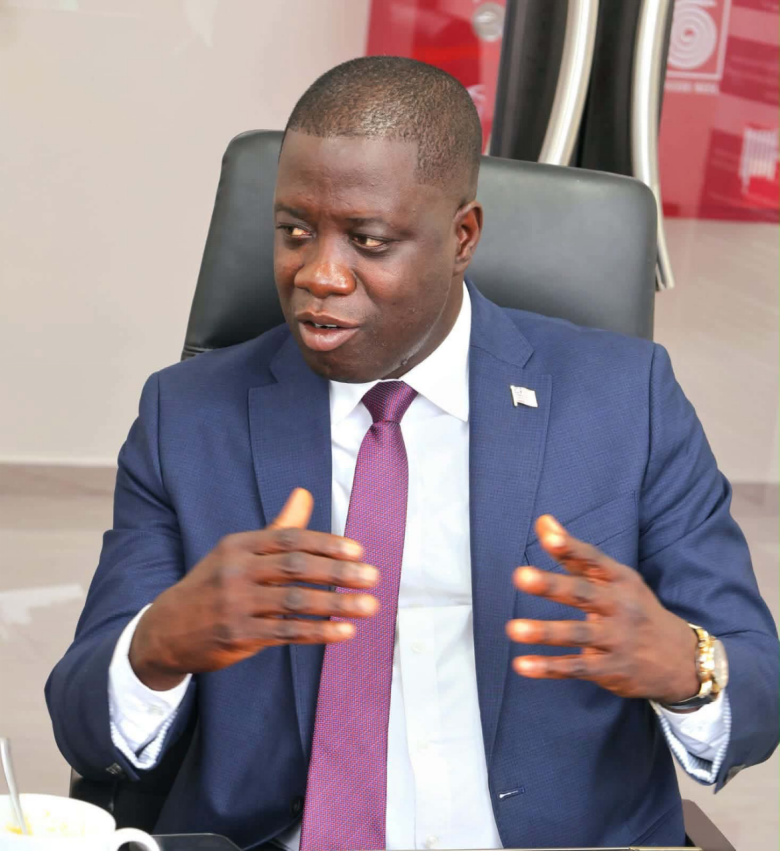
MONROVIA – Less than 24 hours after a court ordered the National Oil Company of Liberia (NOCAL) and the Ministry of Finance and Development Planning closed and sealed, the two institutions changed course. On Thursday, NOCAL executives, including Vice President for Finance and Chief Financial Officer Emmanuel T. Azango, appeared before the Commercial Court alongside Finance Ministry officials and reportedly appealed for a settlement, FrontPage Africa has gathered.
By Willie Tokpah
The appearance marks a sharp turn in a dispute that had appeared headed toward harder enforcement. It followed a day of contempt proceedings in which Azango sat on the court’s bench for more than two hours as the court pressed for compliance with its demands.
The settlement push came after the court’s September 23 action and the public attention generated by Wednesday’s proceedings, FrontPage Africa understands. That order, issued by Chief Judge Eva Mappy Morgan, directed Acting Sheriff Emmanuel Morris, or his deputy, to close NOCAL and the Ministry of Finance with immediate effect, seal their entrances and remove occupants. The sheriff was also ordered to make an official return explaining how the order was served and carried out.
The order supplied to FrontPageAfrica does not say how long a closure would remain in effect, and it does not establish whether the sealing was fully executed. Still, the threat alone changed the stakes. What had been a long-running liability on NOCAL’s books became a question of whether two public institutions could keep their doors open.
The enforcement proceedings arise from an Action of Debt brought by former NOCAL officials Vida A. Mensah and Cllr. Idella Cooper-Shannon. Their claims reportedly began at about US$85,000 each, or roughly US$170,000 combined. After years of litigation, interest and penalties, published reporting in May 2026 put the combined award at US$764,762, more than four times the original claims and an increase of about US$594,762.
The dispute traces to NOCAL’s 2015 restructuring, when the state-owned company was in financial difficulty and moving toward an interim management arrangement.
A contemporaneous Ministry of Foreign Affairs media summary reported in August 2015 that Mensah, then Vice President of Administration, had resigned during the restructuring. According to reporting on the case, Mensah and Cooper-Shannon were among former executives who rejected the reduced severance terms offered and pursued litigation.
Any settlement will likely turn on numbers, and the numbers are not yet clear. Azango told FrontPage Africa on Wednesday that the court required payment of 25 percent of the obligation. The closure order does not specify what amount that represents, nor does it establish whether payment was made.
If calculated against the reported US$764,762 liability, 25 percent would be about US$191,190.50. But the court document available does not state that figure, so the basis of the demand remains a matter requiring clarification. Negotiators will need to settle what is owed, what has been paid, and what portion the court will accept as a good-faith installment.
The central issue is who bears responsibility. Azango has said the obligation is an old debt and that payment rests with the Government of Liberia, particularly the Ministry of Finance. He was not part of NOCAL’s management when the severance dispute arose, and on the facts available he cannot be identified as responsible for creating the liability. As the corporation’s current finance chief, however, he is among the officials expected to help it respond to an enforceable judgment.
The Finance Ministry’s presence in court on Thursday is significant in that light. Its officials’ appearance suggests the dispute can no longer be treated as belonging to NOCAL alone, and that the Government’s central financial authority is now directly engaged. If the Government has accepted responsibility, the settlement talks will also have to address what happened between the point the judgment became enforceable and the contempt hearing.
If an agreement is reached, the immediate pressure from the contempt and closure proceedings could ease, subject to whatever terms the court accepts. But a settlement would not answer the wider questions: how the debt grew so large, what payments have already been made, what remains outstanding, and which institution must ultimately satisfy the judgment. It would also leave open why the finance leadership of a state-owned company reached the point of contempt before a resolution was sought.
NOCAL’s finances have been scrutinized before. A General Auditing Commission report identifies Cooper-Shannon as a former NOCAL board member, and past affairs were examined in connection with executive bonuses and payments tied to the 2013 Block 13 transaction.
A 2018 FrontPage Africa report on the Special Presidential Committee investigating allegations arising from the Global Witness report also named her among former board members in connection with recommendations on restitution. Those matters are separate from the present Action of Debt and should not be conflated with the US$764,762 judgment.
Liberia’s public institutions routinely inherit liabilities from earlier administrations and management teams. The NOCAL case shows what happens when such obligations sit unresolved: interest accumulates, the exposure balloons, and a decade-old dispute ends in a contempt citation and a sealing order.
The question now is whether Thursday’s appeal produces a settlement that finally closes a dispute dating to 2015, or whether the judgment continues to generate contempt proceedings, enforcement actions and questions about how Liberia manages its inherited obligations.
Support Independent Journalism
Your support helps FrontPage Africa continue delivering independent, credible, and impactful journalism. Every contribution strengthens our ability to investigate, inform, and hold power accountable while keeping quality journalism accessible to our readers.
Support our journalism or subscribe to receive the latest FrontPage Africa stories and updates.