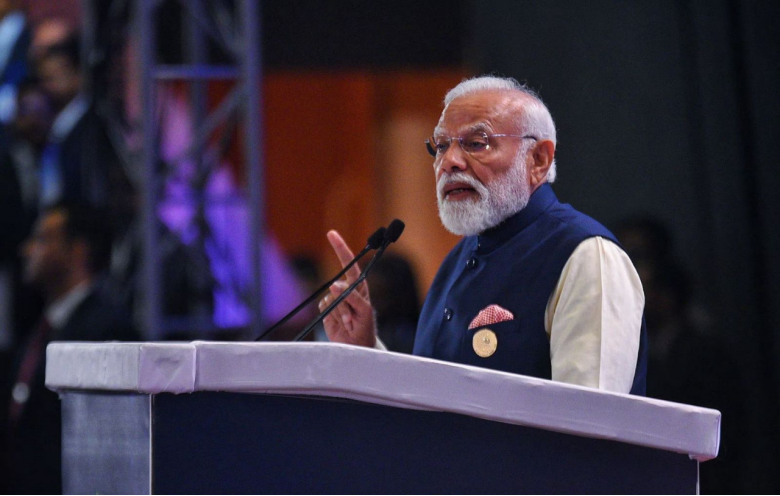
New Delhi, India – Global political leaders, technology executives, policymakers and innovators gathered in New Delhi from February 16–20, 2026, for the India AI Impact Summit 2026, a landmark international forum aimed at shaping the future of artificial intelligence (AI), governance and global digital cooperation.
By Patience M. Jones
The summit was officially inaugurated on February 16 by Indian Prime Minister Narendra Modi and brought together representatives from more than 100 countries. Hosted at the iconic Bharat Mandapam, the high-level gathering featured heads of state, United Nations officials and top executives from major technology companies.
Discussions focused on ensuring that artificial intelligence drives economic growth while protecting humanity from emerging technological risks.
Taking center stage, Prime Minister Modi called for a “human-centric” model of artificial intelligence, emphasizing that technological advancement must serve humanity and remain inclusive—particularly for developing nations.
“Artificial Intelligence marks a transformative chapter in human history,” Modi declared in his keynote address. “India is not just a part of the AI revolution; it is leading and shaping it.”
Framing AI as one of the defining forces of the 21st century, Modi cautioned that innovation must not deepen global inequality. He stressed that developing countries should have equal access to AI development through shared knowledge, affordable digital infrastructure and strengthened international cooperation.
The Prime Minister introduced India’s AI governance framework, branded as the M.A.N.A.V. (MANAV) Vision—meaning “human” in Sanskrit:
M – Moral and Ethical Systems: AI must be built on strong ethical foundations.
A – Accountable Governance: Transparent rules and robust oversight are essential.
N – National Sovereignty: Data belongs to those who generate it.
A – Accessible and Inclusive: AI must empower all, not create monopolies.
V – Valid and Legitimate: AI systems must be lawful and verifiable.
Modi said the framework aligns with India’s guiding philosophy, “Sarvajan Hitaya, Sarvajan Sukhaya”—welfare for all and happiness for all—underscoring the country’s commitment to democratizing AI.
Addressing concerns about misinformation and digital safety, Modi advocated for global standards to combat deepfakes and fabricated content. Drawing a parallel with nutrition labels on food products, he proposed authenticity labels and watermarking for AI-generated content to promote transparency in the digital ecosystem.
“Sunlight is the best disinfectant,” he said, arguing that open collaboration and shared code would enable innovators worldwide to improve AI systems’ safety and reliability.
He also stressed the importance of child safety online and urged governments and industry leaders to build trust into technology from the design stage.
Other global leaders reinforced the call for ethical oversight and international cooperation.
António Guterres warned against allowing artificial intelligence to be controlled by a small group of powerful actors and called for global frameworks to guide responsible AI development.
Emmanuel Macron emphasized the need to balance innovation with citizen protection, particularly in safeguarding young people from harmful online content and misuse of emerging technologies.
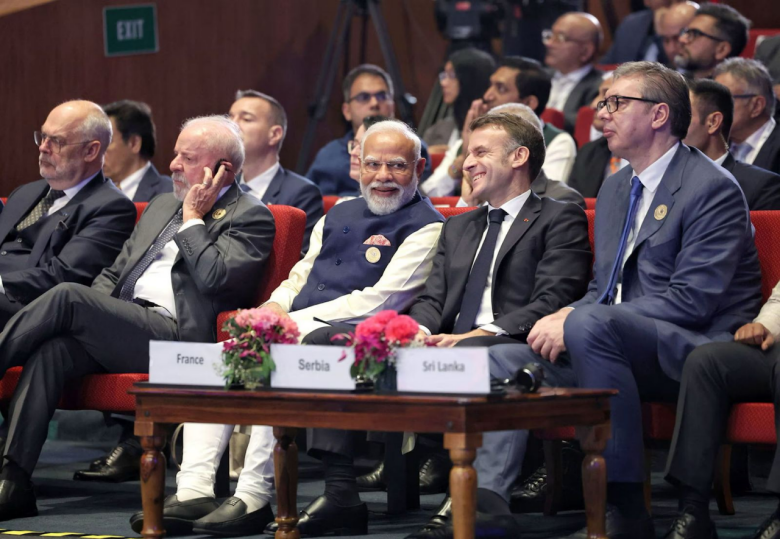
Technology executives also underscored AI’s economic potential. Sundar Pichai described AI as the most significant technological shift since the advent of the internet, predicting breakthroughs in healthcare, education and scientific research.
Sam Altman stressed the importance of collaboration between governments and private innovators to ensure the safe and responsible deployment of advanced AI systems globally.
Addressing fears of job displacement, Modi compared AI to previous technological revolutions that ultimately created new industries and employment opportunities. He described the future as an era in which humans and intelligent systems will “co-create, co-work and co-evolve.”
He called for a mass movement in skilling, reskilling and lifelong learning to prepare societies for emerging job markets shaped by artificial intelligence.
Highlighting India’s digital transformation, Modi pointed to the country’s expanding technology workforce, thriving startup ecosystem, semiconductor initiatives and secure data infrastructure as pillars of a resilient AI ecosystem.
“Design and Develop in India. Deliver to the World. Deliver to Humanity,” he urged, inviting global collaboration.
Summit organizers announced new commitments promoting transparency, safety standards and responsible innovation. Delegates also discussed pressing challenges such as cybersecurity risks, misinformation, unequal access to technology and the socio-economic implications of automation.
For developing regions, including Africa, the summit’s emphasis on inclusion holds significant promise. Experts noted that AI could accelerate development through improved agricultural productivity, digital education systems, healthcare diagnostics and more efficient public administration.
Support Independent Journalism
Your support helps FrontPage Africa continue delivering independent, credible, and impactful journalism. Every contribution strengthens our ability to investigate, inform, and hold power accountable while keeping quality journalism accessible to our readers.
Support our journalism or subscribe to receive the latest FrontPage Africa stories and updates.