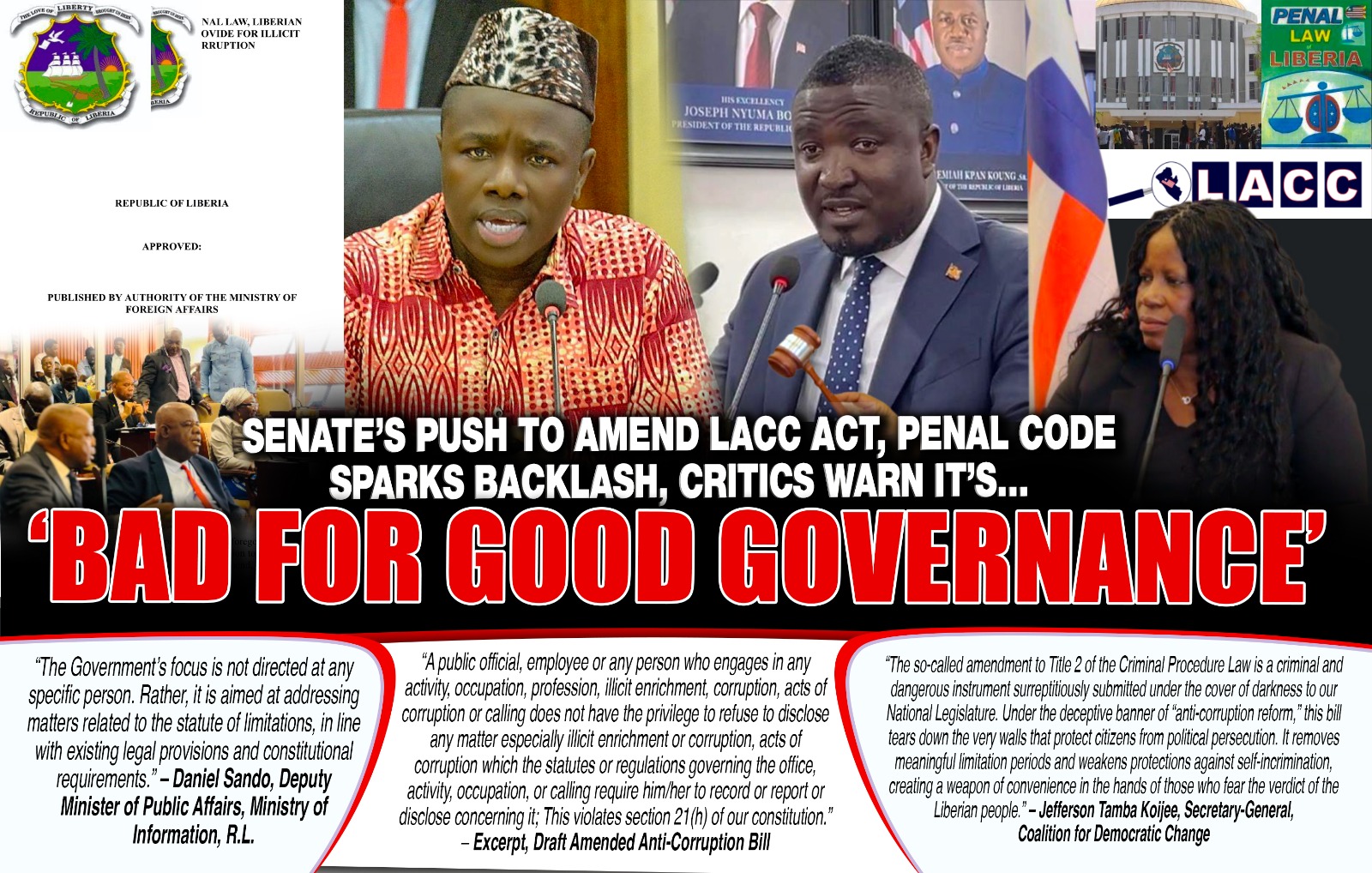
Monrovia – A move by members of the National Legislature to amend the Liberia Anti-Corruption Commission (LACC) Act and provisions of the Penal Code has triggered sharp political and legal debate, with critics warning that the proposed changes could undermine constitutional protections and weaken good governance.
By Gerald C. Koinyeneh, [email protected]
At the center of the controversy is a draft amendment to Liberia’s anti-corruption framework, including proposed revisions to Title 2 of the Criminal Procedure Law relating to statute of limitations and disclosure obligations.
Contested Provision
An excerpt from the draft amended Anti-Corruption Bill states:
“A public official, employee or any person who engages in any activity, occupation, profession, illicit enrichment, corruption, acts of corruption or calling does not have the privilege to refuse to disclose any matter especially illicit enrichment or corruption, acts of corruption which the statutes or regulations governing the office, activity, occupation, or calling require him/her to record or report or disclose concerning it; This violates section 21(h) of our constitution.”
Section 21(h) of the 1986 Constitution of Liberia guarantees protection against self-incrimination, stating that no person shall be compelled to furnish evidence against themselves.
Excerpt: “No person shall be held to answer for a capital or infamous crime except in cases of impeachment, cases arising in the Armed Forces and petty offenses, unless upon indictment by Grand Jury; and in all such cases, the accused shall have the right to a speedy, public and impartial trial by a jury of the vicinity, unless such person shall, with appropriate understanding, expressly waive the right to a jury trial.”
It added: In all criminal cases, the accused shall have the right to be represented by counsel of his choice, to confront witnesses against him, and to have compulsory process for obtaining witnesses in his favor. He shall not be compelled to furnish evidence against himself, and he shall be presumed innocent until the contrary is proved beyond a reasonable doubt. No person shall be subject to double jeopardy.”
Legal analysts argue that the language of the proposed amendment raises constitutional concerns, particularly regarding due process and the right against self-incrimination.
The draft legislation, titled “An Act to Amend Title 2, Criminal Procedure Law, Liberian Codes of Law Revised to Re-Define the Burden of Proof and Statute of Limitation for Corruption, Acts of Corruption and Illicit Enrichment,” seeks to amend Chapter 4 (Time Limitation) and Chapter 21 (Evidence) of the existing law.
No Time Limit for Prosecution
One of the most significant provisions of the proposed amendment is found in Section 4.4, which would allow prosecution for misconduct in office—including corruption and illicit enrichment—to be initiated at any time.
Under the draft, such cases may be commenced while the accused is still in public office, after leaving public office, or at any time thereafter.
The proposed language effectively removes any statute of limitations for corruption-related offenses involving public officials.
Additionally, Section 4.8(d) provides that where a public official fails to declare assets, income, and liabilities as required under the Code of Conduct or the law establishing the Liberia Anti-Corruption Commission (LACC), prosecution may begin at any time following the discovery of evidence.
Political Backlash
The proposed amendments have drawn strong criticism from the opposition Coalition for Democratic Change (CDC).
Jefferson Tamba Koijee, Secretary-General of the CDC, described the bill as “dangerous” and politically motivated.
“The so-called amendment to Title 2 of the Criminal Procedure Law is a criminal and dangerous instrument surreptitiously submitted under the cover of darkness to our National Legislature,” Koijee said. “Under the deceptive banner of ‘anti-corruption reform,’ this bill tears down the very walls that protect citizens from political persecution.”
He further argued that the bill seeks to remove meaningful limitation periods and weaken safeguards against self-incrimination.
“It creates a weapon of convenience in the hands of those who fear the verdict of the Liberian people,” he added.
He alleged that it is a calculated move by the Boakai and Koung regime to manipulate the law and frame and indict former President George M. Weah of the opposition Coalition for Democratic Change, thereby blocking his participation in the 2029 general and presidential elections.
Government’s Response
The government, however, has dismissed claims that the amendments are politically targeted.
Daniel Sando, Deputy Minister of Public Affairs at the Ministry of Information, said the intent of the proposed changes is not directed at any individual.
“The Government’s focus is not directed at any specific person,” Sando stated. “Rather, it is aimed at addressing matters related to the statute of limitations, in line with existing legal provisions and constitutional requirements.”
Sando maintained that the reform effort seeks to strengthen the legal framework governing corruption-related offenses and ensure accountability.
Amendment of the LACC Act
Lawmakers are also considering amendments to the 2022 Act establishing the Liberia Anti-Corruption Commission (LACC), a move supporters say could expand the Commission’s enforcement authority. Still, critics say it would alter key provisions relating to sanctions, asset declaration, and removal of commissioners.
The proposed legislation, titled “An Act to Amend the Act Establishing the Liberia Anti-Corruption Commission (July 22, 2022),” forms part of a broader package of anti-corruption reforms currently before the National Legislature.
Expanded Powers Over Asset Declarations
One of the central changes would amend Section 4.1(h) to reinforce the Commission’s authority to issue citations to public officials required to declare their income, assets, and liabilities under the Code of Conduct Act of 2014.
Additionally, the proposed amendment to Section 4.1(i) would empower the LACC to prescribe additional sanctions against public officials who fail to declare assets or who submit false declarations—even in cases not expressly covered under Section 10.8 of the existing Act.
Public Access to Asset Declarations
Another notable revision appears in Section 5.2(O)(iii), which would require that asset declarations made to the LACC be accessible not only to the public employer but also to the general public, consistent with the law. The Commission would be tasked with prescribing guidelines governing how such disclosures are published.
Governance advocates say public access to asset declarations could enhance transparency, while critics caution that implementation guidelines will be critical to balancing transparency with privacy and security concerns.
Bonus for Successful Prosecution
Perhaps the most debated provision is the proposed amendment to Section 4.1(k), which would authorize the Commission—working with relevant government agencies—to promulgate policies or guidelines for the payment of bonuses tied to the successful prosecution of corruption cases.
Under the draft, such bonuses would not exceed five percent of funds successfully recovered.
Supporters argue that performance-based incentives could motivate investigators and prosecutors in complex corruption cases. Others warn that financial incentives tied to prosecution outcomes may raise ethical and due process concerns.
Removal of Commissioners
The amendment to Section 6.16 clarifies the grounds for removal of an LACC Commissioner by the President. A Commissioner could be removed for proven misconduct involving dishonesty, breach of the peace, incapacity, incompetence, or conviction for an offense relating to integrity.
Legal analysts note that while the grounds for removal are defined, debates may arise over the threshold of “proved misconduct” and the safeguards necessary to ensure the Commission’s independence.
Legislative Justification
The preamble of the bill references Chapter V of the 1986 Constitution, which vests legislative authority in the National Legislature. It also cites Liberia’s obligations under the United Nations Convention Against Corruption (UNCAC) and the government’s stated commitment to intensifying the fight against corruption, illicit enrichment, and related offenses.
Lawmakers argue that strengthening the LACC’s statutory authority is necessary to address gaps in enforcement and improve accountability mechanisms.
The proposed amendments to the LACC Act are being considered alongside other legislative initiatives to amend the Penal Law and Criminal Procedure Law concerning corruption, illicit enrichment, burden of proof, and statute of limitations.
As debate continues, civil society groups and legal experts are expected to closely examine whether the cumulative reforms reinforce institutional independence and constitutional safeguards—or risk concentrating excessive prosecutorial power.
In addition, Lawmakers are considering sweeping amendments to Title 26 of Liberia’s Penal Law that would formally criminalize illicit enrichment and expand the legal definition of corruption, as part of what sponsors describe as a renewed push to strengthen the country’s anti-corruption framework.
Support Independent Journalism
Your support helps FrontPage Africa continue delivering independent, credible, and impactful journalism. Every contribution strengthens our ability to investigate, inform, and hold power accountable while keeping quality journalism accessible to our readers.
Support our journalism or subscribe to receive the latest FrontPage Africa stories and updates.