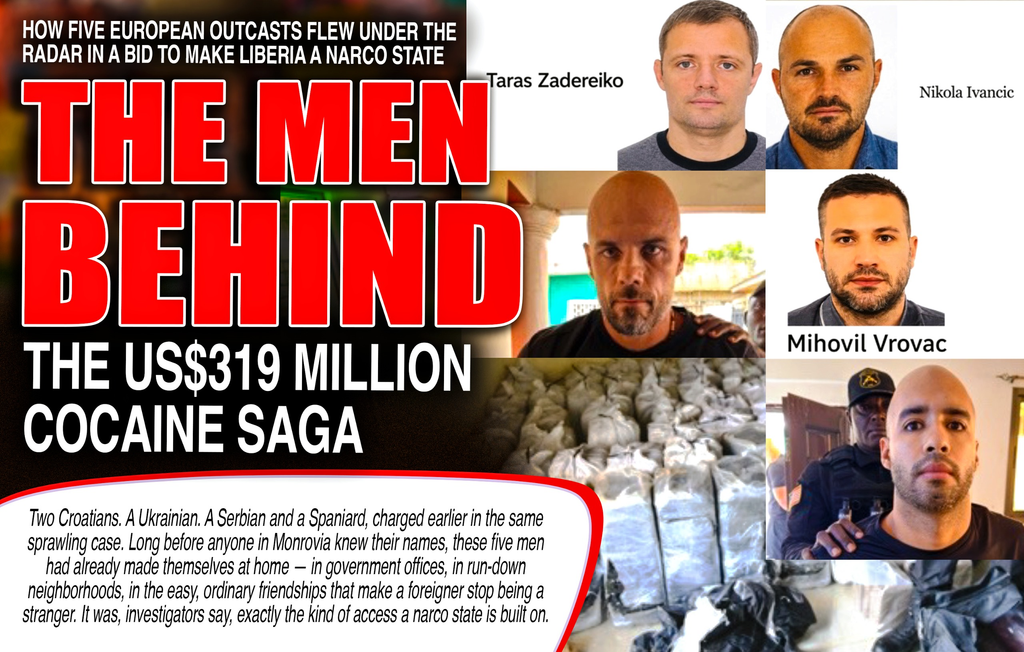
Two Croatians. A Ukrainian. A Serbian and a Spaniard, charged earlier in the same sprawling case. Long before anyone in Monrovia knew their names, these five men had already made themselves at home — in government offices, in run-down neighborhoods, in the easy, ordinary friendships that make a foreigner stop being a stranger. It was, investigators say, exactly the kind of access a narco state is built on.
By Rodney D. Sieh | [email protected]
MONROVIA — In the years before anyone in this country had reason to say the words “US$319 million” in the same breath as Monrovia, three men were already comfortable here. Nikola Ivancic, Mihovil Vrovac and Taras Zadereiko did not slip into Liberia as strangers passing through on false papers and quick exits. They arrived, they stayed, and they built lives — learning the rhythms of Liberian life, making friends in low places and in high ones, until the line between “foreign businessman” and “fixture of the community” had all but disappeared. By the time investigators finally traced a multimillion-dollar cocaine operation running along the airport highway near Duazon and Roberts International Airport — a case that would produce multiple arrests, an indictment of 12 individuals, and court proceedings still unfolding today — these European outcasts had already done the hard part. They had made themselves at home.
A FrontPageAfrica investigation has found that all three men also carry Ghanaian passports — a small detail that says almost as much about how easily the region’s documentation systems can be bent as it does about the men themselves. West Africa has become one of the world’s most heavily used transit corridors for South American cocaine bound for European markets, and Croatian syndicates have learned to move through it with practiced ease. What this case shows, more than anything, is how that movement works: not smugglers slipping through under cover of night, but operators patiently cultivating exactly the kind of political access that makes hiding in the shadows unnecessary.
THE KINGPIN
Nikola Ivancic
“Nic,” to those who trade in his reputation. “The Kingpin,” to the Croatian press that has tracked him across three continents. Nikola Ivancic did not become a fixture of international trafficking networks by accident, and his name entered Croatian law enforcement files long before it ever reached a Liberian courtroom. For more than fifteen years, in one form or another, it has never fully left them.
Ivancic first drew serious public attention after a Croatian police operation exposed a smuggling pipeline running straight out of South America. In 2010, USKOK — Croatia’s Bureau for Combating Corruption and Organized Crime — indicted him for organizing a 13-member criminal network accused of moving large quantities of cocaine from Peru, Argentina and Ecuador into Croatia between 2005 and 2009. Investigators described a network that used “mules,” or swallowers, to carry drugs across borders inside their own bodies, distributed the narcotics through storage sites in Split and Imotski, and kept its own people in line through violence and intimidation. Ivancic spent three and a half years inside Zagreb’s Remetinec prison awaiting trial before he and several co-defendants walked free in 2012 — not acquitted but released after the legal limits on pre-trial detention expired while the case sat stalled in court.
He resurfaced years later in a very different kind of paper trail, after investigators penetrated Sky ECC, the encrypted communications network criminal syndicates across Europe had come to trust with their business. According to the Croatian outlets Jutarnji list and Index.hr, Ivancic had by then become a key partner to Kristijan Palic, a cartel leader whose reputation in Croatian organized crime circles needed no introduction, and who was later arrested in Turkey. In April 2026, USKOK brought a sweeping indictment against a 20-member cartel — Palic and Ivancic among them — accused of attempting to smuggle 6.5 tons of cocaine and 2.5 tons of marijuana into Europe in a single operation. The messages investigators recovered painted a portrait of a man entirely at ease in the business: Ivancic negotiating bulk shipments out of Brazil, haggling over hundred-thousand-euro down payments the way another man might haggle over a used car, and coaching his own associates on how not to get caught. The cartel is accused of hiding drugs inside shipping containers — including, investigators say, shipments of ice cream — before transferring the narcotics into commercial trucks bound for markets across the continent.
Today, Ivancic is classified as unavailable to Croatian authorities and is being tried there in absentia — a fugitive on paper, if not in fact, since intelligence and law-enforcement records place him comfortably in Dubai, the city that has become his suspected financial base. It is the same city where, in 2022, he is alleged to have sat across a table from Liberia’s sitting Vice President and let her believe she was meeting an investor.
“MICHAEL”
Mihovil Vrovac
If Ivancic was the financier, comfortable behind the anonymity of Dubai and an encrypted phone, Mihovil Vrovac was the man willing to be present. Known on the ground by the alias “Michael,” the Croatian national has emerged as a central figure in a trafficking syndicate that stretched from West Africa to South America to Europe — and, in August 2026, his name broke into global headlines attached to the case that has consumed Liberia ever since: the transnational narcotics investigation that led directly to the arrest of Jewel Howard-Taylor, Liberia’s Vice President from 2018 to 2024 and the former wife of convicted warlord Charles Taylor, intercepted at Roberts International Airport as she tried to leave the country.
Liberian and international intelligence agencies describe Vrovac as one of the chief organizers and financiers behind that network — the man accused of orchestrating the illicit importation, distribution and bulk transit of controlled substances through West African corridors, not from a distance, but from the inside. The Liberian government has charged him in absentia, alongside Ivancic and Zadereiko, with criminal conspiracy, unlicensed importation of controlled substances, and money laundering.
Ghana is where investigators believe he lives. Intelligence and law enforcement files describe Vrovac embedding himself there, managing the unglamorous machinery that keeps a trafficking network running: container logistics, local shipping arrangements, the quiet payoffs that keep questions from being asked. Because he remains at large, Liberia’s Justice Minister, N. Oswald Tweh, has said authorities are working through domestic and international law enforcement channels, Interpol among them, to find him.
“TONY,” OR “TOM”
Taras Zadereiko, the Engineer
Around Monrovia, investigators tell FrontPageAfrica, nobody called him Taras. He went by Tony, or sometimes Tom — an easy, forgettable name for a man whose actual role inside the network was anything but forgettable. Investigators regard the Ukrainian national as the group’s engineer and technician, the person who structured its money laundering and distribution operations and kept the machinery of the business quietly running. He is alleged to have worked alongside Ivancic and Vrovac since the syndicate first established a presence in Liberia, sometime between 2021 and 2022.
It is Zadereiko’s alleged connection to Jewel Howard-Taylor, more than his technical role in the network, that has pulled his name into Liberia’s political conversation. A middleman, Sheikh Bassirou Kante, reportedly introduced Zadereiko’s group to the then-Vice President in 2022, presenting the three Europeans as legitimate, high-profile investors interested in pouring roughly US$250 million into the Liberian economy. Kante would later find himself in legal trouble of his own in the United States, and it was that trouble, investigators say, that turned him into a cooperating witness. Wired for sound, he placed a call to Howard-Taylor that referenced the 2022 Dubai meeting directly.
That recording, investigators say, became the basis for her arrest. Howard-Taylor has firmly denied any personal relationship with Zadereiko or his associates. “I don’t know them,” she told FrontPageAfrica directly, adding that her only real connection runs through Kante: “I have met many persons though, but I don’t know them personally.”
Zadereiko, like his Croatian partners, has been charged in absentia, and Liberian authorities have launched international efforts and regional tracking mechanisms to find him. Investigators describe a cartel built to bypass traditional customs checkpoints entirely, using West Africa’s maritime and aviation infrastructure as a corridor to move South American cocaine directly into European markets — a business model that owes as much to Zadereiko’s technical discipline as it does to Ivancic’s money or Vrovac’s presence on the ground.
His profile fits into something larger than one Liberian case. Ukraine’s own criminal networks have been forced to adapt to a wartime map: blocked maritime ports in the Black Sea have pushed major transnational drug pipelines away from historic Ukrainian routes, and traffickers now lean more heavily on the Balkans, West Africa and Belarus to keep product moving. Even as Zadereiko is alleged to operate abroad, Ukraine’s own domestic enforcement has kept striking at his counterparts back home — the Security Service of Ukraine recently dismantled a parallel southern European pipeline in a single sweep, arresting ten major distributors across Kyiv, Lviv and Dnipropetrovsk.
Charged Earlier: The Serbian and the Spaniard
Ivancic, Vrovac and Zadereiko are not the only foreign nationals Liberian authorities have tied to this network — they are simply the three whose names have, so far, dominated the headlines. A Serbian national and a Spanish national were charged earlier in the same broader investigation, according to Liberian authorities, rounding out what officials now describe internally as a five-man European core to the syndicate. Liberia’s Ministry of Justice has not yet released full identifying details or the specific charges against the Serbian and Spanish nationals, and FrontPageAfrica is continuing to press both the Ministry and the Joint National Security Investigative Team for those records. What is already clear, even without their names in print, is that the case against Ivancic, Vrovac and Zadereiko was never really a story about three men. It sits inside a wider, quieter pattern of European nationals moving through Liberia’s ports, airports and government circles over several years — arriving under different passports, answering to different names, and, investigators say, working toward the same end.
An Operational Divide, and a Network Built for the Long Game
Nothing about the way this network was structured looks accidental. Investigators describe a syndicate that spread its key organizers deliberately across three separate geographies, precisely so the loss of any single man would not bring the whole operation down. Ivancic stayed in the relative safety of Dubai, managing finance and negotiating bulk shipments over encrypted channels he believed no one could read. Vrovac put himself in Ghana, close enough to the action to oversee shipping networks, container logistics and payoffs, far enough from Liberia to avoid becoming its most obvious face. Zadereiko moved through Liberia and the wider region under a borrowed name, structuring the money-laundering and distribution side of the business from the inside. A financier abroad. An operator in the region. A technician embedded in the target country. It is a division of labor that let the network survive years of quiet operation — until a single stash house in Paynesville brought the entire architecture, at last, into public view.
The Dubai Link and the “Gift” Call
Every network needs a door in, and investigators say this one’s door opened in 2022, in a hotel meeting room in Dubai. Sheikh Bassirou Kante, the middleman, introduced then-Vice President Howard-Taylor to Zadereiko, Ivancic and Vrovac, presenting the three as legitimate, high-profile investors eager to inject roughly US$250 million into the Liberian economy. Howard-Taylor traveled to Dubai later that year and met the group face to face, according to investigators, personally welcoming their stated interest and assuring them Liberia was open for business.
Kante’s own legal troubles in the United States — a fraud and money-laundering case that turned an accused man into a cooperating witness — are what investigators say ultimately transformed that 2022 introduction into the evidentiary backbone of the case against Howard-Taylor. She has heavily disputed prosecutors’ reading of that meeting. While she acknowledges meeting numerous groups of foreign nationals during official travel to secure development funding for Liberia, she maintains she never personally knew Zadereiko or his partners and interacted with them only under the belief they were legitimate developers. Investigators see it differently. To them, the Dubai summit and the “gift” call that followed it are the clearest evidence available of how top-tier political access was quietly leveraged to secure a pipeline for a cocaine network now valued in the hundreds of millions of dollars.
Twelve Indicted, and a Manhunt Still Underway
The case in Liberia has already produced an indictment of 12 individuals and ongoing court proceedings, spanning the network’s local facilitators, its cooperating informants, and the foreign nationals charged in absentia. But the men who investigators say built and ran this operation — Ivancic in Dubai, Vrovac in Ghana, Zadereiko believed to be moving through the wider region — remain outside Liberian custody. Justice Minister Tweh has said Liberia is pursuing formal international arrest warrants through Interpol and other channels, hoping to bring the trio, along with the Serbian and Spanish nationals charged earlier, back to Monrovia to finally face the courts of the country they spent years quietly making their own.
Whether that effort succeeds will likely decide how this case is remembered years from now: as the moment Liberia’s institutions proved capable of dismantling a transnational trafficking network stretching from Croatian courtrooms to Dubai wire transfers to a stash house in Paynesville — or as a case that named its most senior organizers loudly and publicly, only to watch every one of them remain, for now, exactly where the law cannot yet reach them.
Support Independent Journalism
Your support helps FrontPage Africa continue delivering independent, credible, and impactful journalism. Every contribution strengthens our ability to investigate, inform, and hold power accountable while keeping quality journalism accessible to our readers.
Support our journalism or subscribe to receive the latest FrontPage Africa stories and updates.