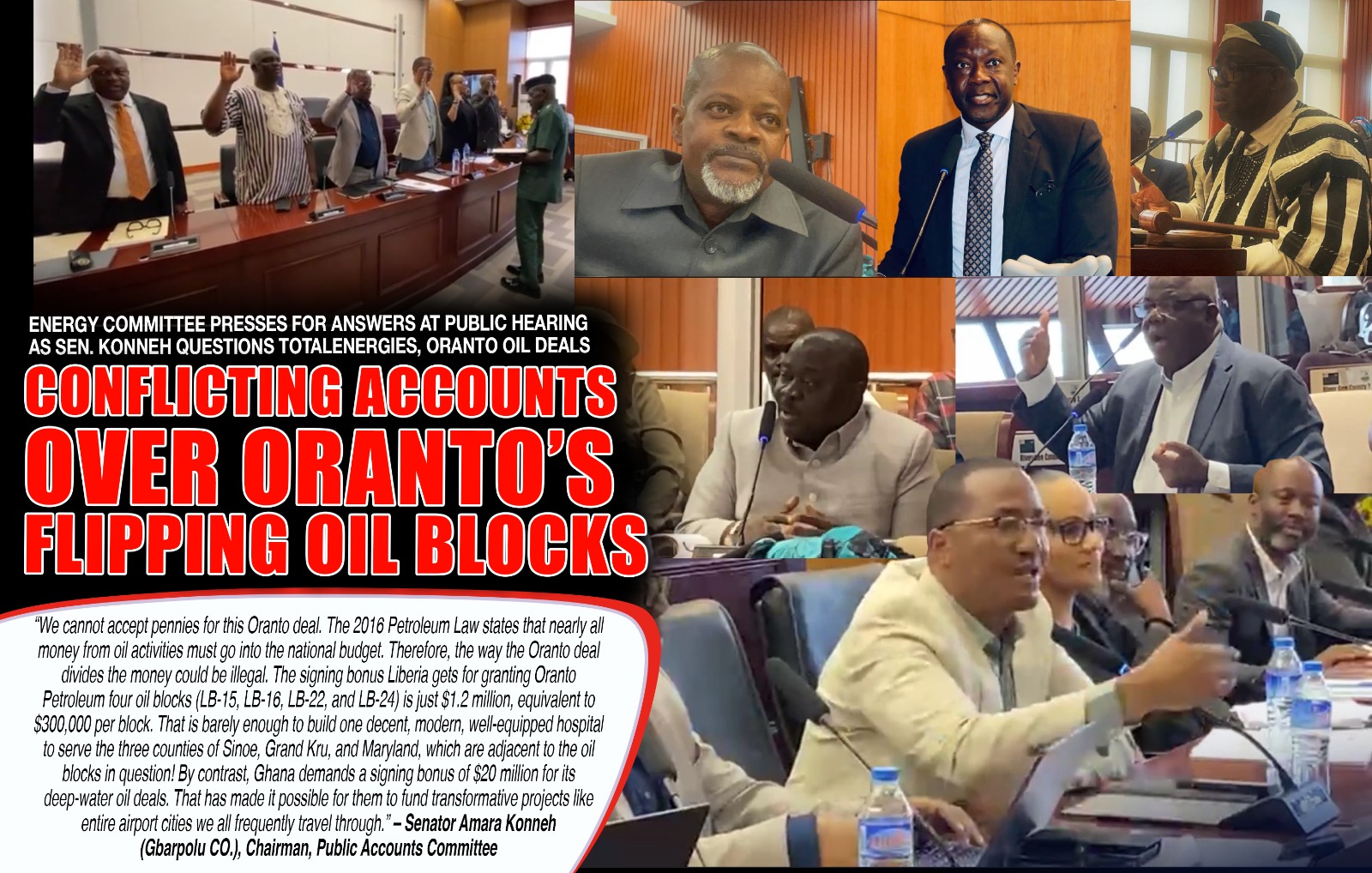
CAPITOL HILL, Monrovia – A Senate public hearing aimed at scrutinizing two new petroleum agreements submitted by the Executive Branch has raised fresh concerns over Liberia’s dealings in the oil sector—specifically, the lack of clarity surrounding Oranto Petroleum’s past operations, tax obligations, and the true value Liberia earned when the company flipped its oil blocks to Chevron more than a decade ago.
By Obediah Johnson and Gerald C. Koinyeneh
Lawmakers questioned how oil blocks previously leased to Nigerian businessman Prince Arthur Eze for a reported US$250,000 were later flipped to Chevron for over US$200 million—with little to no benefit to the Liberian people. Despite that troubled history, Oranto has again been selected—alongside TotalEnergies—to operate eight offshore blocks.
Dillon: “Where Is Oranto Even Located?”
During the tense hearing, Montserrado County Senator Abraham Darius Dillon expressed shock that government representatives could not immediately identify the physical headquarters of Oranto Petroleum Liberia Limited.
“So the GOL is dealing with an entity and nobody from the GOL representing them seems to know where Oranto is headquartered in Liberia?” Dillon asked.
Madam Marilyn Logan, Director General of the Liberia Petroleum Regulatory Authority (LPRA), responded that the company was located in Sinkor and had been registered in Liberia in 2008, again in 2011, and most recently renewed on September 16, 2025.
But Dillon raised red flags over the timing of the latest renewal, noting that the registration was done after the concession agreement had already been submitted to the Legislature for ratification.
“I will be inquiring about Oranto’s business registration annually from 2008 to determine whether they have existed and operated in Liberia—including tax clearances,” he vowed.
Dillon also criticized LPRA for sending lawmakers unsigned copies of the Production Sharing Contracts (PSCs), noting the absence of President Joseph Boakai’s signature. Logan and Senator Edwin Snowe clarified that some copies contained the required signatures, prompting the committee to order LPRA to correct the errors and distribute proper copies.
Questions Over Taxes, Missing Data
The hearing failed to establish whether Oranto paid taxes during its previous stint in Liberia. Witnesses also struggled to confirm how long TotalEnergies and Oranto have operated in other jurisdictions, requesting more time to present documentation.
Senator Snowe expressed frustration
“We are reviewing massive petroleum agreements, yet the witnesses did not bring the actual documents the government signed.”
Bomi County Senator Alex Tyler added that the witnesses appeared “ill-prepared to proceed with the hearing.”
‘Oranto Made No Profit From Flipping Blocks’
NOCAL CEO Fabian Laj (Lai) defended Oranto’s capacity, describing it as an independent oil and gas exploration company with producing wells in Equatorial Guinea and Nigeria.
He confirmed that Oranto acquired three blocks in Liberia between 2007–2010 and later farmed out 70% to Chevron—but denied knowledge of the company receiving any significant payout.
“No, I am not aware of that; they farmed out,” Laj said.
He stated that Chevron only paid for certain data acquisition costs.
However, Laj also disclosed that Oranto may have spent up to US$80 million in Liberia between 2008 and 2010, including surface rental payments, social contributions, training funds, and seismic data acquisition.
Lawmakers remained unconvinced, citing years of unanswered questions about Oranto’s real financial dealings.
LPRA Defends New Deals
LPRA boss Marilyn Logan provided a detailed breakdown of the new PSCs, noting TotalEnergies EP Liberia covers Blocks LB-06, LB-11, LB-17, LB-2 and Oranto Petroleum Liberia Ltd.: Blocks LB-15, LB-16, LB-22, LB-24.
She argued the agreements guarantee Liberia substantial earnings even without commercial oil discovery, including US$27 million in signature and milestone bonuses, US$14.6 million in surface rentals during exploration, US$20 million in management fees over 10 years, US$1.6 million annually for training, US$1.4 million annually for social contributions, US$4 million for a hydrocarbon development fund and Customs lump-sum payments of US$300,000.
She emphasized strong local content requirements, including preferences for Liberian businesses whose prices do not exceed foreign bids by more than 10%.
“These agreements provide a responsible, transparent, and economically sound pathway for restarting Liberia’s oil and gas industry,” Madam Logan stated.
She added that the global environment for exploration had become highly competitive, and Liberia needed flexible fiscal terms to attract companies back into its frontier basin.
Konneh Raises Red Flags
Though absent due to medical leave, Senator Amara M. Konneh—Chairman of the Public Accounts and Expenditure Committee—submitted a memorandum questioning the deals’ credibility and economic value.
In a memo addressed to Senator Edwin M. Snowe, Chairman of the Joint Senate Committee reviewing the PSCs, Sen. Konneh delivered a pointed list of questions and warnings he hopes will guide the hearing toward “a deep and informative discussion to ensure Liberia reaps optimal benefit from these deals.” Sen. Konneh sharply criticized the US$1.2 million signing bonus offered by Oranto Petroleum for four offshore oil blocks—LB-15, LB-16, LB-22, and LB-24—amounting to just US$300,000 per block.
“That is barely enough to build one modern, well-equipped hospital to serve the counties adjacent to these oil blocks,” he wrote, noting that Ghana demands up to US$20 million for deep-water signing bonuses, funding massive national developments “like entire airport cities.” Konneh questioned the Ministry of Finance and Development Planning’s acceptance of what he termed “lousy fiscal terms.”
He pressed the executive officials to explain what metric was used to determine competitiveness and value for Liberia, why the Inter-Ministerial Concessions Committee (IMCC) accepted such low returns from a company with questionable history, and where was the Justice Minister during negotiations, and who protected Liberia’s interest? “Oranto Has No Credibility” — Past Failures in Liberia and Africa Cited Sen.
Konneh strongly opposed Oranto’s return, recalling the company’s failure to drill a single well after receiving oil blocks in Liberia in 2007. Instead, the company flipped the blocks to Chevron, reportedly profiting over US$100 million while Liberia “received almost nothing.”
He referenced similar patterns in several African countries—Uganda, Senegal, Equatorial Guinea—where oil blocks awarded to Oranto and its sister company, Atlas Petroleum, remain undeveloped. Konneh asked the committee to explain which international benchmarks were used to vet Oranto, why multiple African nations have distanced themselves from the company and what evidence shows Oranto can drill this time or protect Liberian interests?
Sen. Konneh reminded the committee that beginning 2011, the Liberian government funded scholarships to train engineers, lawyers, and petroleum specialists to handle complex oil negotiations—expertise he says is not being utilized.
He called for the incorporation of these experts into negotiations and PSC reviews, database of trained Liberians and relevant local companies, evidence from LPRA and NOCAL that such databases exist and a full report from NOCAL detailing all scholarships awarded, how beneficiaries are now contributing, and how the program will be strengthened. According to him, tapping these professionals is essential to enforce Article 13 of the PSC, which prioritizes hiring and procurement opportunities for Liberians.
Sen. Konneh proposed expanding citizen participation beyond a few local oil and gas companies. He called for the adoption of models where citizen-owned companies buy equity shares in oil blocks, hybrid approaches that allow the public to acquire shares through the market while companies retain majority stakes He argued that such models could broaden economic opportunities and spread wealth beyond concession fees.
Senators Want Hearing Rescheduled
Throughout the session, senators repeatedly expressed frustration at the unpreparedness of witnesses.
Sen. Snowe announced that the committee will summon the Ministry of Finance, Liberia Revenue Authority (LRA) AND Other relevant agencies to clarify unanswered questions, including allegations that Oranto previously abandoned staff in Liberia.
Support Independent Journalism
Your support helps FrontPage Africa continue delivering independent, credible, and impactful journalism. Every contribution strengthens our ability to investigate, inform, and hold power accountable while keeping quality journalism accessible to our readers.
Support our journalism or subscribe to receive the latest FrontPage Africa stories and updates.