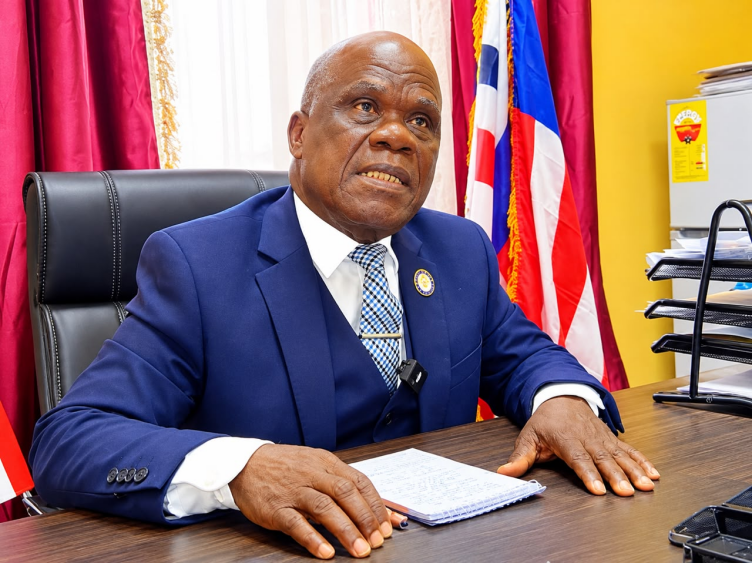
MONROVIA — As Liberia intensifies efforts to expand electricity access across the country, Grand Kru County Senator Numene T. H. Bartekwa is challenging the government and the Liberian Senate to ensure that his county does not remain on the margins of the national electrification drive, warning that continued exclusion could deepen the county’s development gap and undermine the government’s commitment to equitable national development.
The senator is seeking US$5 million in the proposed 2027 National Budget to establish five mini-solar electricity grids in strategic communities across Grand Kru, describing the investment as a necessary intervention to address decades of limited access to reliable electricity.
Bartekwa argues that while the government is making electricity investments in other parts of Liberia, Grand Kru risks being left behind, with residents and businesses continuing to depend heavily on expensive generators to meet their basic energy needs.
His appeal, contained in a formal communication dated November 10, 2026, and addressed to Senate President Pro Tempore Nyonblee Karnga-Lawrence, was presented during Thursday’s Senate session.
The senator’s request raises a broader development question: Can Liberia genuinely claim to be pursuing nationwide electricity expansion when an entire county remains outside the ongoing infrastructure drive?
For Bartekwa, electricity access should not be determined by geographical location, political influence or the economic attractiveness of a particular county. Rather, he believes every Liberian community deserves a fair opportunity to benefit from the country’s development agenda.
In his communication, the Grand Kru lawmaker expressed concern that the county could become increasingly isolated from the government’s electricity expansion program under President Joseph Nyuma Boakai’s ARREST Agenda.
He maintained that electricity infrastructure development, including the installation of power poles, transmission lines and household connections, is progressing in the other 14 counties, while Grand Kru has yet to benefit from comparable ongoing interventions.
Although he commended the administration for its efforts to extend electricity to other parts of Liberia, Bartekwa insisted that national development cannot be considered inclusive if Grand Kru continues to be excluded from such essential public investments.
The senator’s proposal is therefore not simply a request for additional budgetary support; it is a call for the government to address what he considers a growing infrastructure imbalance and demonstrate that the promise of development under the ARREST Agenda extends to every county.
US$5 Million Investment Targeted at Five Communities
To provide a practical solution, Bartekwa disclosed that the county’s leadership had engaged the Rural and Renewable Energy Agency (RREA) to explore alternative electricity options, particularly solar-powered mini-grids capable of serving households, businesses and other community institutions.
Following those engagements, the agency reportedly estimated that approximately US$1 million would be required to establish a mini-solar grid in each of five major communities, bringing the proposed investment to US$5 million.
The targeted communities are Grand Cess, Buah Geeken, Sasstown Down Beach, Garaway Down Beach and Barclayville, the county’s capital.
According to the senator, RREA has assured the county administration of its readiness to undertake the installations, using the solar electricity system in Totota, Bong County, as a model, once the necessary funding becomes available.
The proposal offers a potentially practical pathway toward expanding electricity access without waiting for the immediate extension of conventional power transmission infrastructure into the county.
More importantly, the proposed investment could create opportunities for small businesses, improve household living conditions, support commercial activities and strengthen the delivery of essential community services.
For communities where electricity remains expensive and unreliable, access to solar-powered mini-grids could significantly reduce dependence on privately operated generators and the recurring costs associated with purchasing fuel and maintaining generating equipment.
Electricity: More Than a Convenience
The significance of Bartekwa’s request extends beyond the installation of solar panels and the provision of household lighting.
Electricity is a fundamental driver of economic productivity, educational advancement, healthcare delivery and private-sector development.
Without reliable power, small businesses face increased operating expenses, entrepreneurs struggle to expand their operations, students experience limitations in accessing modern learning resources, and health facilities encounter difficulties sustaining essential services.
For Grand Kru, where geographical isolation and infrastructure limitations already present development challenges, the absence of reliable electricity could further discourage investment and restrict economic opportunities.
A properly implemented mini-grid program could help address some of these constraints by creating a more enabling environment for commercial activities, including refrigeration, food processing, welding, information technology and other electricity-dependent enterprises.
It could also support improved service delivery in schools, health facilities and other public institutions.
Consequently, the proposed US$5 million should be viewed not merely as an expenditure on electricity infrastructure but as a strategic investment in the county’s long-term economic and social development.
A Test of the Government’s Commitment to Inclusive Development
Bartekwa’s appeal also places an important responsibility on the government’s budgetary and development institutions.
With the proposed US$1.54 billion FY2027 National Budget now before the Legislature, the Senate has an opportunity to determine whether the country’s development priorities will translate into tangible investments for communities that have historically faced infrastructure deficits.
The senator has specifically requested the Senate Plenary to empower the appropriate budget committees to consider and incorporate the US$5 million allocation into the proposed national spending plan.
His argument is particularly significant because the ARREST Agenda emphasizes inclusive development. If electricity expansion is one of the administration’s priorities, then communities in Grand Kru should not have to wait indefinitely to benefit from that commitment.
However, the proposed allocation must also be accompanied by clear implementation arrangements, transparent procurement, effective project supervision and measurable delivery targets to ensure that the money produces actual electricity infrastructure rather than becoming another budgetary promise.
The government and RREA would also need to provide clarity on the proposed mini-grids’ generating capacity, projected household and business connections, maintenance arrangements, tariff structure and long-term sustainability.
Such safeguards would help ensure that the investment delivers reliable and affordable electricity beyond the initial construction phase.
Representation Under Growing Public Pressure
Beyond the infrastructure concerns, Bartekwa disclosed that the continued absence of electricity expansion projects in Grand Kru is beginning to generate frustration among residents, some of whom are questioning the effectiveness of their elected representatives in securing development opportunities for the county.
That concern adds a political dimension to the senator’s intervention, particularly as citizens increasingly expect measurable results from their representatives and the national government.
For Bartekwa, the Senate’s intervention would demonstrate that the Legislature is not merely a lawmaking institution but also a platform through which the concerns and development priorities of ordinary Liberians can be elevated and addressed.
He warned that the continued exclusion of Grand Kru from electricity expansion efforts could leave residents feeling abandoned despite the county’s participation in the national development process.
The senator is therefore asking his colleagues to treat the proposed US$5 million as a development priority rather than an ordinary budget request.
Ultimately, the debate surrounding Bartekwa’s proposal presents the government with an opportunity to demonstrate that national development is not measured solely by the number of projects launched in major urban centers or more accessible counties, but also by the extent to which historically underserved communities are brought into the country’s development process.
Grand Kru does not necessarily need preferential treatment; it needs equitable consideration.
As lawmakers begin scrutinizing the proposed FY2027 National Budget, the question before the Senate is whether the county’s electricity concerns will receive the financial attention they deserve or remain another development aspiration deferred to a future administration.
For the people of Grand Kru, the requested US$5 million represents more than a budgetary figure. It represents the possibility of brighter homes, stronger businesses, improved public services and a meaningful opportunity to participate in Liberia’s expanding economic future.
The ultimate test will not be how convincingly the government promises nationwide electricity access, but whether communities such as Grand Kru can finally experience the benefits of that promise.