
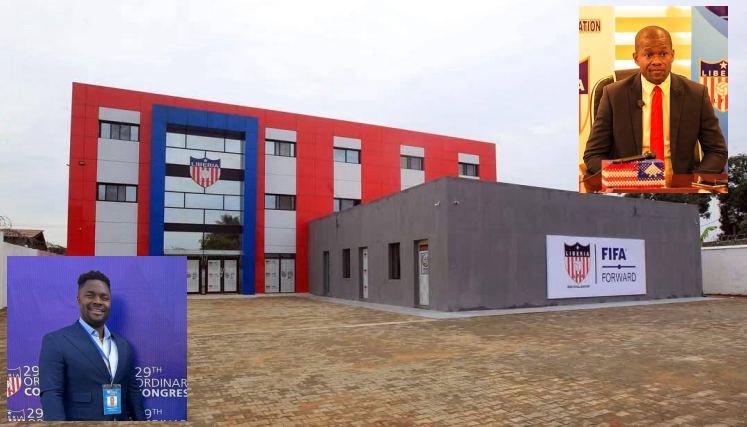
Monrovia – The legal firestorm surrounding the eligibility of FC Fassell President Cassell Anthony Kuoh to contest the upcoming Liberia Football Association (LFA) elections has reached the nation’s highest temple of justice.
By: Christopher C.Walker 0777898224/0886723075, [email protected]
Sources close to Kuoh indicate that a petition filed before the Supreme Court of Liberia seeks a definitive interpretation of the LFA Statutes in light of the 1986 Constitution of Liberia.
According to information obtained by FrontPage Africa from the Kuoh camp, the legal maneuver is not a traditional lawsuit against the LFA, but rather a request for the Bench to test the constitutionality of Article 58.1 of the LFA Statutes.
That specific provision bars individuals convicted of criminal offenses from seeking office within the local football governing body.
Constitutional Supremacy vs. Institutional Rules
Kuoh’s legal team is asking the Bench to determine whether the “Football House” rules conform to the national organic law, arguing that no institutional regulations can supersede the supreme law of the land.
“We did not take the LFA to court. All we did was ask the Supreme Court to explain whether the statute of the LFA is in line with the Constitution of the Republic of Liberia,” a source close to Kuoh told FrontPage Africa on condition of anonymity.
The Supreme Court has reportedly given the LFA’s legal team ten days to respond to the petition. Should the LFA fail to meet this deadline, the Justices are expected to issue an opinion on Kuoh’s eligibility for the April 18, 2026 elections based on the merits of the petition alone. If the LFA responds within the stipulated timeframe, the Court will summon both parties for oral arguments before rendering a final verdict.
The ‘Public Funding’ Argument
A central pillar of Kuoh’s challenge rests on the LFA’s receipt of government funding. His supporters argue that because the LFA receives allocations from the National Budget, it functions as an extension of the state and must adhere strictly to constitutional protections.
“The Liberia Football Association receives money in the national budget. However you look at it, they are part of the government, and they are bound by the Constitution of Liberia,” the source maintained.
The camp further suggested that the legal showdown could have been avoided had the LFA leadership heeded Jubilee FC’s previous call for an Extraordinary Congress to review and amend controversial provisions, an effort that proved unsuccessful.
The Backdrop of Conviction
Kuoh’s eligibility has been the subject of intense debate due to his 2017 criminal conviction in the United States. He was sentenced to 87 months in federal prison after pleading guilty to conspiracy to commit wire fraud. U.S. court records indicate the scheme defrauded investors of over US$9.5 million through fraudulent gold and diamond exports.
Since his release in 2023, Kuoh has aggressively reinvested in Liberian football, leading FC Fassell to a First Division title. However, Article 58.1 remains his primary hurdle to the LFA presidency, where he is viewed as the chief challenger to incumbent Mustapha Raji.
The Legal Pillars: Why Kuoh Believes He Can Win
Kuoh’s legal team is expected to rely heavily on the “Restoration of Rights” clause found in the 1986 Constitution.
Article 21(j): This provision dictates that any person convicted of a criminal offense shall have their civil rights and liberties automatically restored upon serving their sentence and satisfying any penalties.
Constitutional Provision Core Argument
Article 2 The Constitution is supreme; any LFA statute inconsistent with it is void.
Article 11(a) & (c) All persons are equal before the law; barring former convicts from an LFA office is discriminatory.
Article 17 protects the right of all Liberians to associate and seek leadership in organizations.
The FIFA ‘Nuclear Option’
While Kuoh plays the constitutional card, the LFA is expected to counter with the principle of “Global Autonomy.” Under FIFA Articles 14 and 19, member associations must manage their affairs independently without “third-party interference.”
If the Supreme Court overturns an LFA statute, the world football governing body, FIFA, may view it as government interference.
In the past, countries like Nigeria and Kenya have faced global bans when civil courts attempted to dictate football election rules.
The LFA’s legal representation has until February 12, 2026, to respond to the high court. As that deadline looms, the football world remains on edge.
The Supreme Court’s interpretation will not only decide Kuoh’s political future but could fundamentally redefine the boundary between the autonomy of sports federations and the supremacy of Liberian law.
Support Independent Journalism
Your support helps FrontPage Africa continue delivering independent, credible, and impactful journalism. Every contribution strengthens our ability to investigate, inform, and hold power accountable while keeping quality journalism accessible to our readers.
Support our journalism or subscribe to receive the latest FrontPage Africa stories and updates.