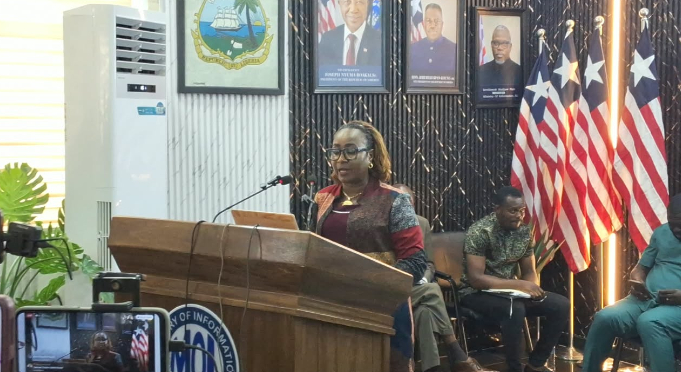
Monrovia, Liberia — ECOWAS Ambassador to Liberia, Josephine Nkrumah, has urged Liberians—especially young people—to rethink their approach to accountability, warning that the country’s biggest challenge lies not only in failed leadership but in a flawed national mindset.
By Patience M. Jones | [email protected]
Speaking Friday at an Intergenerational Dialogue on Strengthening Accountability in Democratic Governance, organized by NAYMOTE Partners for Democratic Development in collaboration with the Governance Commission, Ambassador Nkrumah stressed that Liberia’s democratic future depends on citizens holding themselves accountable before demanding the same from leaders.
The dialogue, held at the Governance Commission Conference Hall in Sinkor, brought together civil society actors, youth leaders, government officials, diplomats, and policy experts under the theme: “Strengthening Accountability in Democratic Governance: Building Trust, Integrity, and Intergenerational Leadership in Liberia.”
“Accountability begins with us”
Delivering a candid address, Ambassador Nkrumah said leaders are a reflection of the society that produces them.
“Our leaders do not come from Mars. Our leaders are a reflection of who we are,” she said. “If we keep demanding accountability while breaking rules in our daily lives, then we are part of the problem.”
She emphasized that corruption is not confined to public offices, but is embedded in everyday actions—bribing traffic officers, ignoring public rules, littering, or bypassing lawful procedures.
“Our mindset has failed us,” she added. “Until we change it, discussions about accountability will remain empty rhetoric.”
According to her, Liberia needs “a new kind of citizen”—one who prioritizes national interest, discipline, and responsibility alongside rights.
Rights without responsibility?
Nkrumah also warned of a growing imbalance in public discourse, where citizens vigorously demand their rights but often neglect their responsibilities.
“The citizens have their rights, but where are the citizens’ responsibilities?” she asked, noting that poor sanitation and damaged public infrastructure reflect collective neglect.
“Why is Monrovia filthy? Is it the politician who dropped the rubbish? We did,” she said. “You broke it, fix it.”
Civic education key to reform
The ECOWAS envoy underscored civic education as critical to building a culture of accountability, citing Ghana as an example where civic awareness has been systematically institutionalized across all levels of society.
“It did not happen by chance. It was deliberate,” she noted, urging Liberian institutions to embed civic responsibility into education and governance systems.
NEC’s Delaney: Ignorance fuels abuse
Also speaking, Archie Delaney, Sr., a Data and Spatial Management Consultant at the National Elections Commission (NEC), warned that civic ignorance remains a major threat to Liberia’s democracy.
“If you don’t know your rights, people will abuse you,” Delaney said.
He identified weak accountability systems, corruption, youth marginalization, and fragile institutions as key barriers to progress. Citing the 2022 census, he noted that young people dominate Liberia’s population, making them central to the country’s future.
Delaney called for sweeping reforms, including stronger anti-corruption institutions, independent oversight mechanisms, legal frameworks for youth inclusion, and a nationwide civic education campaign. He also renewed calls for constitutional reform, arguing that the current framework contributes to governance challenges.
Yealue: “Knowledge is not resident in positions”
Lawrence Yealue II, head of the National Civil Society Council of Liberia, challenged entrenched political and cultural norms, arguing that Liberia must confront outdated systems that limit youth participation.
“Knowledge is not resident in positions. Intelligence is not defined by appearance,” he said.
He criticized legal restrictions that allow young people to vote but bar them from contesting certain offices, describing such contradictions as outdated. He also lamented what he called a “lucky accident” system, where youth succeed despite structural barriers.
Kiawoin: Democracy lacks substance
James Kiawoin, Country Manager of Luminous Fund, described Liberia’s democracy as “procedural rather than substantive,” arguing that while elections are held, institutions remain weak and public trust is low.
“Many Liberians appeal to foreign embassies instead of local institutions when seeking justice,” he said, highlighting a lack of confidence in domestic systems.
Kiawoin also criticized the government’s approach to youth empowerment, saying it is often limited to short-term employment initiatives, while critical sectors like technology, higher education, and healthcare remain underfunded.
“We celebrate youth presence at the table, but rarely ask whether they have real power,” he noted.
Tokpa: Democracy is a shared responsibility
Alaric K. Tokpa, Acting Chairman of the Governance Commission, described democracy as a “collective trust” that requires active participation from all citizens.
“We must act because corruption erodes trust. We must act because exclusion weakens democracy. We must act because silence empowers impunity,” he said.
He urged both older and younger generations to embrace accountability, discipline, and responsibility in safeguarding Liberia’s democratic future.
A call beyond rhetoric
The event, opened by NAYMOTE Executive Director Eddie D. Jarwolo, emphasized the need for honest intergenerational dialogue as Liberia navigates its democratic path.
As discussions concluded, one message stood out: accountability must move beyond slogans to become a lived culture—driven not only by institutions, but by the daily actions of ordinary citizens.
For Ambassador Nkrumah, the path forward is clear:
“Without accountability beginning with us, democratic governance will remain nothing more than an academic exercise.”
Support Independent Journalism
Your support helps FrontPage Africa continue delivering independent, credible, and impactful journalism. Every contribution strengthens our ability to investigate, inform, and hold power accountable while keeping quality journalism accessible to our readers.
Support our journalism or subscribe to receive the latest FrontPage Africa stories and updates.