Monrovia – The four children of Siah Tamba, a visually impaired mother, attended a public school last school year due to the help of others. This year, she has not received any help and is worried that her kids will remain out of school.
Report by Aria Deemie, [email protected], Contributor
Siah had sponsored her kids until 2011 when she was diagnosed with cataract in the eye and a year later she became blind. Her husband had died couple of years earlier.
With her children not attending school since it resumed September this year, Siah often moves around town with one of them to beg passersby for handout.
“From morning to night, my children have to take me from one store to another before we can find food to eat, and this is not the life I had, I am a seamstress but with my disability what can I do,” she questioned rhetorically.
Siah is worried that the money raised from begging cannot send the kids to school so one of the three is sells boiled chicken eggs from money accrued from her daily begging.
Siah (her first daughter), 15, Tenneh, 6, Fayiah, 9, and Varney, 12, are her four children. The eldest, “Small” Siah is now an eighth grader at the Matilda Newport Junior High Public School.
“Since I cannot send all of them to school, I had to send the oldest so that when she finishes, she will help her siblings, I have no choice, but this is what I have to do,” she said.
Siah is recommending that the Government specifically the Ministry of Gender and partners help with children who are born unto parents with disability.
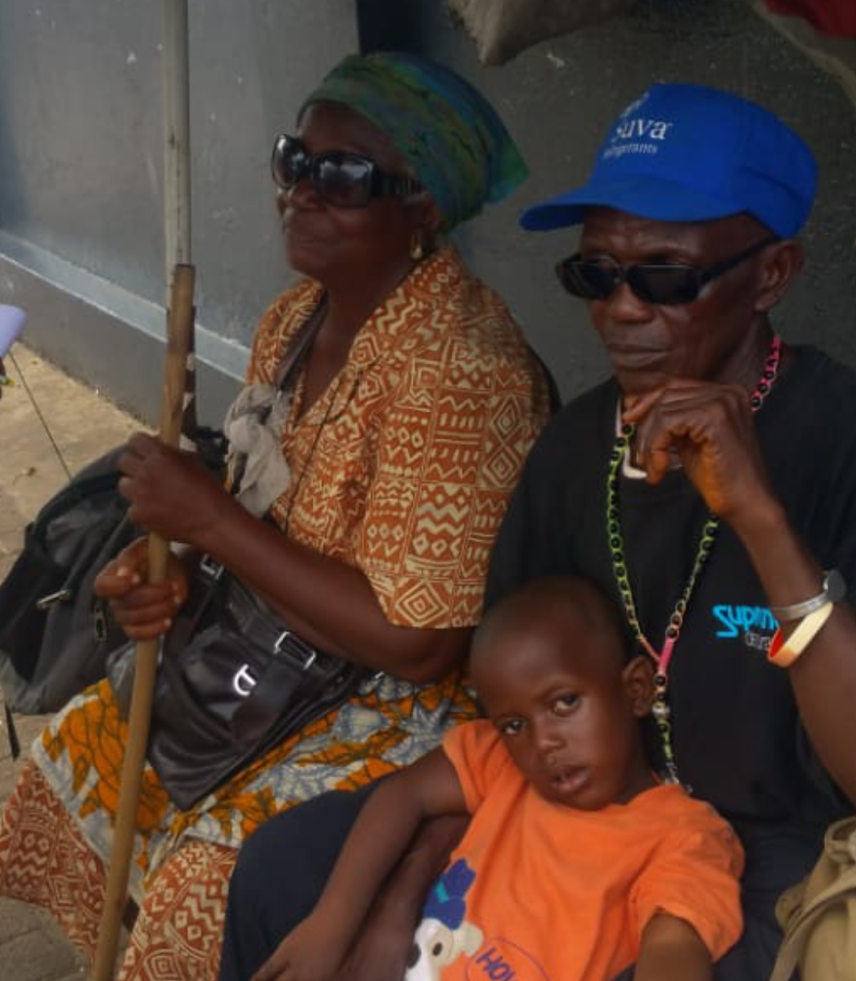
Like Siah, Kumba Matthew is a grandmother of four children who have also not enrolled in school this year due to financial constraints. The children’s father is a farmer in Lofa County while their mother sells charcoal for a living.
Kumba grandchildren were sent to school last year through community members’ intervention. So far this year, no one has extended alms.
According to her, she became visually impaired in 2015 after she was diagnosed with pressure in the eye.
Kumba now depends on her grandkids to carry her around the city, where she begs for alms to pay her rent and cater for her grandchildren.
“I never thought that I will result to this, begging from stores, market,” she said.
“I mean anyone who can give me a dime for a day that’s what we survive on, because my blindness, it is hard and I don’t know what to do.”
Samuel Patrick, 13, and Isaac Patrick, 11, carry the burden of catering for the other two despite their tender ages. The two boys say street begging is the only option to source money for food.
“If we don’t take her to beg, how we will get food, so it’s compulsory that we take her to beg, because at the end of the day what we raised is for everybody,” said Samuel, who recounted how they are often insulted and bullied.
“When we take her to stores and shops to beg, sometimes the words said to her, we can feel bad, but nothing to do; we can only continue to beg.”
“Since I cannot send all of them to school, I had to send the oldest so that when she finishes, she will help her siblings, I have no choice, but this is what I have to do.”
– Siah Tamba, a visually impaired mother of four
David Molubah, another visually impaired father of two children who also survives by means of begging, says he cannot afford to send his children to school this year.
Before becoming visually impaired, Molubah was a carpenter. Now, his five-year-old son Godgive leads him in the streets to beg.
“I know trade, but look at me, I can’t even afford to send my children to school before I can say provide them food, life is just unbearable right now as I speak,” he said.
He added that all those who helped him in the past no longer extend alms to him because of the bad economy.
“Anyone you asked now, you hear them say it’s pro-poor, and I can’t force them because they have their families,” said Molubah.
Molubah recalled his friend who passed last year because he couldn’t withstand the poor economy coupled with failure to provide for family.
“Last year my friend drank poison and died because he couldn’t stand the hardship,” he said.
Despite the ‘bad economy’ Molubah is hopeful that his children will be assisted by a Good Samaritans.
According to UNICEF most recent estimates, approximately 15-20% of children aged 6-14 years old are not enrolled in school.
In 2015, school census data indicated that approximately 170,000 children between the ages of 6-14 were not enrolled in school – equal to approximately 17% of the population of children aged 6- 14.
Alfreda Jacobs, Director for Rehabilitation at The Ministry of Gender and Social Protection, says her department focuses on providing psychosocial counseling, promotes children within the family service, refers them to services that are available if needed, advocate for their rights (education, better livelihood) and provide them with available scholarships.
Jacobs added that the Ministry doesn’t take the children away from their parents but will do “only in extreme situations”.
Support Independent Journalism
Your support helps FrontPage Africa continue delivering independent, credible, and impactful journalism. Every contribution strengthens our ability to investigate, inform, and hold power accountable while keeping quality journalism accessible to our readers.
Support our journalism or subscribe to receive the latest FrontPage Africa stories and updates.