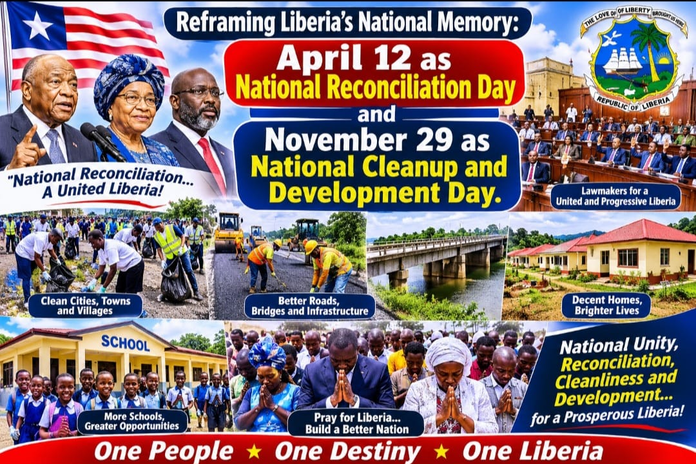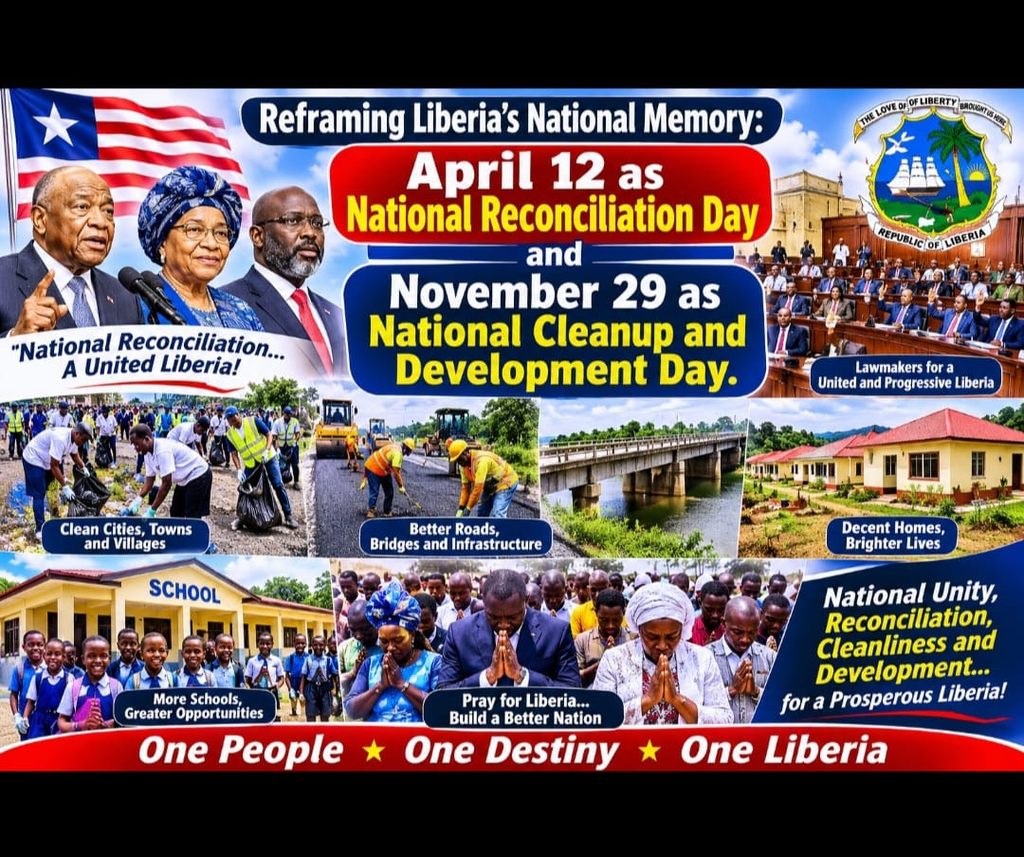
April 12 — National Reconciliation Day: A day to remember the consequences of the 1980 military coup, reflect on the suffering that followed, honor victims, confront historical injustices, and promote forgiveness and national healing.
By: Austin S Fallah – A True Son of the Planet Earth Soil: [email protected]
November 29 — National Cleanup and Development Day: A day dedicated to cleaning our cities, towns, villages, waterways, public institutions, and communities while renewing our commitment to moral responsibility, environmental stewardship, and national development.
President Joseph Nyuma Boakai: National Reconciliation and Healing: September 23, 2025: United Nations General Assembly address. President Boakai stated: “My government has taken deliberate and meaningful steps toward national reconciliation.” He further emphasized the pastortance oictims, memorialization, justice, and the rule of law. Why this matters: April 12 can become an opportunity to translate the President’s stated commitment to national reconciliation into a nationwide culture of remembrance, accountability, and healing.
Former President Ellen Johnson Sirleaf — National healing and reconciliation; January 16, 2006 — Inaugural address: “True reconciliation means a process of national healing.” She added that reconciliation involves learning from the past, strengthening democracy, promoting economic justice, and expanding opportunities for citizens. Why this matters: Her words provide a strong historical foundation for transforming April 12 from a date associated with political upheaval into a day devoted to national healing and reconciliation.
Former President George Manneh Weah: National unity and collective responsibility: January 22, 2018 — Inaugural address: “The loudest battle cry that must ring from the mountains of Wologisi to the peak of Yekepa; from the ranges of Putu to the hills of Bomi; from the coast of Harper to the shores of Monrovia, must be the cry of National Unity!” He also stated:
“We belong to Liberia first before we belong to our inherited tribes, or chosen counties.”Why this matters: These statements support a national initiative that brings Liberians together regardless of political affiliation, ethnicity, county, religion, or social background.
Liberia’s history contains moments of profound pain, political transformation, social division, and national aspiration.
The country has endured settler-indigenous inequality, authoritarian rule, military coups, civil wars, corruption, economic hardship, and repeated struggles to build a democratic society that serves all its people.
Yet Liberia has also demonstrated remarkable resilience.
Its people have repeatedly shown the ability to survive crisis, rebuild institutions, and renew hope in the possibility of a better nation.
For Liberia to move forward with a stronger sense of common citizenship, the National Legislature should pass laws declaring April 12 a National Reconciliation Day and November 29 a National Cleanup and Development Day.
These observances would not simply add more holidays to the nasecond-classdar.
Propetheired, they could become instruments for civic education, healing, public service, national unity, and development.
April 12 marksed as National Reconciliation Day because it represents a major rupture in Liberia’s politihe diedpril 12, 1980, the administration of President William R. Tolbert Jr. was overthrown by a group of enlisted soldiers led by Master Sergeant Samuel Kanyon Doe.
The event ended more than a century of political dominance by the Settlers-Liberian establishment and the True Whig Party. For many indigenous Liberians, the overthrow of the old order was seen as the fsawd the long-standing exclexpandedpopulation.
The revolutiongreaternce and later disappointments, symbolized the demand for a Liberia in which citizenship, opportunity, and political authority would not be reserved for a narrow elite.
At the same time, April 12 cannot be treated as a simple celebration of a military coup.
The events surrounding the overthrow of the Tolbert government included violence, executions, fear, and national trauma.
Liberia’s later history also demonstrated that the collapse of an authoritarian political order did not auly create democracy, justice, or prosperity.
The People’emption Council, or PRC, assumed power after the coup and promised change and greater inclusion.
Ito serveal structure that had dominated Liberia for decades.
Indigenous Liberians and people from previously mara ginalized backgrounds gainrecordter visibility in national affairs.
In this sense, the April 12 movement opened a national conversation about representation, equality, and who had the right to shape Liberia’s future.
However, the PRC period also showed the danger of replacing one form of exclusion with another form of political domination.
The lesson of April 12 should therefore not be that La iberia ought to glorify milita ary rule or overlook thea suffering causan ed by political via olence.
Rather, a the lesson should be that no nation can survive peacefully when large segments of its population feel excluded from power, opportunity, dignity, and justice.
A national observance devoted to reconciliation would allow Liberians to remember the event honestly while using its historical meaning to promote a different future.
Declaring April 12 National Reconciliation Day would allow the country to bring together descendants of settlers, indigenous communities, survivors of political violence, former combatants, youth, women, religious leaders, traditional leaders, public officials, and members of the Liberian diaspora.
The central idea should be that Liberia belongs equally to all Liberians.
For too long, the country’s history has been interpreted through competing narratives: one group remembers exclusion under the old political order; another remembers the killings and instability that followed the coup; others focus on the civil wars, displacement, and economic destruction that later devastated the country.
These experiences are real, and national unity cannot be built by forcing citizens to forget them.
Reconciliation does not mean pretending that the past never happened.
It does not mean that victims must remain silent or that historical injustices should be excused.
Genuine reconciliation requires truth, acknowledgment, forgiveness where possible, accountability where necessary, and a shared commitment not to repeat the mistakes of the past.
April 12 should therefore be observed through public dialogues, memorial services, peace forums, school programs, cultural events, and community meetings.
The holiday should encourage Liberians to discuss the country’s history with maturity rather than bitterness.
It should create space for citizens to say: “We remember the pain, but we refuse to allow the pain to destroy our common future.”
Such a day could also strengthen civic education. Many young Liberians were born after the coup of 1980 and after the civil wars that followed.
Their understanding of national history may come from family stories, political speeches, or fragmented public narratives.
Schools should use National Reconciliation Day to teach students about the causes and consequences of inequality, authoritarianism, military intervention, civil conflict, and democratic reform.
Students should learn that political power is not a privilege of one class, tribe, region, or family.
They should also learn that democracy requires respect for human rights, peaceful elections, constitutional government, and the rule of law.
A thoughtful April 12 observance would help move Liberia away from personality-centered politics.
Instead of celebrating an individual leader or a military regime, the country would honor the broader principle of national inclusion.
The day would represent the moment when Liberians from different social backgrounds were forced to confront the reality that the old political arrangement could not continue unchanged.
The goal would be to transform that painful historical turning point into a lasting commitment to equality and unity.
The phrase “let bygones be bygones” is meaningful only when it is understood responsibly.
Liberia must not remain imprisoned by historical resentment, but neither should it bury its history without learning from it.
Letting bygones be bygones should mean refusing to inherit hatred from previous generations.
It should mean recognizing that the children of those who suffered injustice are not destined to hate the children of those associated with privilege.
It should mean rejecting tribalism, regionalism, class prejudice, and political revenge.
Most importantly, it should mean building institutions that ensure no Liberian is again treated as a second class citizen in his or her own country.
In the same spirit, November 29 should be declared National Cleanup and Development Day.
November 29 is associated with the birth of President William V. S. Tubman, who led Liberia from 1944 until his death in 1971.
Tubman remains one of the most significant figures in Liberian political history.
His administration introduced policies such as the Open Door Policy, which sought foreign investment, and the Unification Policy, which formally promoted the integration of indigenous Liberians into the national political community.
Under his leadership, Liberia experienced infrastructure growth, expansion in public administration, and increased international visibility.
Roads, schools, public buildings, and economic projects became symbols of a nation seeking modernization.
Nevertheless, Liberia should not celebrate November 29 as an unquestioning tribute to Tubman’s 27 years in power.
His long presidency also reflected the dangers of one-party dominance, corruption, human rights abuses, political imprisonment, and concentrated executive authority.
The political system of the period did not provide the level of competition, accountability, and democratic participation that Liberia needs today.
If November 29 is to remain meaningful, it should be redefined in a way that serves the needs of contemporary Liberia rather than merely honoring the legacy of an individual president with questionable human rights records.
National Cleanup and Development Day would be a fitting, productive way to do so.
It would connect national development to practical citizenship.
Development is not only the responsibility of the president, ministers, lawmakers, international partners, or private investors.
It is also the responsibility of ordinary citizens.
A clean community, functioning drainage system, protected water source, repaired road, organized market, planted tree, and maintained public school all reflect the everyday work of nation-building.
When citizens participate directly in improving their neighborhoods, they develop a stronger sense of ownership in the country’s future.
On every November 29, the government should organize a nationwide service initiative involving counties, districts, cities, towns, schools, churches, mosques, civil society organizations, businesses, and Liberians abroad.
Activities could include cleaning streets and markets, clearing drainage systems, removing garbage from public spaces, rehabilitating community roads, planting trees, repairing schools and clinics, restoring public playgrounds, and educating citizens about sanitation.
Such a program would be especially important in urban communities where poor waste management and blocked drainage contribute to flooding, disease, and environmental degradation.
The holiday should not be limited to sweeping streets for a few hours.
Its true purpose should be planning for development. Each community should use the day to identify local priorities and begin projects that can continue throughout the year.
For example, a community may decide to establish a waste collection committee, repair a damaged bridge, construct public toilets, support a youth vocational program, create a reading center, or organize a farmers’ cooperative.
Local governments could use the occasion to present development reports and receive public feedback.
Citizens should be able to ask what happened to allocated funds, which projects were completed, and what plans exist for the coming year.
In this way, National Cleanup and Development Day would combine service with accountability.
The Legislature would play a critical role in making both observances meaningful.
A law establishing the holidays should clearly define their objectives, activities, and institutional responsibilities.
The law should designate April 12 as a day for reconciliation, peace education, historical reflection, and national unity.
It should designate November 29 as a mandatory national day of community service, environmental sanitation, and local development planning.
Ministries responsible for education, internal affairs, youth and sports, public works, health, gender, and environmental protection should collaborate with county authorities and civil society groups.
The law should also ensure that these days do not become empty ceremonies dominated by political speeches.
National Reconciliation Day must not be used to promote one political party, ethnic group, or historical faction.
National Cleanup and Development Day must not become a photo opportunity for officials while ordinary citizens perform all the labor.
The success of both holidays would depend on transparency, broad participation, and measurable outcomes.
County and municipal authorities should publish reports showing the activities completed, funds used, challenges encountered, and plans for future improvement.
Liberia’s future will not be secured by forgetting history, nor will it be secured by remaining permanently divided by history.
The country needs national symbols that encourage citizens to reflect honestly on the past while working collectively in the present.
April 12 and November 29 can serve this purpose if they are reimagined with wisdom.
April 12 should become National Reconciliation Day because it marks a historic turning point in the struggle to create a Liberia in which indigenous people and settlers, rural citizens and urban citizens, rich and poor, young and old, can sit at the same table to discuss the future of their country.
Its observance should acknowledge the injustice of exclusion, the tragedy of violence, and the necessity of peaceful democratic inclusion.
It should send a clear message that Liberia has one people and one future.
November 29 should become National Cleanup and Development Day because national progress requires more than admiration for past leaders.
It requires citizens who think and act like developers of a new nation in the 21st-century and beyond.
By cleaning communities, protecting the environment, planning local projects, and demanding accountability, Liberians can honor the aspiration for development without celebrating authoritarianism.
Together, these two national days would express a powerful vision: Liberia must reconcile its people and rebuild its country.
One day would call citizens to heal the social and political wounds of the past; the other would call them to put their hands, minds, and resources into the work of development.
This is the kind of national memory Liberia needs, not memory that divides, glorifies, or retaliates, but memory that educates, reconciles, mobilizes, and builds.
Support Independent Journalism
Your support helps FrontPage Africa continue delivering independent, credible, and impactful journalism. Every contribution strengthens our ability to investigate, inform, and hold power accountable while keeping quality journalism accessible to our readers.
Support our journalism or subscribe to receive the latest FrontPage Africa stories and updates.