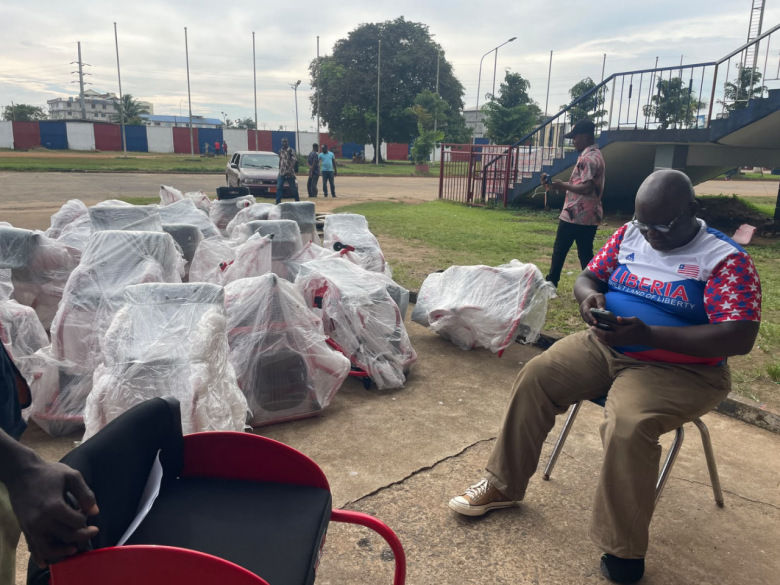
Paynesville City–The Liberia National Wheelchair Basketball Federation, founder Ambassador S. Lionel Johnson, says President Joseph Nyuma Boakai’s donation of specialized sports wheelchairs has given Liberian athletes with disabilities a major opportunity to compete internationally after years of struggling with inadequate equipment.
By Jaheim T. Tumu- [email protected]
For years, the federation has faced difficulties participating in international competitions because it lacked the specialized wheelchairs required for the sport. Whenever the team traveled outside Liberia, it had to rent equipment, often at high costs and sometimes using old wheelchairs.
But Johnson says the President’s intervention has changed that situation, giving the athletes access to equipment that could improve their performance and reduce the financial burden on the federation.
Johnson recalled that the federation first appealed to President Boakai on October 24, 2024, requesting 100 sports wheelchairs. He said the President subsequently facilitated the procurement of 36 wheelchairs in March 2026, although only 24 are currently in Liberia.
Describing the donation as a major breakthrough, Johnson said the new equipment is among the best available in West Africa.
“Most of the sports wheelchairs we rent are very old ones. We pay huge money for them because we want to represent our country in wheelchair basketball,” he said.
The federation’s founder said the donation has relieved the athletes of a major challenge they had faced whenever Liberia received an international invitation.
“I don’t want to be so emotional and cry, but this is a very big breakthrough for us,” Johnson said.
He also praised President Boakai for paying a fine that had resulted in the federation’s suspension by its international governing body and supporting Liberia’s participation in a competition in South Africa in 2025.
Johnson said the President’s intervention helped the federation return to international competition after years of financial struggles.
However, while celebrating the donation, he made it clear that providing sports wheelchairs alone cannot solve the challenges facing wheelchair basketball in Liberia.
Athletes Have Wheelchairs, but No Proper Court
One of the federation’s biggest challenges is the lack of a proper basketball court and gymnasium where athletes can train and compete.
Johnson explained that wheelchair basketball requires a specialized wooden playing surface. Unlike ordinary basketball, the sport requires a suitable court that allows the sports wheelchairs to move properly during competition.
Although the federation has access to an open-air training area, it still needs funding to roof the facility and install the appropriate wooden floor.
For Johnson, this is a serious concern because the country could invest in sports wheelchairs without providing the facilities needed to use them effectively.
“We cannot be buying sports wheelchairs where we don’t have gymnasium or we don’t have the court to play on,” he said.
His concern highlights a gap in Liberia’s disability sports development: athletes are receiving equipment, but the infrastructure needed to support their training and development remains inadequate.
Liberia Faces Funding Challenge Ahead of Cairo World Cup
The federation is now preparing for the 3-on-3 Wheelchair Basketball World Cup in Cairo, Egypt, scheduled for November 23–29, 2026.
Johnson said Liberia is the only African country expected to represent the continent at the competition, which will bring together teams from across the world, including the United States, Canada, Australia, Germany and Asian countries.
But despite receiving the sports wheelchairs, the federation still needs financial assistance to transport its athletes and meet the cost of participation.
Johnson warned that failure to attend could result in Liberia being suspended and facing a substantial fine.
“We are awaiting a positive response from our own communication that will be able to help us to get to Thailand and complete the 3-on-3 World Cup in Cairo, Egypt,” he said.
The federation is also seeking government support for a high-performance and capacity-building camp in Thailand to improve the team’s competitiveness.
Johnson expressed confidence that President Boakai would respond positively, saying the President has consistently supported the federation.
The situation, however, shows that the country’s progress in wheelchair basketball remains heavily dependent on government assistance whenever international competitions arise.
‘We Cannot Keep Running to the Executive Mansion’
Beyond the immediate need for international travel, Johnson wants the government to provide regular funding to develop wheelchair basketball across the country.
He disclosed that the federation submitted a budget proposal exceeding US$1 million to House Speaker Richard Koon in 2026, but the proposed funding did not materialize.
The federation has since submitted another budget proposal exceeding US$4 million to support its expanded activities.
The proposed funding would cover the purchase of additional sports wheelchairs, recruitment of players across the counties, training of technical staff, establishment of clubs and organization of national competitions.
Johnson said the federation cannot continue depending on the President whenever it needs money to participate in international competitions or organize local activities.
“We can’t keep going to the President every time we want to travel. No. We are in the budget,” he said.
His concern is that disability sports should have a sustainable place in the national budget rather than depending on individual appeals to the Executive Mansion.
He also questioned the level of institutional support available to disability sports within the Ministry of Youth and Sports, lamenting that the federation does not have a dedicated office or a representative specifically responsible for disability sports.
360 Wheelchairs Planned for County Sports Meet
Despite the financial difficulties, Johnson said the federation is planning to expand wheelchair basketball to all 15 counties ahead of the 2027 National County Sports Meet.
He disclosed that the federation expects to procure 360 new sports wheelchairs between January and March 2027, with 24 allocated to each county to support male and female teams.
The plan is part of a broader effort to make wheelchair basketball accessible to more persons with disabilities instead of concentrating the sport among a small number of athletes.
Johnson said the federation currently has six national teams and approximately 30 players. However, expanding the program will require more funding to recruit athletes, establish clubs and train technical personnel.
He described the 2027 County Sports Meet as an important opportunity for persons with disabilities to become more involved in national sporting activities.
Disability Sports Village Seen as Long-Term Solution
Johnson also wants the government to support the construction of the proposed Liberia National Disability Sports Village, which he considers essential to the future of wheelchair basketball and other disability sports.
He said the project is a central part of the federation’s long-term development plan because providing wheelchairs without suitable sporting facilities would not guarantee the growth of the game.
The proposed village is expected to provide a dedicated space where athletes with disabilities can train, compete and develop their sporting abilities.
Johnson wants the project proposal presented to President Boakai for consideration in the 2027 national budget, beginning with land acquisition and preparations for construction.
He believes the facility would provide the foundation needed to sustain wheelchair basketball and expand disability sports across Liberia.
Beyond Basketball: Giving Persons with Disabilities Hope
For Johnson, wheelchair basketball is not simply about winning competitions or representing Liberia internationally. He sees the sport as an opportunity for persons with disabilities to improve their lives, gain independence and become part of national development.
He estimated that more than one million persons with disabilities live in Liberia, many facing poverty, marginalization and limited opportunities.
Recalling an experience in Angola, Johnson said European scouts showed interest in Liberian wheelchair basketball players, with two athletes nearly securing opportunities to play professionally in Spain.
He believes such opportunities can change the lives of athletes who otherwise struggle to find employment and support themselves and their families. “Wheelchair basketball is not just a game, it is a way of life,” he said.
Johnson argued that through sports, persons with disabilities can gain international recognition and opportunities that extend beyond the basketball court.
While thanking President Boakai for the donation and Mamaika Bility for her role in facilitating the arrival of the wheelchairs, Johnson said the government must now move beyond individual assistance and establish a sustainable system for disability sports.
Support Independent Journalism
Your support helps FrontPage Africa continue delivering independent, credible, and impactful journalism. Every contribution strengthens our ability to investigate, inform, and hold power accountable while keeping quality journalism accessible to our readers.
Support our journalism or subscribe to receive the latest FrontPage Africa stories and updates.