FARMINGTON, November 2, 2026 – Margibi County – Liberia’s Customs Commissioner, Saa Saamoi, has called on customs intelligence officers across West and Central Africa to move beyond administrative reporting and strengthen practical, intelligence-led enforcement to combat transnational crime, protect national revenue, and facilitate legitimate trade.
By Emmanuel Weedee-Conway
Commissioner Saamoi noted that the operating environment for customs authorities has become increasingly complex and unpredictable, with growing pressure on seaports, airports, and land border crossings as global supply chains become more interconnected.
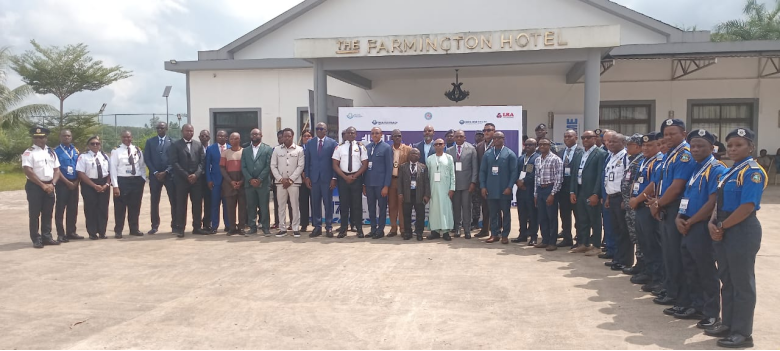
He made the call Monday, November 2, 2026 at the opening of the 17th Annual Joint Meeting of National Contact Points of the World Customs Organization (WCO) Regional Intelligence Liaison Offices (RILO) for West and Central Africa, held at The Farmington Hotel in Margibi County.
The meeting marks the first time Liberia is hosting the regional gathering, which has brought together delegates from 24 customs administrations.
“Global supply chains are becoming more interconnected, and our seaports, airports and land border crossings are experiencing growing pressure,” he said. “Today’s transnational criminal enterprises are often highly organized, financially resourced, technologically equipped and connected to networks extending across multiple jurisdictions.”
The Threats That Exist
According to the Commissioner, criminal networks are exploiting regulatory differences and weaknesses in intelligence-sharing systems to engage in activities such as cargo misdescription, under-valuation, origin fraud, document falsification, and the diversion of transit goods.
He challenged National Contact Points to move beyond serving as administrative channels for forwarding seizure reports, emphasizing that their effectiveness should be measured by the practical impact of intelligence exchanged and the enforcement operations it supports.
“The effectiveness of this network must ultimately be measured not simply by the volume of information we exchange, the number of meetings we convene or the reports produced, but by the operational value of the intelligence generated and the enforcement outcomes it supports,” Saamoi stressed.
“Intelligence collected but not analyzed has limited value. Intelligence analyzed but not shared in a timely manner loses its operational relevance,” he added.
The Customs Commissioner expressed hope that the Farmington meeting would be remembered not merely as the first time Liberia hosted the gathering, but for the practical outcomes and commitments it produces in strengthening regional cooperation against cross-border criminal activities.
Adapting Proactive Approach
Representing the Vice-Chair of the WCO West and Central Africa Region, Ibrahim Njoya emphasized the need for customs authorities to adopt a proactive approach to intelligence gathering and border surveillance.
“A vigilant customs service is one that does not simply check those who arrive at the border. It understands the circuits, identifies the methods, cross-references information, and directs its controls where the risk is real,” Njoya said while delivering the Vice-Chair’s address.
He disclosed that only 17 of the region’s 24 customs administrations participated in Operation CRIFAX 11, calling for broader and more consistent participation in future regional intelligence and enforcement initiatives.
“Information that isn’t shared in a timely manner loses most of its operational value,” Njoya noted.
He also commended the Liberia Revenue Authority (LRA) for involving other national law enforcement institutions in the meeting, describing interagency cooperation as essential to addressing increasingly sophisticated criminal networks.
Njoya further recalled that the 6th Annual Meeting in Bamako recommended the integration of emerging technologies, including geospatial intelligence, open-source intelligence, artificial intelligence, and tracking tools, to strengthen intelligence gathering and operational effectiveness.
Also speaking at the occasion, Director General of RILO West Africa, Amandu Tejan Sesay, said customs seizures involving narcotics, falsified medicines, and protected wildlife species should not be viewed merely as enforcement statistics but as interventions that protect communities and society.
“Criminal networks know how to exploit borders, adapt the routes, and take advantage of shortcomings in coordination between our services. Information collected in one country can inform an inspection in another,” Sesay noted.
He also praised a senior officer of the Liberia Revenue Authority’s Customs Department for representing the institution and Liberia positively across the region through professionalism, quality work, and commitment to the regional intelligence network.
At the same time, speaking on behalf of Liberia’s Joint Security, Deputy Director General of the Liberia Drug Enforcement Agency (LDEA), Prince B. Mulbah, warned that the country’s security environment has evolved from isolated criminal activities into an increasingly interconnected system of transnational organized crime.
“We are dealing with illicit drugs and psychotropic substances, particularly kush and tramadol, that are destroying our youths, illicit financial flows, arms smuggling, counterfeit pharmaceuticals and environmental crimes,” Mulbah said.
He observed that criminal networks are increasingly coordinating their operations across national borders, stressing that law enforcement institutions must adopt the same level of cooperation to effectively confront the threat.
Mulbah described intelligence shared through the WCO-RILO Customs Enforcement Network (CEN) and Customs Enforcement Network Communication (CENcomm) platforms as “the oxygen that Joint Security needs.”
He outlined three commitments on behalf of Liberia’s Joint Security institutions, which include the Liberia National Police, Liberia Immigration Service, LDEA, Armed Forces of Liberia, National Security Agency, Liberia Customs, and the Presidential Task Force on Illicit Mining.
“Number one, intelligence sharing is national security — we commit to breaking silos. Number two, from seizures to networks — we are moving away from only counting seizures to targeting the masterminds, the money and logistics. Number three, capacity and integrity — a well-trained, well-equipped and ethical officer is our best detector,” he declared.
Mulbah also urged delegates to openly address persistent challenges confronting regional enforcement efforts, including porous borders, inadequate forensic laboratories, delays in intelligence sharing, and corruption.
The week-long regional meeting is expected to assess the implementation of recommendations from the previous meeting in Bamako, improve data quality on the CEN and CENcomm platforms, and develop actionable recommendations to support coordinated enforcement operations across West and Central Africa.
The gathering is expected to strengthen regional collaboration and enhance the capacity of customs and law enforcement institutions to detect, disrupt, and dismantle criminal networks operating across national borders.
Support Independent Journalism
Your support helps FrontPage Africa continue delivering independent, credible, and impactful journalism. Every contribution strengthens our ability to investigate, inform, and hold power accountable while keeping quality journalism accessible to our readers.
Support our journalism or subscribe to receive the latest FrontPage Africa stories and updates.