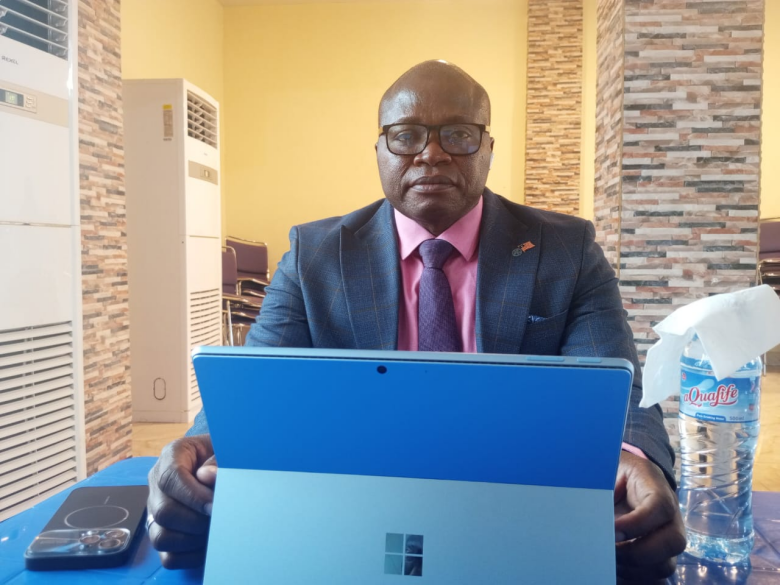
Ganta City, Nimba County — The United Nations Development Programme Deputy Resident Representative, Louis Kuukpen, has urged Liberia’s higher-education leaders to prioritize quality, relevance and collaboration as the country expands access to universities and colleges.
By Franklin Doloquee / Nimba County
Delivering the keynote address at the Public Higher Education Institution two-day Workshop in Ganta City, Nimba County over the weekend, UNDP Deputy Resident Representative Kuukpen said, ‘‘the future of Liberia will be determined not only by the natural resources beneath our soil, but increasingly by the knowledge, skills, creativity and capabilities of our people,” calling higher education a “nation-building imperative.”
Attendees included members of the National Commission on Higher Education, presidents and senior leaders of universities and colleges, development partners and other stakeholders.
Kuukpen said Liberia’s development ambitions hinge on the quality and relevance of its education system.
He urged universities to produce teachers, engineers, doctors, public servants, entrepreneurs, researchers and innovators who can drive economic transformation and strengthen institutions across the country.
Noting the education continuum, Kuukpen warned that weak literacy, numeracy, critical-thinking and digital skills at early stages undermine higher-education outcomes.
At the same time, he pointed out that strong universities are essential for training teachers, conducting research, developing curricula and producing evidence that benefits the whole system.
As Liberia expands higher-education access, Kuukpen argued, policymakers must be equally ambitious about quality.
He encouraged stakeholders to move beyond counting institutions, programmes and graduates and instead ask what students are actually learning, whether curricula match economic needs, whether faculty are qualified and whether learning infrastructure laboratories, libraries and technology is adequate.
Kuukpen emphasized the central role of the National Commission on Higher Education in safeguarding standards, accreditation and quality assurance.
“Quality assurance should not be seen simply as regulation or bureaucracy. It is about protecting the credibility and value of a Liberian university education,” he said, stressing that a degree represents a promise to employers, other universities and society.
He also called for greater relevance, urging universities to align research and teaching with national challenges including agriculture, climate change, healthcare, natural-resource management, digital government, infrastructure and job creation.
He proposed reframing the measure of success from “How many students are we graduating?” to “What problems are our graduates capable of solving.”
Kuukpen highlighted the growing importance of digital technologies and artificial intelligence (AI), saying Liberia must decide whether it will merely consume technologies developed elsewhere or develop the capacity to create, adapt and responsibly use them.
He cited UNDP’s collaboration with the University of Liberia to establish a postgraduate AI Programme, while cautioning that such a programme requires qualified faculty, technology, governance, research capacity and rigorous accreditation.
He issued four challenges to participants: place quality at the center of higher-education expansion, strengthen governance and accountability, deepen collaboration and research with industry and the private sector and prepare Liberian graduates to compete UNDP Urges Quality, Relevance in Liberia’s Higher Education globally.
“A graduate educated in Liberia should be able to stand confidently alongside a graduate educated anywhere in the world,” Kuukpen said.
In closing, Kuukpen reminded the audience that natural resources alone do not transform nations—people do.
He pledged UNDP’s continued support to the government, the National Commission on Higher Education, universities, the private sector and development partners to build Liberia’s human capital, digital capabilities and innovation ecosystem.
He left the workshop with a final question for the sector: “Are we simply producing more graduates or are we producing the knowledge, skills and people capable of transforming Liberia?”
Meanwhile, the two-day workshop held under the theme: “Strengthening Higher Education Governance and Quality Assurance Through Leadership, Collaboration and Institutional Standardization,” the workshop was held by National Commission on Higher Education in Ganta, Nimba County.
Support Independent Journalism
Your support helps FrontPage Africa continue delivering independent, credible, and impactful journalism. Every contribution strengthens our ability to investigate, inform, and hold power accountable while keeping quality journalism accessible to our readers.
Support our journalism or subscribe to receive the latest FrontPage Africa stories and updates.