Part III
The President of the Republic of Liberia, His Excellency Joseph Nyuma Boakai; Speaker Hon. Richard Nagbe Koon of the House of Representatives; and the President Pro Tempore, Madam Nyonblee Karnga-Lawrence, directly expressed their principles that the Legislature must demonstrate the standards of accountability it expects other government institutions to uphold.
By: Austin S Fallah – A True Son of the Planet Earth Soil: [email protected]
President Joseph Nyuma Boakai: Addressing the National Legislature:
“From Resolve to Results: Building on Progress and Delivering for the Liberian People.”
Context: Theme of the President’s Annual Message to the 55th Legislature, January 26, 2026.
Relevance: Legislative leadership should translate national priorities into laws, budgets, oversight, and tangible improvements in people’s lives.
Hon. Richard Nagbe Koon, Speaker of the Liberian House of Representatives: “Let me officially say welcome back to do the job for which you were elected and one to which you have committed yourselves.”
Context: Opening of the Second Quarter of the Third Session of the 55th Legislature, reported May 11, 2026.
Relevance: Legislative service must be measured by commitment to the responsibilities entrusted to elected representatives.
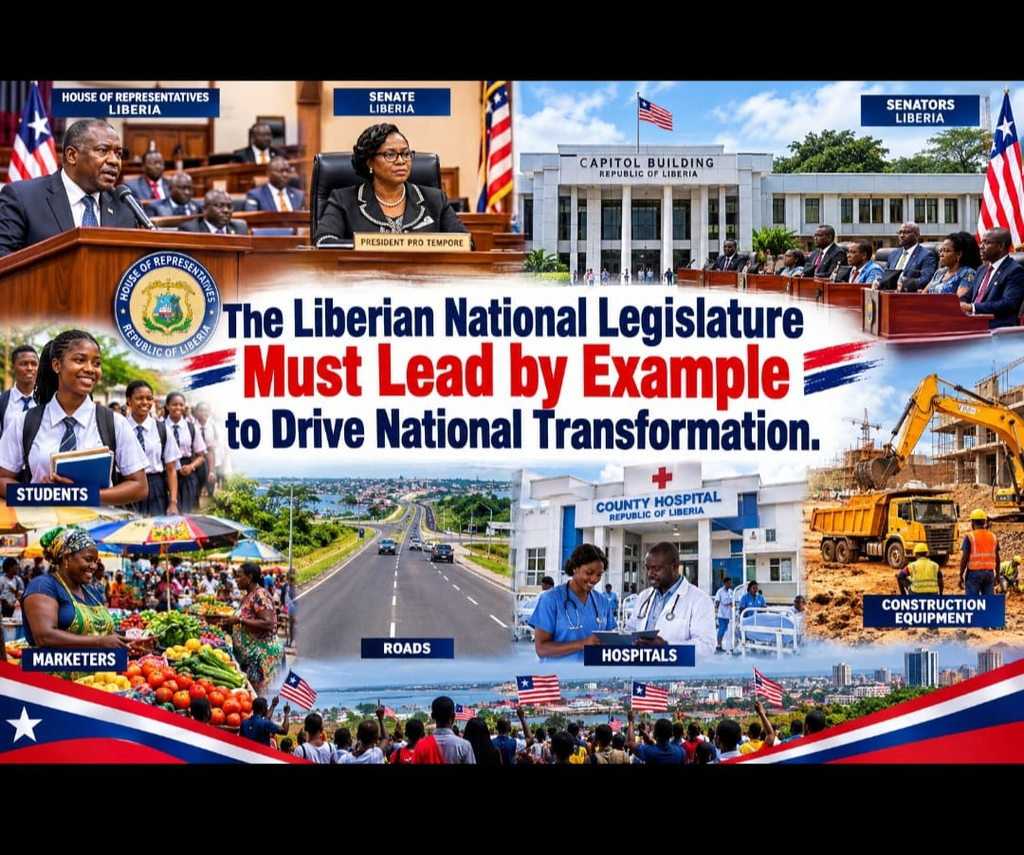
Speaker Koon: “The Liberian National Legislature Must Lead by Example to Drive National Transformation.”
On leadership and service: “They expect leadership that places the country above conflict and service above self-interest.”
— Speaker Richard Nagbe Koon, opening address to the second quarter of the third session of the 55th Legislature, May 11, 2026.
On unity and restoring public trust: “These challenges are a clear indication that the responsibility to promote peace, advance unity, and restore trust can not be overemphasized.”
— Richard Nagbe Koon, opening of the Second Session of the 55th Legislature, January 13, 2025.
On leading by example: “If we can not run a transparent and accountable Legislature, we can not use our oversight responsibility to hold other institutions accountable.” — President Pro Tempore Senator Nyonblee Karnga-Lawrence, remarks on Senate financial accountability, reported August 2024.
President Pro Tempore Madam Nyonblee Karnga-Lawrence: On transparency and accountability: “The Legislature should set the example for transparency and accountability in the country.” — Senator Nyonblee Karnga-Lawrence remarks at the opening of a public hearing into the Auditor General’s Report, July 15, 2024.
Senator Nyonblee Karnga-Lawrence: On moving from words to action: “This launch is not just ceremonial. It renews our commitment to making the government more transparent and inclusive. To achieve these goals, we must move beyond rhetoric and take concrete legislative and policy actions.”
— Senator Nyonblee Karnga-Lawrence remarks at the launch of Liberia’s Fifth National Action Plan under the Open Government Partnership on February 26, 2025.
“Our collective efforts are needed to change the trajectory of our country.” — Senator Nyonblee Karnga-Lawrence, acceptance speech as President Pro Tempore, January 15, 2024.
Hon. Alhaji V Kromah: “The question to our lawmakers: Are you making an impact in the lives of those who elected you? They are awaiting the proof.”
Hon. Edward Wesee: “The days for sugar-coated and honey-spread speeches are over. The people need tangibles as testimonies”
Liberia stands at a critical point in its national development.
As the country moves deeper into the second half of the twenty-first century, it must decide whether it will remain trapped by recurring political distrust, weak institutions, poverty, poor public services, and uneven development, or whether it will build a more accountable and prosperous democratic state.
The Liberian National Legislature has a central role to play in this national transformation.
It cannot continue to see itself merely as a lawmaking body that debates bills, confirms appointments, and approves the national budget.
It must become an institution that actively drives economic, social, and political change through responsible legislation, fiscal discipline, oversight, and personal example.
The Legislature controls one of the most important instruments of government: the national purse.
Through its constitutional authority to approve budgets, authorize public spending, scrutinize revenue collection, and oversee executive agencies, the Legislature influences nearly every major aspect of national development.
Schools, hospitals, roads, agriculture, sanitation, security, youth employment, women’s empowerment, and county-level services all depend on how public money is raised, allocated, and monitored.
If the Legislature uses this authority responsibly, Liberia can make meaningful progress.
If it uses that power carelessly or selfishly, however, the country will remain stagnant.
For this reason, the Legislature must first put its own house in order.
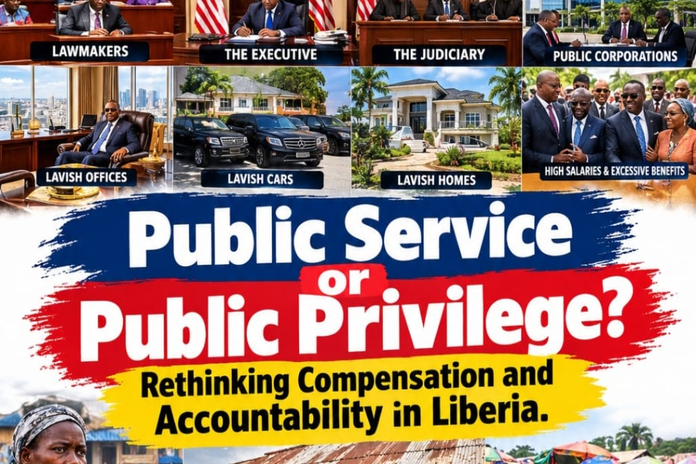
Members of the National Legislature cannot sit in a glass house of high salaries, generous benefits, expensive vehicles, travel allowances, fuel allocations, and other privileges while asking ordinary Liberians to endure hardship, unemployment, inadequate schools, poor health care, and rising living costs.
In a country where many citizens struggle to afford food, transportation, rent, medicine, and school fees, excessive compensation for public officials creates anger and destroys trust in government.
A legislature that appears disconnected from the suffering of the people cannot credibly demand sacrifice, efficiency, and accountability from the executive branch or the public.
The Bible offers a useful moral lesson in this matter: one must first remove the log from one’s own eye before pointing out the speck in another person’s eye.
In public leadership, this principle means that lawmakers must practice the reforms they demand from others.
If legislators criticize the executive branch for wasteful spending but refuse to review their own benefits, they appear hypocritical.
If they call for austerity while maintaining privileges that ordinary citizens consider excessive, they weaken their moral authority.
If they demand transparency from ministries and agencies but fail to disclose their own compensation and spending, they contribute to public cynicism.
Hypocrisy in government is not merely a moral problem; it is a development problem.
When citizens believe that leaders are enriching themselves while the public suffers, people lose confidence in institutions.
Tax compliance declines because citizens question where public money is going.
Young people become disillusioned and may lose faith in democracy.
Investors become cautious when they see a political system that appears more interested in elite benefits than long-term national planning.
Civil servants may become less motivated when leaders demand discipline from lower-level employees but do not impose the same discipline upon themselves.
In short, government hypocrisy can stagnate social and economic development because it damages the trust that a functioning state requires.
Therefore, the Liberian National Legislature should harmonize and reform its salary and benefits structure.
Harmonization does not mean that lawmakers should be impoverished or prevented from carrying out their duties.
Legislators deserve fair compensation because their work is important, demanding, and often requires travel and engagement with constituents.
However, compensation must be reasonable, transparent, consistent with the country’s economic capacity, and tied to measurable public service responsibilities.
It should not place lawmakers far beyond the living conditions of the citizens they represent.
A credible reform process could begin with an independent review of the salaries, allowances, vehicles, fuel benefits, travel budgets, medical benefits, housing support, and retirement packages available to legislators.
The findings should be made public. Liberia should establish a transparent and legally defined compensation system for all senior public officials, including legislators, ministers, judges, heads of state-owned enterprises, and senior civil servants.
Such a system should reduce arbitrary allowances and hidden benefits that are difficult for citizens to understand or monitor.
The public has a right to know how much its representatives earn and how public funds are used.
Lawmakers could also adopt a formula that links their compensation to broader national economic realities.
For example, salary adjustments for legislators could be tied to national revenue performance, inflation, public-sector wage conditions, and progress in essential public services.
If teachers, nurses, police officers, and sanitation workers go unpaid or receive inadequate compensation, it is unjust for legislators to enjoy excessive benefits.
A government’s priorities are revealed by how it treats those who educate children, care for the sick, protect communities, and maintain public order.
There are international examples of political leaders and lawmakers accepting salary reductions during periods of national financial stress.
These examples do not prove that cutting politicians’ salaries alone creates development.
No country builds good schools, hospitals, roads, or a high quality of life simply by reducing lawmakers’ pay.
Development requires sound economic policy, strong institutions, investment in education and health, anti-corruption enforcement, productive agriculture, infrastructure, peace, and competent public administration.
Nevertheless, reductions in political salaries can be important because they demonstrate shared sacrifice, free resources for public priorities, and help restore public confidence.
Ireland provides one useful example. During the global financial crisis of 2008 and the severe recession that followed, Ireland introduced substantial public-sector austerity measures.
Political officeholders, including members of parliament and senior public officials, experienced significant pay reductions. Ministers’ salaries were cut, and broader reductions were applied to high public-sector salaries.
These measures were controversial, and they caused hardship for many workers.
Yet the willingness of political leaders to accept reductions helped communicate that the financial burden should not fall only on ordinary citizens.
Ireland later recovered economically, strengthened employment, and restored public finances.
Over time, its capacity to invest in public services improved.
The salary reductions were not the sole cause of recovery, but they were part of a broader national effort toward fiscal responsibility and institutional credibility.
Portugal offers another example. During the European debt crisis, Portugal adopted austerity reforms that affected public officials, including members of parliament and senior government leaders.
Salary cuts and reductions in bonuses for public-sector workers were introduced as part of efforts to reduce budget deficits and stabilize public finances.
Portugal’s recovery was also shaped by tourism growth, exports, labor reforms, European support, and fiscal management.
Still, the principle was significant: elected officials were not entirely insulated from the sacrifices imposed on the country.
In later years, Portugal improved its economic performance and regained fiscal stability, allowing it to protect and expand important public services.
Again, political salary reductions did not independently create development, but they contributed to a culture of shared national responsibility.
Kenya is also relevant to Liberia because it is an African democracy with public debates over the high cost of government.
In 2013, Kenya’s Salaries and Remuneration Commission reduced the salaries of members of parliament and other state officers after widespread public concern that lawmakers were excessively paid compared with ordinary citizens.
The decision was strongly resisted by many legislators, yet it reflected public pressure for more reasonable compensation.
Kenya has continued to face serious governance and inequality challenges, so it would be inaccurate to claim that the reductions alone transformed the country.
However, the action established an important democratic principle: public officeholders should not be able to determine unlimited compensation for themselves without independent oversight.
Kenya’s experience shows that salary reform is politically difficult but necessary when the cost of government threatens public confidence.
In Sierra Leone, after taking office in 2018, President Julius Maada Bio announced reductions in the salaries of the president, vice president, ministers, and senior officials as part of a message of austerity and responsible governance.
While this was not primarily a legislative salary reform, it demonstrates how leaders can use personal sacrifice to establish public credibility.
Sierra Leone continued to face substantial economic and social difficulties, but the decision had symbolic value.
It communicated that government leaders should not demand sacrifice from citizens without first sharing that sacrifice themselves.
Liberia can learn from this principle. Leadership is not only about speeches; it is also about conduct.
Liberia should not copy any foreign country blindly.
Its reforms must be designed for Liberian conditions.
The country has a relatively small formal economy, limited domestic revenue, significant infrastructure needs, and a large population that depends on public services that remain underfunded.
Every dollar spent on unnecessary government privilege is a dollar unavailable for a classroom, clinic, rural road, agricultural extension program, maternal health service, water project, or youth job initiative.
Even if reductions in legislative benefits do not solve the entire budget problem, they can demonstrate a new national standard: public funds belong first to the people, not to political officeholders.
The Legislature must also recognize the limits of its proper role.
District and county development projects should not become the direct operational responsibility of lawmakers.
Legislators are elected to make laws, represent constituents, approve budgets, and oversee the executive branch.
They should identify the needs of their districts and counties, advocate for fair allocation of national resources, and hold ministries accountable for delivering services.
However, they should not personally manage construction projects, distribute development funds without transparent systems, or act as contractors and project implementers.
The direct responsibility for implementing development projects belongs to the executive branch through competent ministries, agencies, commissions, county authorities, and local governments.
For example, the Ministry of Education should be responsible for building and staffing schools according to national plans and standards.
The Ministry of Health should oversee clinics, hospitals, medical supplies, and health personnel.
The Ministry of Public Works should manage roads, bridges, drainage, and public buildings.
The Ministry of Agriculture should lead agricultural programs that support farmers and improve food security.
When legislators attempt to perform executive functions, the lines between branches of government become blurred, accountability becomes weak, and opportunities for patronage and corruption increase.
This does not mean legislators should ignore local development.
On the contrary, they should become stronger advocates and overseers for their communities.
A representative from a rural district should know whether schools have teachers, whether clinics have medicines, whether roads are passable, whether county funds are being properly used, and whether young people have access to employment opportunities.
The legislator should bring these concerns to the national budget process, demand answers from ministers, and ensure that development is distributed fairly.
But the legislator should not personally control the project budget.
The person who approves and oversees spending should not be the same person who spends the money.
To support this separation of powers, Liberia should strengthen legislative oversight committees.
Committees on public accounts, health, education, agriculture, infrastructure, and budget should regularly summon ministers and agency heads to explain how funds have been used.
Audit reports should not be ignored. Findings from the General Auditing Commission should lead to public hearings, corrective actions, and, where necessary, prosecution.
The Legislature should measure ministries not by political loyalty but by performance: How many clinics were supplied?
How many schools were renovated?
How many kilometers of roads were maintained?
How many communities received clean water?
How many young people received job training?
Ultimately, Liberia’s future depends on leaders who understand that public office is a trust, not a business opportunity.
The National Legislature must lead the campaign for a new political culture rooted in modesty, transparency, accountability, and service.
It must harmonize its own salaries and benefits before demanding reforms from other branches of government.
It must use its power over the national budget to prioritize education, health, agriculture, infrastructure, and jobs rather than unnecessary political privilege.
It must respect the separation of powers by allowing the executive branch to implement development projects while rigorously overseeing performance.
Liberians deserve a Legislature that reflects their hopes rather than their frustrations.
A responsible Legislature can help rebuild trust in democracy, encourage tax compliance, attract investment, and ensure that public resources reach communities in need.
Salary reform alone will not transform Liberia, but it can be a powerful beginning.
When lawmakers accept reasonable compensation, reject wasteful benefits, and insist on transparent spending, they send a clear message: the nation comes before personal comfort.
That is the kind of leadership Liberia needs if it is to thrive as a respected member of the international community in the decades ahead.
Support Independent Journalism
Your support helps FrontPage Africa continue delivering independent, credible, and impactful journalism. Every contribution strengthens our ability to investigate, inform, and hold power accountable while keeping quality journalism accessible to our readers.
Support our journalism or subscribe to receive the latest FrontPage Africa stories and updates.