Part 1:
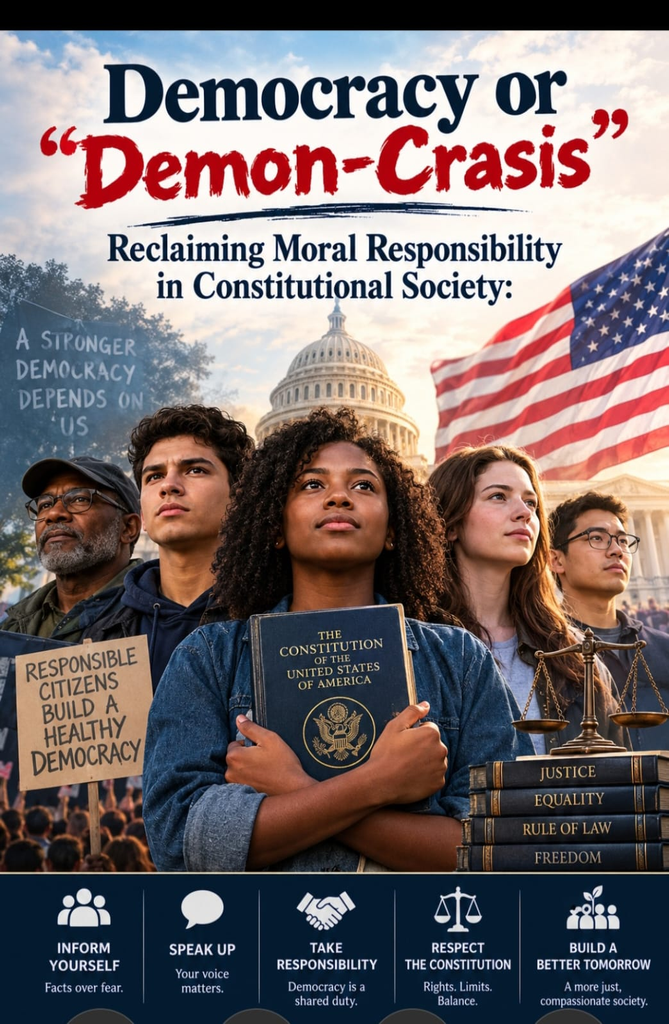
“Demon-Crasis” is a rhetorical play on the word democracy, suggesting a system in which democratic institutions are corrupted by greed, abuse of power, or moral irresponsibility.
By: Austin S Fallah – A True Son of the Planet Earth Soil: [email protected]
President of Liberia Joseph Nyuma Boakai:“The rule of law is fundamental for peace, justice, strong institutions, and dignity for the human person.”
Source: President Boakai’s address to the 79th Session of the United Nations General Assembly, September 25, 2024.
Relevance to theme: Democracy loses its moral foundation when leaders place personal interests above the law.Constitutional society requires institutions that protect human dignity and hold public officials accountable.
President Alassane Ouattara of Côte d’Ivoire (Ivory Coast): “La liberté de la presse, la liberté d’expression et les libertés individuelles ont été renforcées.” English translation: “Freedom of the press, freedom of expression, and individual liberties have been strengthened.”
Source: President Ouattara’s address to Parliament meeting in Congress, June 18, 2024, reported by the official Ivorian government portal. Relevance to theme: Constitutional democracy must protect citizens’ freedoms and create conditions in which governments can be questioned, criticized, and held accountable. The quotation is a statement by the president about his country; it should not be mistaken for an independent assessment of the state of those freedoms.
President Julius Maada Bio — of the Republic of Sierra Leone: “The spirit of independence is not just about our freedom; it is about taking responsibility in lifting our country and ensuring that no one is left behind in the nation’s development.” Source: President Bio’s Independence Day broadcast, April 27, 2025, published by Sierra Leone’s Embassy in Kuwait.
Relevance to theme: Political freedom is not sufficient on its own. Democracy also demands ethical responsibility, inclusion, and a commitment to all citizens’ welfare.
ECOWAS: Democracy, constitutionalism, and accountability: “Zero tolerance for power obtained or maintained by unconstitutional means.”
Source: ECOWAS Supplementary Protocol on Democracy and Good Governance, December 21, 2001, Article 1(c).
Connection to your theme: This principle challenges the use of constitutional language to justify unconstitutional political conduct. It provides a basis for examining how political power is acquired, exercised, and retained.
Former South African President Nelson Mandela: With freedom comes responsibility.”
Former UN Secretary-General Kofi Annan: Danger of rule by law rather than rule of law.”
Democracy is often praised as the highest form of government because it gives people the power to choose their leaders, express their opinions, organize politically, and hold public officials accountable.
In a true constitutional democracy, citizens are not expected to be silent, fearful, or blind followers of those in power.
They have the right to criticize government, challenge bad policies, demand justice, and advocate for reform.
However, democracy is not disorder, disrespect, criminality, or moral rebellion.
Freedom is not a license to destroy society.
When individuals use constitutional rights as excuses to insult elders, abuse women, abandon cultural values, support drug trafficking, undermine lawful authority, or corrupt the youth, they are not strengthening democracy.
They are practicing what may be called “demon-crasis”, a destructive imitation of democracy in which freedom is separated from responsibility, morality, and respect for human dignity.
The term “demon-crasis” is not a formal political concept, but it can serve as a powerful moral warning.
It describes a condition in which people claim the benefits of democracy while rejecting the duties required to sustain it.
They demand freedom of speech but use their words to humiliate, threaten, spread lies, and encourage hatred.
They demand freedom of association but join criminal groups, drug cartels, or violent networks.
They demand the protection of the law but refuse to obey it themselves.
They demand public accountability from leaders while avoiding accountability for their own harmful behavior.
Such conduct does not represent the true spirit of constitutional democracy. Instead, it weakens families, communities, institutions, and the nation itself.
This concern is relevant in many countries, including Liberia, where citizens have fought, suffered, and sacrificed for peace, stability, and democratic government.
Liberia’s history includes painful experiences of division, violence, civil conflict, poverty, and political instability.
Those experiences should teach citizens that democracy is fragile. It cannot survive merely because a constitution exists or because elections are held every few years.
Democracy survives when people respect the rule of law, protect one another’s dignity, value education, honor moral principles, and accept that rights come with responsibilities.
Some Liberians, like some people in every nation, may misunderstand freedom as the right to do whatever they want without consequences.
That misunderstanding can become dangerous when it is encouraged by political manipulation, social media abuse, economic desperation, substance abuse, and a declining respect for cultural and spiritual values.
One major sign of “demon-crasis” is the deliberate undermining of heritage, culture, and tradition.
Every society has traditions that help shape its moral identity.
Culture teaches people how to relate to parents, elders, neighbors, children, and community leaders.
It teaches hospitality, humility, mutual assistance, responsibility, and respect.
Of course, not every old tradition should be protected without question.
Some customs may be unfair, outdated, or harmful and should be reformed.
Genuine democracy gives people the opportunity to discuss and improve their traditions.
Yet reform is different from contempt.
A young person who asks thoughtful questions about cultural practices may be helping society grow.
But a person who mocks everything sacred, ridicules elders, and treats inherited values as worthless is not necessarily progressive.
That person may be contributing to moral emptiness.
Respect for elders is especially important. Respect does not mean that elders are always correct or that young people must remain silent in the face of injustice.
Elders can make mistakes, and democracy allows citizens of all ages to challenge bad decisions.
Nevertheless, there is a difference between disagreement and insult.
A society that teaches children to curse, shame, and humiliate older people in public will eventually lose the wisdom that connects generations.
Elders have lived experience that books and the internet cannot always capture.
They remember the nation’s struggles, family histories, community values, and past mistakes.
When young people refuse to listen, they may repeat destructive patterns that earlier generations already understand.
The abuse and degradation of women is another serious example of conduct that cannot be defended as freedom.
No society can claim to be democratic while women are abused, harassed, exploited, silenced, or treated as objects.
Women are mothers, daughters, sisters, professionals, community leaders, educators, entrepreneurs, religious leaders, and political actors.
Their rights and dignity are not optional.
A man does not become “free” because he can insult or abuse a woman.
Rather, he reveals a lack of discipline, morality, and respect for humanity.
True democracy requires equal protection under the law and equal respect in society.
It requires citizens to condemn domestic violence, sexual harassment, rape, exploitation, and the public humiliation of women.
When women are unsafe, democracy is unsafe.
Likewise, the spread of drug trafficking and drug abuse threatens the foundation of national life.
Drug cartels and trafficking networks do not represent entrepreneurship, freedom, or political expression.
They profit from addiction, misery, violence, corruption, and the destruction of youth.
A nation cannot develop when its young people are being recruited into criminal activity or trapped in addiction.
In Liberia, the term “Zogos” is often used to describe vulnerable young people living in extremely difficult circumstances, including homelessness, addiction, unemployment, and social exclusion.
These young people should not be mocked or discarded.
They should be seen as citizens in need of intervention, rehabilitation, education, employment, counseling, and hope.
At the same time, society must not romanticize or excuse the criminal systems that feed addiction and despair.
Those who traffic drugs, recruit young people into drug use, or profit from social breakdown are not exercising democratic rights.
They are attacking the future of the country.
Government institutions, religious communities, families, schools, traditional leaders, and civil society organizations must work together to prevent young people from becoming victims of drug culture.
Rehabilitation centers should be strengthened.
Schools should provide practical skills and civic education.
Communities should create employment opportunities and mentorship programs.
Law enforcement should pursue traffickers fairly and professionally, without corruption or political favoritism.
The goal should not only be punishment, but restoration and prevention.
Another important issue is the misunderstanding of free speech.
Freedom of speech is essential in a constitutional democracy.
Without it, citizens cannot criticize corruption, expose wrongdoing, advocate for human rights, or participate meaningfully in public life.
A government that punishes every critic is not democratic.
However, free speech does not mean that speech has no ethical or legal boundaries.
It does not protect criminal threats, incitement to violence, or defamation, fraud, harassment, or the deliberate spreading of dangerous falsehoods.
Even when speech is legally protected, it can still be morally irresponsible.
For example, a citizen may have the right to criticize a president, minister, senator, judge, or local leader.
That criticism can be necessary and patriotic when it is based on facts and offered in good faith.
But there is a difference between holding leaders accountable and using vulgar insults, fabricated accusations, ethnic hatred, or personal attacks to destroy public trust.
When political debate becomes an exchange of insults rather than ideas, citizens become divided and institutions lose legitimacy.
The nation then becomes easier to manipulate by opportunists who thrive on anger, fear, and confusion.
It is also important to recognize that constitutional authority should not be undermined merely because citizens dislike particular leaders. In a democracy, leaders may be criticized, voted out, investigated, impeached where appropriate, or challenged through lawful processes.
But citizens should not encourage violence, reject election results without evidence, attack public institutions, or call for chaos whenever political outcomes do not favor them.
Constitutional democracy depends on the principle that disagreements must be resolved through law rather than through intimidation or force.
The constitution is not meaningful if people respect it only when it benefits them.
At the same time, respect for constitutional authority must never become blind obedience.
Governments also have responsibilities. Public officials must not use the language of morality or national unity to silence legitimate criticism.
They must govern transparently, fight corruption, provide security, protect civil liberties, and serve all citizens rather than only their supporters.
A government that ignores poverty, unemployment, drug addiction, violence against women, and youth despair creates conditions in which social disorder can grow.
Therefore, the fight against “demon-crasis” is not only the responsibility of ordinary citizens.
It is also the responsibility of political leaders, religious leaders, teachers, parents, traditional authorities, and community organizations.
The spiritual dimension of this issue is also significant.
For many people, belief in God, referred to by some as Hala-Na-Meleka, God Almighty, Gla-poh, Allah, Yahweh, Nye-Suah, etc., provides a moral foundation for public life.
The fear of Hala-Na-Meleka -God-Almighty should not mean fearfulness, intolerance, or the desire to impose religion by force.
Rather, it should mean humility, conscience, accountability, and recognition that human beings are not above moral law.
A person who fears Hala-Na-Meleka-God-Almighty should understand that power must be used carefully, women must be respected, children must be protected, the poor must not be exploited, and truth must not be sold for personal gain.
A society that loses all sense of spiritual or moral accountability may become obsessed with material wealth, political power, pleasure, and individual pride.
True democracy, therefore, requires more than ballots and political speeches.
It requires character.
It requires citizens who understand that liberty without discipline becomes chaos, and rights without responsibility become selfishness.
It requires parents who teach children respect, schools that teach civic duty, religious institutions that promote compassion and integrity, and leaders who model service rather than greed.
It requires citizens who oppose drug trafficking, reject violence against women, care for vulnerable youth, and defend institutions without refusing necessary reform.
The solution is not to abandon democracy. The solution is to practice democracy correctly.
Liberia and other nations need a constitutional democracy rooted in law, dignity, truth, cultural wisdom, and moral responsibility.
Citizens must be free to speak, but they must speak with purpose.
They must be free to organize, but not to organize criminality.
They must be free to criticize, but not to destroy others through lies and hatred.
They must be free to pursue success, but not by poisoning the youth or exploiting the weak.
“Demon-crasis” describes the dangerous moment when people use the language of freedom to excuse behavior that damages the nation.
It appears when rights are separated from duties, when disrespect is mistaken for courage, when criminality is defended as liberty, and when morality is dismissed as old-fashioned.
A true democracy is stronger than this.
It protects freedom while demanding accountability.
It honors the constitution while recognizing that law must be supported by conscience.
It respects culture while allowing reform.
It empowers young people while guiding them away from drugs, violence, and hopelessness.
Above all, it reminds every citizen that national development is not only the work of presidents and lawmakers.
It is the work of every person who chooses responsibility over disorder, respect over insult, truth over deception, and democratic citizenship over “demon-crasis.”
Support Independent Journalism
Your support helps FrontPage Africa continue delivering independent, credible, and impactful journalism. Every contribution strengthens our ability to investigate, inform, and hold power accountable while keeping quality journalism accessible to our readers.
Support our journalism or subscribe to receive the latest FrontPage Africa stories and updates.