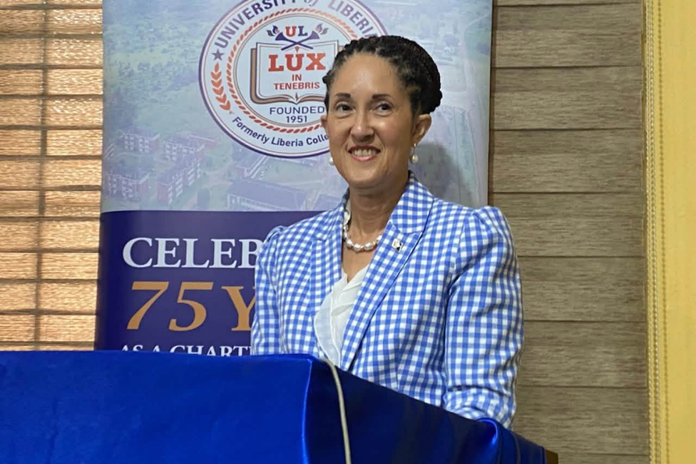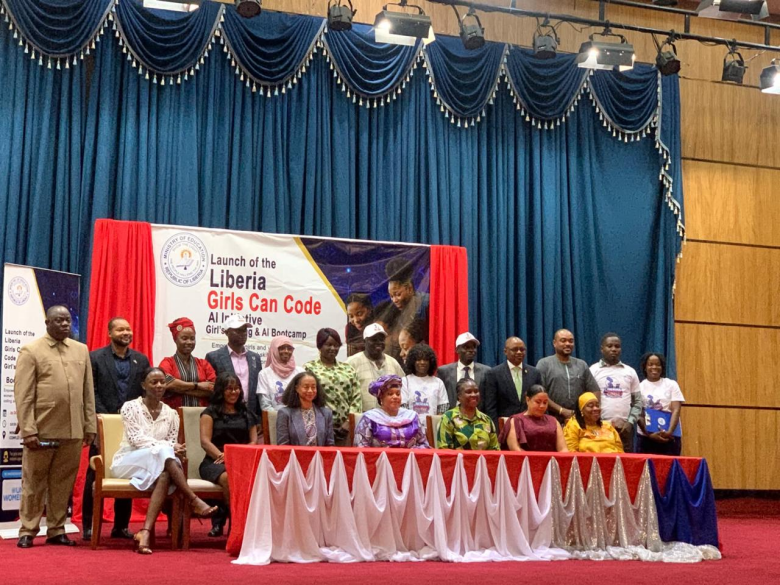
ESJ Ministerial Complex, Congo Town– Minister of Education, Dr. Jarso Maley Jallah has launched the Liberia Girls Can Code and AI Initiative 2026, a nationwide program aimed at equipping young women with coding, artificial intelligence and digital skills while opening pathways to future careers in technology and innovation.
By Jaheim T. Tumu- [email protected]
The initiative, which is being implemented in partnership with UN Women and other stakeholders, seeks to train 1,000 girls, beginning with an initial group of 250 participants drawn from Bong, Margibi, Grand Bassa, Lofa and Maryland counties. Organizers said no previous coding experience will be required.
Speaking at the launch, Jallah said the program is designed to ensure that girls across Liberia, especially those outside Monrovia, have equal opportunities to benefit from the country’s digital transformation.
“If Liberia’s digital transformation reaches girls who already have computers, connectivity, and exposure while leaving behind those in places where those opportunities are scarce, then we will simply reproduce an old inequality in our new economy,” she said.
The minister explained that participants will receive practical training in coding, digital literacy, artificial intelligence, cybersecurity, innovation and entrepreneurship. The program will also include mentorship opportunities, internships and team projects focused on solving real-life community problems.
Jallah praised the Liberia Bank for Development and Investment (LBDI) for committing internship opportunities to graduates of the program and encouraged other partners to provide similar support.
The education minister stressed that digital skills are becoming important in nearly every profession and should not be viewed as useful only for careers in technology.
“I want a future teacher who understands how technology can improve learning and uses it in the classroom. I want a young entrepreneur who can use digital tools to reach a market beyond her community,” she said.
She added that girls interested in agriculture and other sectors should also understand how technology, data and artificial intelligence can help solve challenges in their fields.
Jallah used the process of learning computer programming as a lesson in resilience and problem-solving. She told participants that coding teaches people how to respond to challenges rather than give up when difficulties arise.
“When your code does not work, the computer does not decide that you are not smart. It gives you an error,” she said. “Look again. Test again. You can change something if you try.”
Encouraging participants to view setbacks as learning opportunities, she shared a message she often uses when discussing education and personal growth. “Failure is not really failure. Failure is first attempt in learning,” Jallah told the audience.
The minister noted that while access to technology is improving across Africa, significant gender gaps remain. She cited data showing that women continue to have less access to the internet and digital opportunities than men, making targeted programs for girls increasingly important.
According to Jallah, confidence, exposure, mentorship and community support are just as important as academic ability in helping girls succeed in science, technology, engineering and mathematics (STEM) fields.
She highlighted the achievements of Hellen Momoh, a Liberian data scientist and Harvard University graduate who founded Surna Technologies (is Africa’s first data refinery, a sovereign AI cloud that enables nations to own, host, and analyze their data to support stability and economic growth). Jallah said Momoh’s journey demonstrates that Liberian girls can become global innovators when given opportunities and support.
“So I wanted to bring a live experience to you so that you think beyond the coding and the AI intelligence to see yourselves in this young woman,” she said. “It is possible.”
Jallah urged the girls to study Momoh’s story and understand that success often comes after hard work, setbacks and persistence. “Sometimes we see the end of the story, and it’s glorious, but we don’t see the work behind the story,” she said.
Sh also emphasized that the success of the initiative should not be measured only by the number of girls who complete training sessions. Instead, she said the real test will be whether participants continue developing their skills and applying what they learn after the program ends.
“I do not want us to look back at this initiative and simply say 250 girls or a thousand girls attended a boot camp,” Jallah said. “I want us to ask harder questions. Six months later, what can they still do? Who continued learning? What did they build?”
She said the program includes participant follow-up, mentorship and evaluation mechanisms to determine its long-term impact before any future expansion. Launching the initiative, Jallah encouraged participants to approach challenges with determination and curiosity. “A problem in front of you is not necessarily telling you to stop,” she said. “Sometimes it is telling you what you need to learn next.”
Support Independent Journalism
Your support helps FrontPage Africa continue delivering independent, credible, and impactful journalism. Every contribution strengthens our ability to investigate, inform, and hold power accountable while keeping quality journalism accessible to our readers.
Support our journalism or subscribe to receive the latest FrontPage Africa stories and updates.