MONROVIA — For most of the past half-century, Liberia’s mineral wealth has been a story told in the past tense. In the 1960s and 1970s, iron ore from the Nimba and Bong ranges made this small West African nation one of the world’s leading exporters of the steelmaking ingredient. Then came 14 years of civil war, and the mines, railways and ports fell silent.
By Rodney D. Sieh
This month, the government is staking its economic future on rewriting that story in the present tense.
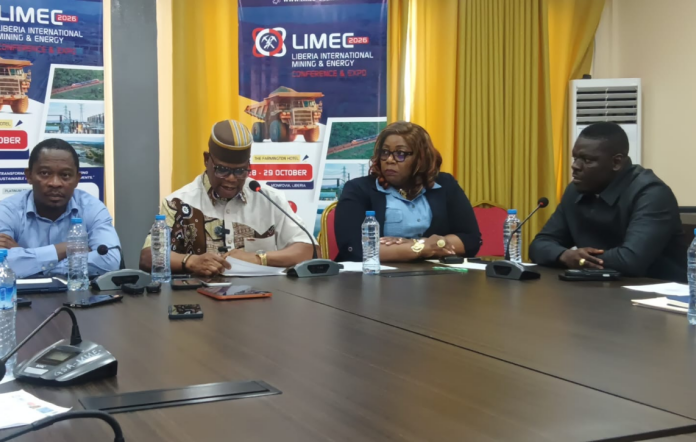
On October 28 and 29, Liberia will host the first Liberia International Mining and Energy Conference & Expo, known as LIMEC 2026, a gathering of ministers, mining executives, energy developers, financiers and development partners. Organized jointly by the Ministry of Mines and Energy, the Liberia Chamber of Mines and the London-based events firm AME Trade Ltd, the conference will be held at the Farmington Hotel under the theme “Powering Prosperity: Sustainable Mining and Energy as Catalysts for Liberia’s Economic Transformation.” Organizers say ongoing and planned projects could draw more than $3 billion in new investment.
Launching the event at a news conference over the weekend, Mines and Energy Minister R. Matenokay Tingban framed it as a turning point.
“Our message to the international investment community is clear: Liberia is open for responsible business, committed to reform, and ready to build mutually beneficial partnerships,” he said.
But he attached a condition that will be closely watched by the companies already operating here. “Our natural resources must serve not only the interests of investors but also the broader aspirations of the Liberian people,” he said.
That tension — between courting capital and capturing a fairer share of its rewards — runs through every part of Liberia’s resource economy today.
From boom to ruin, and back
Liberia, founded in 1847 and Africa’s oldest republic, built much of its post-war-era economy on concessions: rubber, timber and, above all, iron ore. The Liberian American-Swedish Minerals Company (LAMCO) in Nimba County and the German-backed Bong Mines were among the largest mining operations in Africa, linked by dedicated railways to the ports of Buchanan and Monrovia.
The civil wars of 1989 to 2003 destroyed that system. Rail lines were stripped for scrap, ports decayed, and an industry that once underpinned the national budget vanished.
The revival began in 2005, when Mittal Steel — now ArcelorMittal, the world’s second-largest steelmaker — signed a Mineral Development Agreement to restart mining in Nimba and rebuild the 250-kilometer (155-mile) railway to Buchanan. First exports followed in 2011. But the Ebola epidemic of 2014-15 and a collapse in iron ore prices slowed ambitions, and for more than a decade the company shipped around 5 million metric tons a year.
Liberia also opened its first commercial gold mine, New Liberty in Grand Cape Mount County, which began production in 2016 after Turkey’s MNG Gold rescued the Ebola-stricken project.
What has changed in the past 18 months is scale.
The ArcelorMittal factor
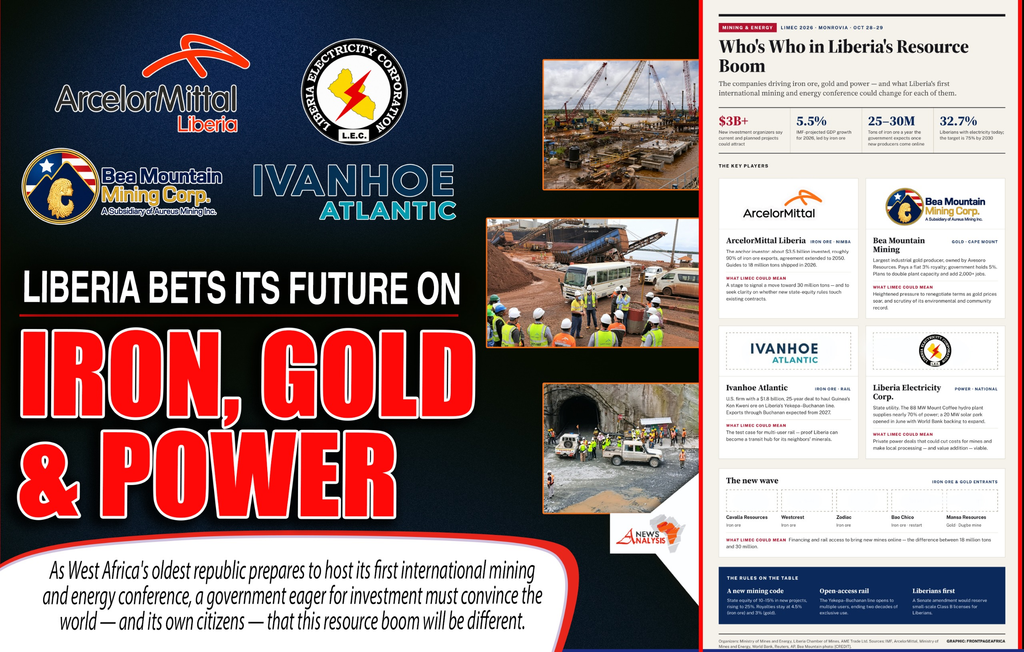
ArcelorMittal Liberia remains the anchor of the sector, accounting for roughly 90 percent of the country’s iron ore exports. Its $1.8 billion expansion, built around a new concentrator at Tokadeh in Nimba County, lifts the company’s total investment in Liberia to about $3.5 billion — the largest foreign direct investment since the war.
In January, lawmakers ratified a third amendment to the company’s agreement, extending it to 2050 with an option to renew for a further 25 years. In return, ArcelorMittal agreed to pay $200 million upfront for the extended mining rights and reserved rail capacity, and annual license fees rose tenfold, from $50,000 to $500,000. The payment alone represented roughly 16 percent of the national budget, according to the credit insurer Coface.
The results are already visible. ArcelorMittal Liberia set production and shipment records in 2025, shipping about 10 million tons. The company initially targeted 20 million tons for 2026 but now guides to 18 million, citing heavy rains that slowed mining and port operations in the second quarter. It is also upgrading the railway to carry up to 30 million tons a year should it decide to expand further.
For the government, the deal secured long-term certainty from its largest investor. For ArcelorMittal, LIMEC is likely to be a stage on which it can present itself as a partner in Liberia’s ambitions — while watching carefully how far the reform agenda reaches into existing contracts.
Breaking the rail monopoly
The most consequential structural change in Liberia’s mining economy may not be a mine at all, but a railway.
For two decades, ArcelorMittal held exclusive use of the Yekepa-to-Buchanan line. Under President Joseph Boakai’s multi-user rail policy, that is ending. In December 2025, the Legislature ratified a 25-year Concession and Access Agreement with Ivanhoe Atlantic, a U.S. company founded by mining billionaire Robert Friedland, valued at $1.8 billion.
The deal allows Ivanhoe to haul ultra-high-grade iron ore from its Kon Kweni project in neighboring Guinea — which holds about 752 million tons of direct-shipping ore, including 209 million tons grading 67.8 percent iron — across Liberia to Buchanan. The company plans initial output of 2 million to 5 million tons a year, with exports through Liberia expected from 2027, and an eventual second phase of up to 30 million tons.
The amended ArcelorMittal agreement now requires new rail users to invest in expanding capacity to meet their own needs, an arrangement designed to turn the corridor into shared national infrastructure rather than a private asset.
The stakes are geopolitical as well as commercial. Ivanhoe markets Kon Kweni as a source of high-grade ore for Western supply chains, an alternative to the China-led Simandou mega-project elsewhere in Guinea, and the U.S. Embassy in Monrovia has publicly endorsed the deal. The corridor sits atop an estimated 12 billion tons of iron ore reserves straddling the border, much of it still under exploration licenses.
If the model works, Liberia could become a transit hub for Guinea’s landlocked southeastern deposits — earning fees, jobs and port traffic from minerals it does not even own.
Gold, grievances and the 3 percent question
If iron ore is Liberia’s success story, gold is its flashpoint.
Bea Mountain Mining Corporation, controlled by Turkish businessman Murathan Günal through Avesoro Resources, is the country’s largest industrial gold producer. It plans to double plant capacity and says the expansion will create more than 2,000 jobs. But the company has faced mounting scrutiny. A joint investigation by The Associated Press and The Gecko Project published in January documented cyanide spills into waterways, 2,200 hectares (5,436 acres) of cleared rainforest and community anger that turned deadly during 2024 protests. The company says it has reinforced its tailings dam and points to its record of rescuing the mine and safeguarding more than 1,200 Liberian jobs.
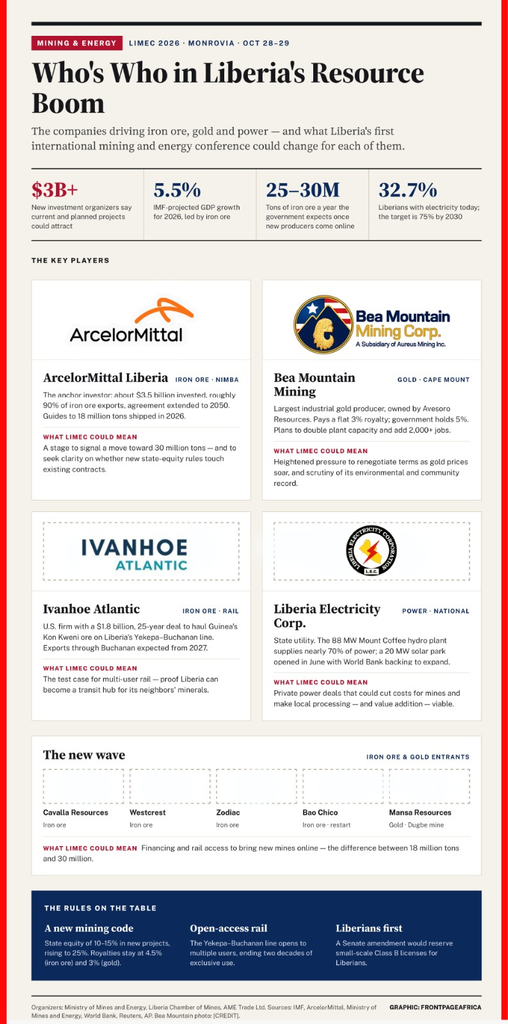
Politically, the sharpest issue is money. With gold prices near record highs — approaching $4,200 an ounce earlier this year — both senators from Grand Cape Mount County have called for the company’s agreement to be renegotiated, arguing that its flat 3 percent royalty no longer reflects the value leaving the country. The government holds a 5 percent stake in the operation. A visit by Vice President Jeremiah Kpan Koung, at which figures of about $1.6 billion in company revenue were discussed, stirred public outrage over the gap between that wealth and conditions in host communities.
Liberia remains a modest gold producer, at roughly 10 tons a year, and an estimated 70 percent of gold activity is informal, according to Senator Francis Dopoh, who has co-sponsored a bill to create a state-owned National Gold Company and a domestic refinery.
Rewriting the rules
These pressures have converged on a single question: Liberia’s mining law, written in 2000, is widely seen as out of date.
In February, Minister Tingban told Reuters at the Mining Indaba conference in Cape Town that a new mining code would be ready within three months. It would create a national mining company entitled to a free-carried equity stake of 10 to 15 percent in new projects, rising over time to 25 percent. Royalties would remain at 4.5 percent for iron ore and 3 percent for gold, with a new 8 percent rate for heavy mineral sands.
“We are moving from a royalty-only approach to equity participation to maximise returns,” Tingban said at the time. Whether the new equity terms would apply to existing projects, he added, would be determined by the Ministry of Justice.
Eight months on, the overhaul is still working its way through the Legislature. The House of Representatives opened public hearings in July, where the minister pressed for tougher penalties against illegal mining and mineral smuggling. The Senate has advanced an amendment reserving small-scale Class B licenses for Liberians. The Liberia Chamber of Mines, which represents the industry, has urged lawmakers to pursue a comprehensive rewrite rather than piecemeal fixes, saying investors expect fairness, consistency and transparency.
For existing operators, LIMEC arrives at a moment of regulatory uncertainty. The government’s message — welcome, but on better terms — will be tested by how it treats contracts already signed.
Power: the missing ingredient
The “energy” half of LIMEC’s title addresses what may be Liberia’s biggest structural handicap. Only about a third of Liberians — 32.7 percent — have access to electricity.
The government aims to raise that to 75 percent by 2030 under a national energy compact backed by the World Bank, while lifting renewables to 75 percent of the power mix.
There has been progress. The 88-megawatt Mount Coffee hydropower plant, rebuilt after the war, supplies nearly 70 percent of the country’s electricity. In June, President Boakai inaugurated the country’s first utility-scale solar plant, a 20-megawatt park at the Mount Coffee site, and signed a $57 million World Bank financing agreement to expand it and add battery storage. With Mount Coffee’s full capacity restored, the state utility has begun cutting costly imports from Côte d’Ivoire and Guinea through the regional CLSG power line.
For miners, reliable grid power would lower costs and make processing — and the value addition Tingban champions — more viable.
Without it, ambitions to refine gold or process ore at home will remain largely aspirational.
What it means for the economy
The macroeconomic picture is encouraging. The International Monetary Fund estimates Liberia’s economy grew 5.1 percent in 2025, up from 4 percent in 2024, and projects 5.5 percent growth this year, driven chiefly by iron ore, with support from manufacturing and construction. Inflation stood at 5.3 percent in May, and the country remains on a $210 million IMF Extended Credit Facility running through 2027.
Mining’s weight is growing fast. Extractives already accounted for more than 21 percent of domestic revenue in 2023, according to the Extractive Industries Transparency Initiative, and mining drove roughly two-thirds of economic growth in the first three quarters of 2025, Coface estimates.
Tingban has projected that mining’s share of national output could climb from 15 percent in 2024 to as much as 50 percent as new producers — including Cavalla Resources, Westcrest, Zodiac and a revived Bao Chico — come online, with national iron ore output potentially reaching 25 million to 30 million tons.
That concentration is also the risk. The IMF projects Liberia’s current account deficit will widen sharply this year, to 18 percent of GDP from 7 percent, as fuel and mining equipment imports surge. A single company still dominates exports, and the country’s fortunes are tightly bound to iron ore prices — and therefore to Chinese steel demand — at a time when vast new supply from Guinea’s Simandou is coming to market.
And Liberia’s history offers a sobering lesson: in the decades of the LAMCO era, iron ore generated enormous export earnings while much of the population remained poor, a disparity that fed the grievances behind the country’s collapse.
The real test
Tingban himself has set the bar. “LIMEC 2026 must be measured not only by the quality of its discussions,” he said, “but also by the investments it attracts, the partnerships it builds, the jobs it helps create, and the lasting benefits it delivers to the Liberian people.”
For international investors, Liberia offers rare advantages: a rebuilt rail corridor, deep-water access, a stable currency, an IMF-backed reform program and a government openly courting capital. For Liberians, the questions are older and harder — whether this boom will build schools and power lines in Nimba and Grand Cape Mount, whether communities will be heard, and whether the country can finally turn the wealth beneath its soil into prosperity above it.
Next week’s conference will not answer those questions. But it will show whether Liberia, a generation after the guns fell silent, is ready to be judged by them.
Support Independent Journalism
Your support helps FrontPage Africa continue delivering independent, credible, and impactful journalism. Every contribution strengthens our ability to investigate, inform, and hold power accountable while keeping quality journalism accessible to our readers.
Support our journalism or subscribe to receive the latest FrontPage Africa stories and updates.