Summary:
· Liberia’s Witness Protection Agency is stepping up operations as the country pushes to establish war and economic crimes and anti-corruption courts.
· The Agency faces major challenges, including limited funding, a shortage of trained protection officers, no safe house of its own and the need to build public trust.
· The Agency plans to expand protection services nationwide, including safe facilities for witnesses and victims who may testify before a future war crimes court.
By Anthony Stephens, senior justice correspondent with New Narratives
As efforts build to establish war and economic crimes and anti-corruption courts in Liberia, the government agency responsible for protecting witnesses, victims and whistleblowers is confronting a fundamental challenge: persuading people that it can keep them safe.
The Witness Protection Agency, established by law in 2022 but operationalized only within the past nine months, has begun holding consultations, developing protection policies and working to build public confidence in a country where witnesses, whistleblowers and human rights investigators have faced threats and retaliation, and some have fled for their safety.
“If Liberian citizens continue to believe in panic and fear and cannot see that the government can be trusted to protect them, then this whole effort will be in vain,” said Teklo Maxwell Grigsby II, the Agency’s director, in an interview. “The more we invest in people, the more people can trust us, the more accurately we can push to get what the country deserves.”
The Agency’s ability to deliver on those promises could be critical to Liberia’s broader justice push. The proposed courts will depend on witnesses willing to provide evidence, including in cases involving powerful people and crimes committed decades ago. But getting people to testify may depend on whether they believe the government can protect them from retaliation — a difficult task for an Agency still struggling with limited funding, a shortage of trained protection officers, no safe house of its own and public mistrust shaped by past experiences.
Some Liberian institutions, including the Liberia National Police, Liberia Immigration Service, National Security Agency, Liberia Anti-Corruption Commission, Ministry of Justice and Office of the Ombudsman, have mechanisms or procedures that can provide protection, confidentiality or other safeguards for witnesses, victims and whistleblowers. But the Witness Protection Agency is the first institution established specifically to administer and coordinate a national program for their protection.
By operationalizing the Agency, Liberia joins a relatively small group of African countries, including Kenya and Ghana, that have enacted laws establishing dedicated agencies to protect witnesses and others who may face threats or retaliation for cooperating with investigations and prosecutions. Other countries, including South Africa and Uganda, operate witness-protection programs within existing justice or prosecution institutions.
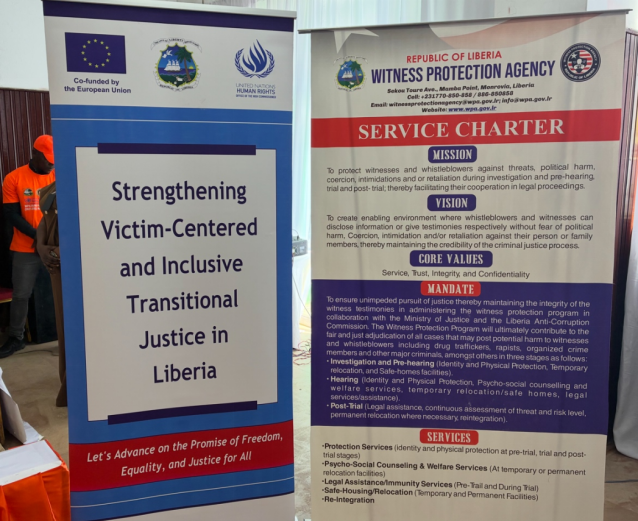
Liberia’s Witness Protection Agency is headed by Grigsby, a lawyer, with Varney Ali Sherif serving as deputy director and Frank S. Suku, also a lawyer, as coordinator and head of its secretariat. Its mandate covers protection during investigations and pre-hearing proceedings, trials and the post-trial period.
Its services include identity and physical protection, psychosocial counseling and welfare support, legal assistance, safe housing, temporary or permanent relocation and reintegration. Confidentiality is one of its stated core values.
At a recent program to validate the Agency’s 5-year plan in Monrovia, Grigsby acknowledged that convincing Liberians to entrust sensitive information — and potentially their lives — to a government institution will not be easy. Past experiences with institutions responsible for handling sensitive cases, he said, have contributed to fears about whether people can safely disclose wrongdoing. Some have instead sought safety outside Liberia.
Few people understand those concerns better than Hassan Bility, director of the Global Justice and Research Project, Liberia’s leading war-crimes investigation group.
His organization and its Swiss partner, Civitas Maxima, have worked with authorities in foreign jurisdictions to help build cases against more than a dozen people accused of crimes connected to Liberia’s civil wars in the United States and Europe. Bility said he, members of his staff and witnesses involved in those cases have faced harassment and intimidation.
“One reason why witnesses don’t trust Liberians, don’t trust us Liberians generally, is that they think that we, in the Liberian English, ‘talk too much,’” said Bility, also at that event. “So there has got to be a system.”
He also stressed the need for experienced specialists to help develop Liberia’s protection system, something Grigsby acknowledged.
“You need people with the technical expertise who have worked in this area for many years to help us in setting the pace for legal and institutional framework,” Grigsby said in an interview. “We need the international dimension, global best practice for witness protection in Liberia.”
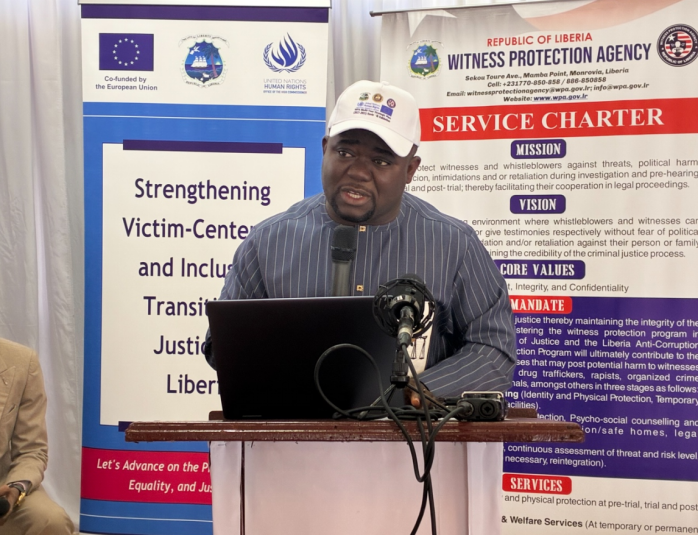
With funding from the European Union, the Office of the United Nations High Commissioner for Human Rights is providing financial and other support to the Agency. The Office has also brought in an international expert to help the Agency strengthen its strategic five-year plan and align it with international standards.
The Boakai administration has repeatedly pledged to strengthen protections for victims, witnesses and whistleblowers. In June, as President Boakai launched Liberia’s National Security Strategy 2026–2036, promising to strengthen public confidence in the country’s security institutions.
His administration has also moved to strengthen incentives for people who disclose wrongdoing. According to the Witness Protection Agency, Boakai called on relevant government institutions at a March Cabinet meeting to review the Whistleblower Act of 2021 and propose amendments. The president directed then-Justice Minister Oswald Tweh to pursue stronger incentives for witnesses, victims and whistleblowers who provide information in high-profile corruption cases, mineral and natural-resource smuggling and other major crimes.
Among the proposed changes, the Agency is pushing to increase rewards for whistleblowers from 5 percent to 10 percent and introduce bounties intended to encourage reporting of corruption, organized crime and smuggling.
The Agency has consulted government ministries and agencies involved in anti-corruption efforts, lawmakers, the media and civil society about the proposed amendment. Grigsby said the proposal received overwhelming support.
But persuading witnesses and whistleblowers to come forward is only part of the problem. Keeping them safe can be expensive. Under its plan, the Agency is proposing more than US$6 million for protection operations as part of projected spending of US$20.54 million. Its financing proposal includes a one-cent levy on every gallon of petroleum imported into Liberia to help finance a proposed Victim, Witness and Whistleblower Trust Fund, alongside international donor support.
Current government allocations are far below those ambitions.
The 2026 national budget national budget allocated US$700,000 to the Witness Protection Unit, with projections of US$390,000 for fiscal year 2027 and US$401,000 for 2028.
Money is not its only constraint. The Agency currently employs 65 people, but Grigsby acknowledged that it does not yet have enough professionally trained protection officers. Many newly recruited employees are undergoing specialized training, requiring the Agency to rely on personnel from the Liberia National Police, National Security Agency and other security institutions.
Grigsby said 20 officers were being sent for basic police training to strengthen their capacity to provide physical protection. The Agency has also begun international training for personnel working in areas including internal control, finance and human resources. It plans to recruit about 45 additional protection officers and psychosocial counselors in 2027 as it expands its capacity.
The Agency is also trying to establish strict rules governing the information entrusted to its employees. Grigsby said staff members had signed confidentiality undertakings barring them from disclosing information about potential witnesses and victims, including their identities. Breaches, he said, could carry penalties of up to 10 years in prison.
Those safeguards will operate against a history in which some people who disclosed wrongdoing have reported retaliation. In 2023, New Narratives Narratives documented 12 cases of government whistleblowers who allegedly faced retaliation over the previous 14 years. Seven died in circumstances their families linked to efforts to silence them, four lost their jobs, and three fled the country or went into hiding.
The Agency, meanwhile, has no safe house of its own, limited vehicles and protection personnel, and operations largely concentrated in Montserrado. Its ambitious strategy proposes five safe houses — two in Montserrado and three elsewhere — where threatened witnesses and their families could be temporarily relocated.
The need could grow if Liberia establishes its proposed War and Economic Crimes Court. Grigsby said the Agency plans to coordinate with the Office for the Establishment of the War and Economic Crimes Court over its proposed witness-protection unit. He said the Agency also wants existing and future safe homes used for witness protection brought under common national standards and coordination.
Grigsby said the Agency intends to take a more central role in overseeing facilities used to shelter witnesses and victims. “All safe homes across the Republic of Liberia will have a minimum standard, guided by our policy and coordinated by our office,” he said.
Grigsby said the Agency’s priority will be building enough public confidence for witnesses, victims and whistleblowers to trust the government with their safety. Without that trust, he said, the country’s efforts to finally address war time justice and combat corruption will fail.
This story was a collaboration with New Narratives as part of the Investigating Liberia project. Funding was provided by the U.N. Office of the High Commissioner for Human Rights and the European Union. The funders had no say in the story’s content.
Support Independent Journalism
Your support helps FrontPage Africa continue delivering independent, credible, and impactful journalism. Every contribution strengthens our ability to investigate, inform, and hold power accountable while keeping quality journalism accessible to our readers.
Support our journalism or subscribe to receive the latest FrontPage Africa stories and updates.