Courtesy of Mr. Jerome Gayman: https://www.facebook.com/share/r/1BuZd5aAw9/
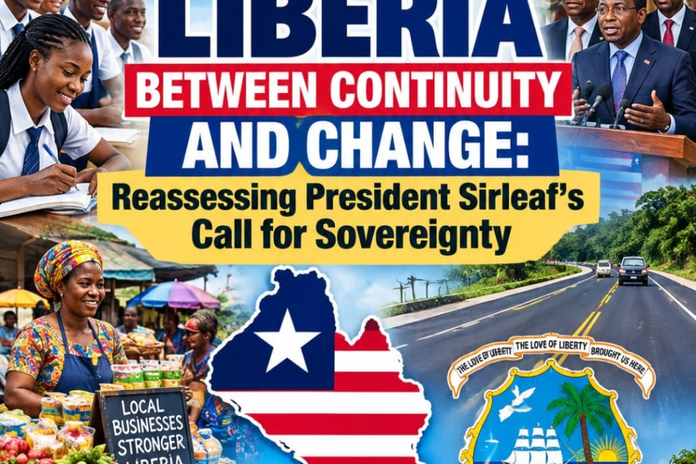
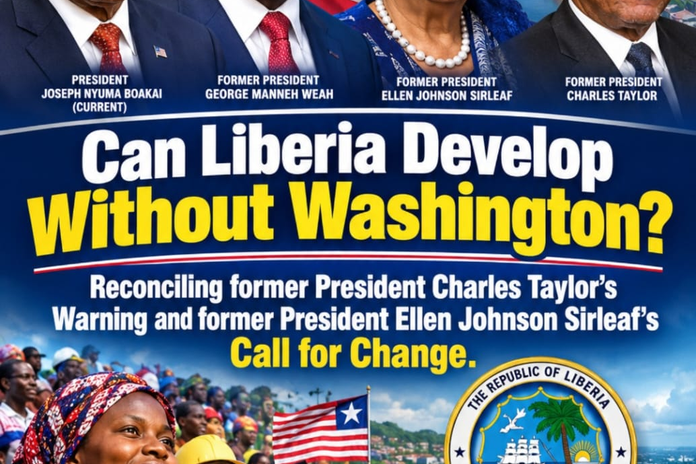
President Joseph Nyuma Boakai: “Growth must come with development, and growth must be equitable. We will welcome Foreign Direct Investment but in a partnership that will ensure our people benefit fully from our resources.”
By: Austin S Fallah – A True Son of the Planet Earth Soil:[email protected]
President Boakai: “To the business community, we say the country is always open to business – legitimate business that links to our development agenda, creation of wealth, increased productivity, and serious participation of Liberians in the economy.”
Former President George Manneh Weah: “To the private sector, I say to you that Liberia is open for business. We want to be known as a business-friendly government.”
Former President Weah:“An environment that will be conducive for the conduct of honest and transparent business.”
Former President Ellen Johnson Sirleaf:“The private sector will be the engine of our country’s growth.”
Former President Ellen Johnson Sirleaf:“Sustainable and broad-based”
because it can:”Engage and empower a wider range of actors within the community.”
Hon.Augustine Kpehe Ngafuan-Minister of Finance and Development Planning: “The ultimate measure of our progress is the extent to which these gains translate into improved services, greater economic opportunities in terms of job creation, and better living conditions for our citizens and residents.”
Hon. Ngafuan:“Unpaid government obligations can leave businesses unable to service their bank loans.”
Hon. Ngafuan: “We came here in a spirit of partnership, accountability, and shared ambition to build an Africa that is prosperous, inclusive, and resilient.”
Former Finance Minister Samuel D. Tweah Jr.: “The involvement of the private sector will help the Liberian Government to achieve its Pro-Poor Agenda.”
Hon. Tweah:“Robust collaborative efforts of both the private sector and government”
Hon.Tweah: “Our goal is to increase growth that is sustainable and inclusive.”
Former Finance Minister Boima S. Kamara: “As long as we remain reliant on the extractive industries to drive growth, we are vulnerable.”
Hon. Kamara: “The way to build a resilient economy is to diversify and leverage on our comparative advantage as a country—and that would be agriculture.”
Hon.Elie E. Saleeby:“We must also get rid of the belief and attitude that it’s the government’s duty to provide, and ours to consume and criticize.”
Hon. Saleeby:“If the economy of Liberia will make a significant and sustainable turnaround, Liberians must change their attitudes and concept of citizenship, and its duties and responsibilities.”
Hon. Saleeby:“De-dollarization is not going to solve all our problems. What we need is prudent and sound fiscal discipline.”
Professor Wilson K. Tarpeh:
“The Liberian government remains committed to providing the necessary environment that will promote sustainable business sector intended to stimulate the Liberian economy.”
Dr. Togba-Nah Tipoteh: “Liberia belongs to all Liberians and all Liberians have [the] right to all of the resources in Liberia.”
Dr. Tipoteh:“Good leadership, good governance calls for taking action to ensure that all Liberians have equal access to all of Liberia’s resources through the market place and the ballot box.”
Dr. Tipoteh:“My leadership works for adding value to all of resources, as in the education of our human resources and as in the promotion of manufacturing under Liberian ownership, using our raw materials here instead of exporting them.”
Dr. Toga Gayewea McIntosh:“Where we are today, we have a Finance and Development Planning Minister, who is strong in Finance but very weak on the programming side.”
Joseph E. Stiglitz — Nobel Prize-Winning Economist:“developing countries and emerging markets do not get compensated adequately for their natural resources”
Paul Collier — Oxford Development Ecgives perhaofficial’s home area’s home area’s home area’s home area’s home area’s home areatarkest historical warning:
“If we look at the history of resource extraction in Africa and elsewhere, it is not a happy history. In fact, it is a history of plunder.”
Dani Rodrik — Harvard Economist: Rodrik makes the enterprise/institution connection explicit: “All instances of successful development are ultimately the collective result of individual decisions by entrepreneurs to invest in risky new ventures and try out new things.”
Liberia is not poor because it lacks resources.
It possesses fertile agricultural land, timber, iron ore, gold, diamonds, a long coastline, and a youthful population capable of producing far more than the country currently consumes.
Yet the existence of resources has never automatically guaranteed national development.
Many countries rich in minerals, forests, and strategic geographic locations remain burdened by poverty because the benefits of productto reduce salariesolitical mattersal class.
Liberia’s central challenge, therefore, is not merely to discover or extract more resources; it is to build an enterprise economy supported by mature political inseemonsible public budgeting, and an informed citizenry.
An enterprise economy is one in which citizens are free and encouraged to create, invest, trade, innovate, and compete under fair rules.
It does not mean abanthe doning the poor or allowing powerful businesses to exploit workers and communities.
Rather, it means that government creates the conditions under which ordinary people, not only politically connected elites, can participate in economic life.
Such a system requires secure property rights, dependable roads, access to finance, transparent regulation, credible courts, effective schools, and a public budget that gives priority to national development instead of political patronage.
tish PrMinister Margaret Thatcher repeatedly emphasized this connection between enterprise and national progress.
In her remarks to world leaders on the enterprise economy, she contrasted countries such as Russia and Angola, which were associated with highly centralized economic systems, with Japan and Taiwan, whose growth demonstrated the power of private initiative, production, savings, trade, and competitive enterprise.
Her essential argument was pellucid: societies that suppress individual enterprise and place too much economic power in the hands of the state tend to stagnate, while societies that permit people to work, invest, and create are more likely to advance.
PM Thatcher’s comparison remains relevant to Liberia, though it must be applied thoughtfully rather than mechanically.
Liberia is not Russia, Angola, Japan, or Taiwan.
Its history, population, infrastructure, and political institutions are different.
Nevertheless, the underlying lesson is valuable.
A country can not tax, borrow, owomen-ownedits way into prosperity if its people have limited opportunities to produce wealth.
Government can redistribute only what the economy first creates.
If farms are unproductive, businesses can not obtain credit, roads are impassable, contracts are unreliable, and public revenues disappear into private accounts, then the nation’s resources will remain trapped in the pockets of the select few instead of reaching the plates, education, and homes of every Liberian.
The contrast between Angola and Japan is especially instructive.
Angola has long possessed substantial petroleum and mineral resources, yet resource wealth has not always translated into broad social progress.
The country’s history demonstrates the familiar resource curse, in which revenues from extractive industries strengthen political elites while failing to create diverse employment, durable institutmostble public services.
When national wealth comes mainly from oil, minerals, or concessions, leaders may become avaricious and citizens may be excluded from meaningful economic participation.
The state can grow dependent on rents rather than on the productive energy of its people.
Japan, by contrast, rose from the devastation of World War II to become a major industrial power not because it possessed extraordinary natural resources, but because it developed human capital, industrial capacity, technology, infrastructure, and a culture of disciplined production.
Its success showed that a country’s greatest resource is often its people.
Taiwan offers a similar example. Through land reform, investment in education, export oriented manufacturing, support for small and medium-sized businesses, and strategic state policies, Taiwan moved from agricultural poverty toward industrial sophistication.
The comparison is not meant to suggest that Liberia should imitate every Japanese or Taiwanese policy.
It should instead recognize that prosperity is more durable when it is built on learning, entrepreneurship, productivity, and institutions rather than on the extraction of raw materials alone.
Russia presents another cautionary comparison.
The Soviet economic model concentrated major decisions in the hands of the state.
Central planners determined what would be produced, where it would be sent, and at what price it would be sold.
Although this system achieved certain industrial and military goals, it often lacked the flexibility, innovation, and consumer responsiveness that a competitive economy encourages.
Bureaucracies can become garrulous in their promises but ineffective in implementation.
They may generate reports, committees, and regulations while neglecting the practical needs of farmers, market women, artisans, manufacturers, and young entrepreneurs.
Liberia must avoid an incogitant approach in which policies are announced without considering their likely consequences for ordinary citizens.
At the same time, Liberia should not confuse enterprise with indifference.
A purely insouciant government that assumes markets will solve every problem without public investment would fail the people.
Markets require rules, and enterprise requires a foundation.
A farmer can not compete if farm-to-market roads are destroyed during the rainy season.
A student cannot become an engineer or entrepreneur if schools are underfunded.
A small business owner cannot expand if electricity is unreliable, the tax system is confusing, and unofficial fees are demanded at every stage of operation.
The role of government, therefore, is not to replace enterprise but to enable it.
A sagacious government recognizes that public authority should be used to provide essential services, enforce fair rules, and invest in the nation’s long-term productive capacity.
This is where political maturity becomes indispensable.
Liberia’s political culture must move beyond election season rhetoric, partisan insults, and the vituperative exchanges that often consume public debate.
Political disagreement is natural in a democracy, but it should not become vitriolic hostility that prevents cooperation on national priorities.
Citizens should expect their representatives to debate vigorously while remaining focused on policy.
The quality of democracy cannot be measured only by whether elections are held; it must also be measured by whether elected officials govern with perspicacity, integrity, and a sense of responsibility to future generations.
Liberia’s budget hearings and public discussions must therefore focus squarely on the nation’s social and economic development.
A national budget is not simply a list of expenditures.
It is a moral and political document that reveals whom a government values and what it considers important.
If a budget allocates substantial funds to salaries, allowances, luxury vehicles, travel, and politically convenient projects while schools lack materials, hospitals lack medicine, and communities lack clean water, then the budget reflects distorted priorities.
The result is often a lugubrious cycle: citizens lose confidence in government, public institutions weaken, and national development is delayed.
Every item of pork in the budget must be weeded out. Pork-barrel spending is especially deleterious in a country with limited revenues and extensive development needs.
It redirects public money toward narrow political interests instead of projects that produce broad national benefits.
A road should be funded because it connects farmers to markets, not because it passes through the home area of a powerful official.
A health clinic should be built where medical need is greatest, not where it will generate the most electoral gratitude.
Scholarships should be awarded through transparent standards, not through political loyalty. Public money must serve the public.
This does not mean that legislators should ignore the concerns of their constituencies.
Representatives have a duty to understand local needs.
However, they must be circumspect in distinguishing legitimate constituency development from pork-barrel patronage.
The former promotes public welfare through accountable investments; the latter purchases political support with national funds.
Liberia’s legislature must develop transparent criteria for capital spending, publish project costs, require independent audits, and ensure that citizens can track whether approved projects are actually completed.
In this context, the national legislature should seriously consider Senator Abraham Darius Dillon’s proposal for salary reduction.
The proposal is important not only because it may save public funds, but because it raises an ethical question: should public officials in a developing country enjoy compensation and privileges that appear disconnected from the economic conditions of the population they serve?
A salary reduction for senior officials will not, by itself, transform Liberia’s economy.
The country’s structural problems are larger than legislative payroll.
Yet symbolism matters in public life. When leaders accept shared sacrifice, they strengthen public trust and demonstrate that service is not merely a route to personal enrichment.
Critics may argue that reducing salaries could make public service less attractive or encourage corruption.
That concern deserves consideration. Public servants should be paid adequately enough to perform their duties with dignity and independence.
However, this argument should not become an excuse for excessive compensation, unaccountable allowances, or privileges that separate leaders from citizens.
The proper solution is a rational and transparent compensation system: fair base salaries, clearly defined benefits, public disclosure, strict conflict-of-interest rules, and firm penalties for corruption.
Such reform would be more effective than either reckless cuts or complacent acceptance of excessive spending.
Liberia also needs to broaden the meaning of enterprise beyond large foreign concessions.
Foreign investment can contribute to development, especially in mining, agriculture, energy, telecommunications, and infrastructure.
But an economy dependent entirely on multinational companies is vulnerable. Commodity prices can fall, concessions can be poorly negotiated, and profits can leave the country.
Liberian development must include local farmers, fishing communities, small manufacturers, construction workers, transport operators, information technology professionals, and women owned businesses.
The objective should be to turn Liberians from spectators in their own economy into active producers and owners.
Agriculture should be central to this strategy. Liberia imports food that its own soil could help produce.
Supporting agriculture requires more than speeches encouraging people to farm.
It requires land security reforms, improved seeds, extension services, storage facilities, rural credit, irrigation where appropriate, farm-to-market roads, and market information.
It also requires policies that encourage value addition. Rather than exporting raw cassava, cocoa, rubber, timber, or palm products with little processing, Liberia should seek opportunities to process more of its own output.
This would create jobs, increase incomes, and reduce dependence on imported goods.
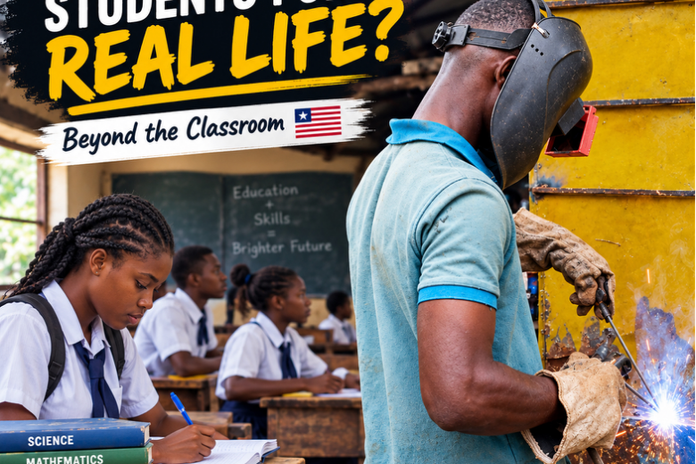
Education is equally vital. An enterprise economy cannot thrive if the majority of young people leave school without functional literacy, numeracy, technical skills, or digital competence.
Liberia needs an educational system that prepares students not only for public sector employment but also for productive work in agriculture, manufacturing, construction, services, and technology.
A pertinacious commitment to education must survive changes in administration.
Too often, promising policies are abandoned when political leadership changes.
National development requires continuity.
The temptation to seek quick solutions must be resisted.
It takes temerity to confront entrenched interests, especially those who benefit from opaque budgets, monopolistic concessions, and political favoritism.
Reformers may face criticism from those who prefer the existing arrangement.
Yet courage without wisdom can be dangerous. Liberia needs leaders who are both bold and prudent leaders prepared to challenge corruption but careful enough to design reforms that can endure.
This combination of temerity and circumspect judgment is the essence of responsible leadership.
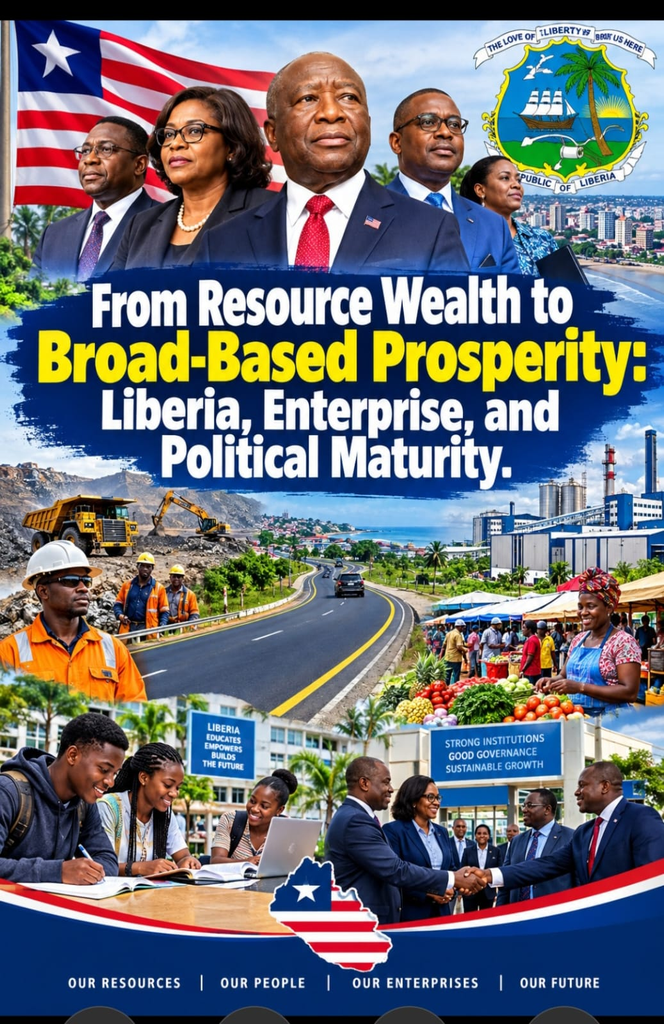
Ultimately, Liberia’s future depends on whether it can convert its natural wealth into human development.
The country’s minerals, forests, land, and waters should not enrich only a privileged few.
Their value must be reflected in nutritious food for children, well-equipped schools, accessible health care, decent housing, reliable electricity, safe roads, and dignified jobs.
That transformation will not occur through slogans or through the accumulation of government offices.
It will occur when public institutions become accountable, when the national budget reflects national priorities, when wasteful pork is eliminated, when legislators embrace reforms such as Senator Dillon’s salary reduction proposal, and when citizens are empowered to build enterprises of their own.
PM Margaret Thatcher’s comparison of Russia and Angola with Japan and Taiwan points toward an enduring lesson: nations rise when their people are allowed and equipped to create, produce, save, invest, and innovate.
Liberia should absorb that lesson while shaping an economic model consistent with its own democratic aspirations and social needs.
Its path should be neither uncontrolled private greed nor suffocating state control.
It should be a balanced enterprise economy in which government serves the people, markets create opportunity, and national resources become the foundation of shared prosperity.
Support Independent Journalism
Your support helps FrontPage Africa continue delivering independent, credible, and impactful journalism. Every contribution strengthens our ability to investigate, inform, and hold power accountable while keeping quality journalism accessible to our readers.
Support our journalism or subscribe to receive the latest FrontPage Africa stories and updates.