MONROVIA – When officers raided a compound on Cement Road in the VOA Community on July 21, they found 3,971 “plates” of the drug, packed in 157 bags and valued at about US$317 million.
By Rodney D. Sieh
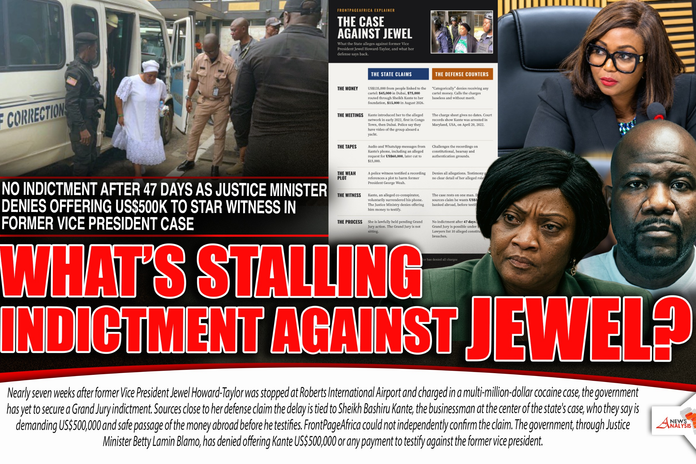
Two foreign men were arrested on the spot. Eleven weeks later, the State has gone much further. A 55-page indictment now names 20 people, among them senior security officers, an aviation official and the woman who was once a heartbeat from the presidency, former Vice President Jewel Howard Taylor.
But a close reading of the document tells a messier story. Dates shift from page to page. Payments grow or appear out of nowhere. The indictment gets Taylor’s own term of office wrong, and the court that filed it is not the court that ordered the arrests.
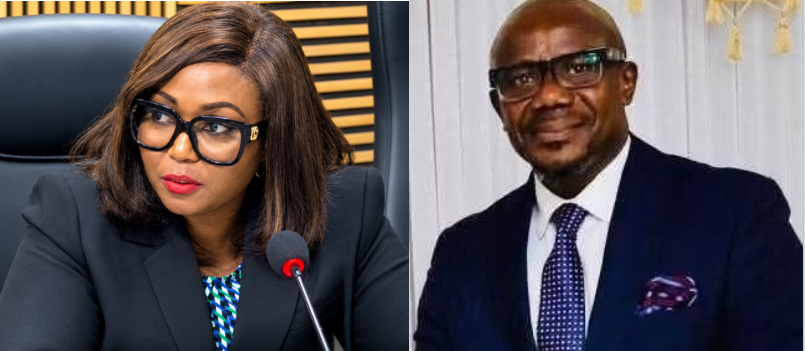
Taylor’s lawyer, Cllr. Gbawou Kowou, says the case against his client rests on the word of one man, co-defendant Sheik Bashiru Kante.
“The entire indictment of Jewel is nothing more [than] the same ‘Sheikh say,'” Kowou told FrontPageAfrica, playing on the word “hearsay.” The government’s evidence, he said, “as referenced and narrated in Numbers 12, 29 through 31 of the indictment, clearly show[s] the same ‘Sheikh say’ reliance on which the case against Jewel is built.”
He also accused prosecutors of lumping strangers together. The State, he said, “placed everyone in one group, most of whom are not connected or known to each other.”
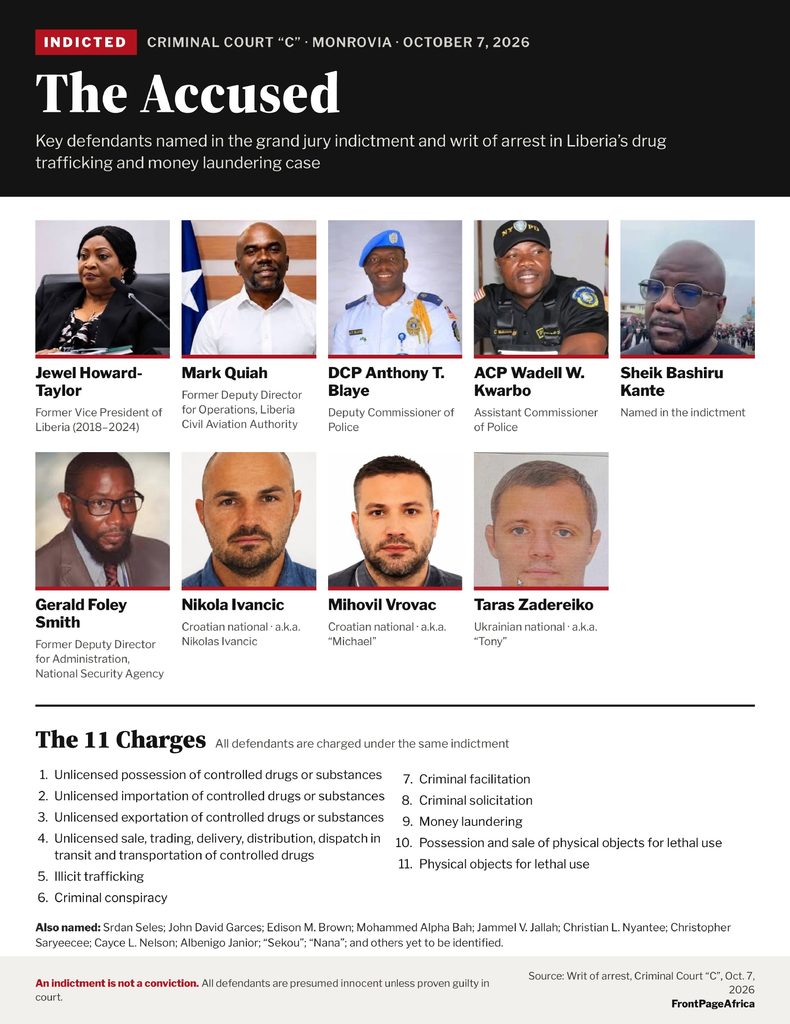
None of the allegations have been tested in court, and every defendant is presumed innocent.
An office she no longer held
The State’s theory is simple. In 2021, it says, Taylor agreed to use her power as Vice President to protect a cartel moving cocaine through Liberia to Europe. In return, money flowed to her and to her charity, the Jewel Starfish Foundation.
On that theory, she faces seven of the 11 counts: conspiracy, importation, transportation, trafficking, exportation, facilitation and money laundering.
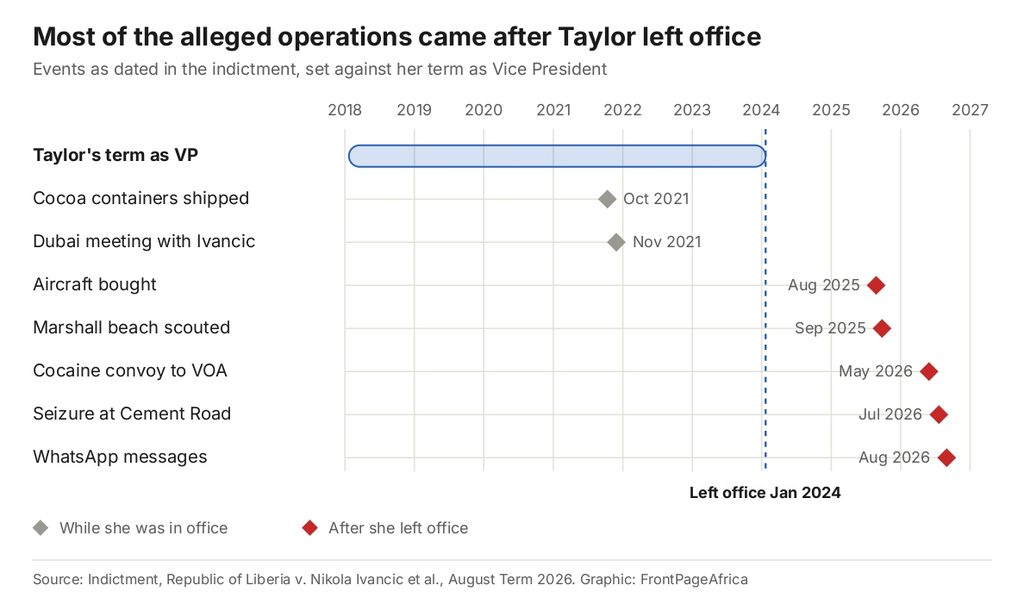
The trouble starts with the calendar. The indictment says she served as Vice President until January 2023. In fact, the Weah–Taylor government left office on January 22, 2024. And nearly everything the cartel is accused of actually doing in Liberia happened after that date: the aircraft bought in August 2025, the beach scouting at Marshall that September, the land at Royesville, the May 2026 convoy and the July seizure.
Nowhere does the indictment say what protection a former Vice President could offer in 2025 or 2026. It does not describe a single phone call, order, or favor she gave the network at any time. “High-level political assurance and cover” is the phrase it uses, again and again, without saying what that cover was.
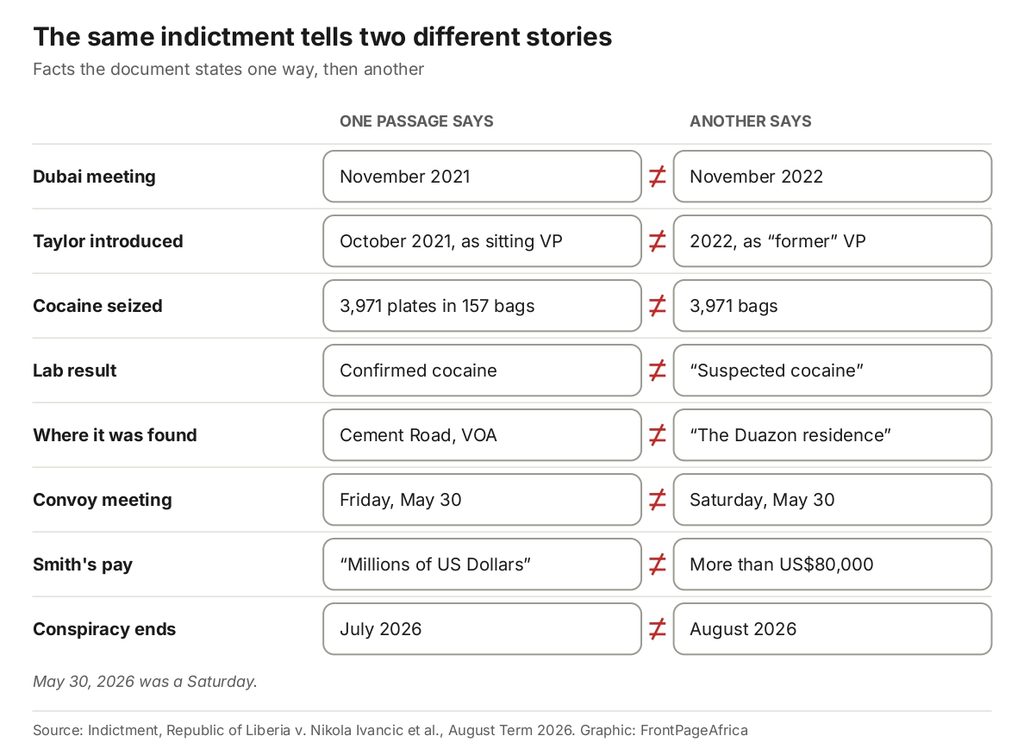
Even the story of how she was recruited changes. In one paragraph, two cartel men meet her at her Congo Town home in October 2021, and she flies to Dubai to meet their boss that November. In another, the introduction happens “in 2022,” and she is already called the “former” Vice President, though she was then in office. A third paragraph moves the Dubai meeting to November 2022.
The money moves too. A US$27,000 travel payment and a US$75,000 gift to her foundation appear early. A US$45,000 “shopping-gift bag” turns up only in the money-laundering count, 52 pages in. The 2021 payments are called “proceeds of the cocaine,” though no cocaine deal before them is described.
There is also a question of law. The 2021 conduct is charged under the Controlled Drugs and Substances Act of 2023. Liberia’s Constitution, in Article 21(a), forbids punishing anyone under a law that did not exist when the act took place. Prosecutors may answer that a conspiracy is a continuing crime. That argument is much harder to make for the other counts.
One export charge even ties her to a cocoa shipment that left the Freeport of Monrovia on October 12, 2021, weeks before the Dubai meeting at which she was supposedly recruited. No cocaine was ever reported found in those containers.
Only the 2021 shipment and Dubai meeting fall inside her term. Everything else the indictment describes came after she left office.
The tapes, and the man in the middle
The newest evidence against Taylor is a set of WhatsApp voice notes she allegedly sent Kante on August 31, 2026. That is six weeks after the cocaine was seized and the first arrests made.
On the recordings, as quoted by prosecutors, she sounds like a politician short of cash. “You know things are really crazy on our end,” she says. “So please ask Nicholas if he could send me some help.” She thanks Kante for US$15,000, worries about a child’s school fees, and talks of party conventions and campaign vehicles across the 15 counties.
What she never mentions is drugs. The talk of “the 19 kilos” and “19 million or whatever that was” is put in Kante’s mouth, not hers. Her most suspicious-sounding line, “So maybe [they are] being hidden somewhere until a better time,” carries two words in brackets that the prosecution added.
The law asks more than whether she took money from Ivancic. For money laundering, the State must show she knew or suspected the money came from crime. The indictment says she knew who sent it. It does not say how she knew where it came from.
Nor does it explain how the recordings were obtained, or from whose phone. One of the files is even labeled an “Image,” though it is described as audio.
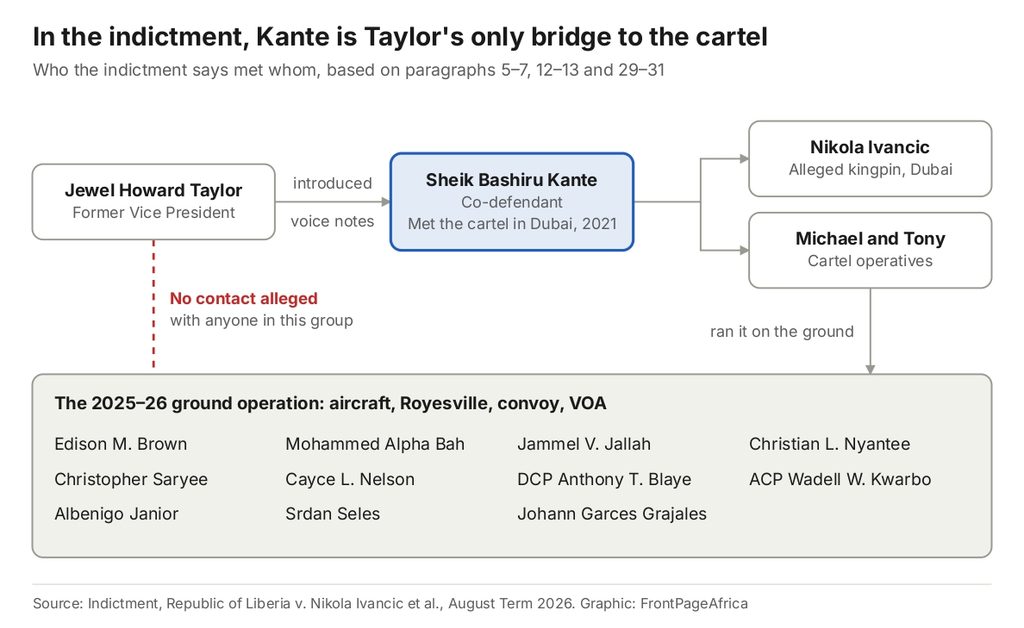
This is where Kowou’s “Sheikh say” argument bites. Read paragraphs 12 and 29 to 31, the ones he cites, and Kante is everywhere. He meets the cartel men in a Dubai nightclub. He promises them protection from top officials. He brings them to Taylor’s home, travels in her Dubai delegation, and receives her voice notes.
The indictment lists only three witnesses, all police officers, plus unnamed documents. It names no one outside the defendants who saw Taylor agree to anything. If the 2021 story rests on Kante, a man charged in the same case, his credibility will decide much of it.
Kante arranged or attended every meeting Taylor is accused of. The indictment never says she met, called, or paid anyone who ran the 2025–26 operation, which is the heart of Kowou’s complaint that strangers were lumped together.
A document at odds with itself
The problems are not confined to Taylor. The indictment itself was filed before Criminal Assizes “A” and Judge Roosevelt Z. Willie. The writ ordering the arrests came from a different court, Criminal Court “C” under Judge Ousman F. Feika, which describes the case as its own. The writ also misspells the former Vice President’s first name as “Jowel.”
The grand jury’s sign-off raises its own questions. There are 11 counts but only six “True Bill” endorsements, with no word on which counts they cover. The closing paragraph mentions only one crime, illicit trafficking. And on the copy FrontPageAfrica reviewed, the date beside the foreman’s signature appears to read 2025, a year before the seizure.
Perhaps the most striking gap is the cocaine itself. Drug charges in Liberia are graded by the type and amount of the drug, yet the indictment never gives a weight. It counts “plates” in one place and “bags” in another. It calls the substance lab-confirmed cocaine on one page and “suspected cocaine” on others.
The smaller details wobble too. One defendant is said to have “lived in” the Royesville house until his arrest, though he was arrested at a different address, on Cement Road. Former NSA official Gerald Folley Smith is paid “millions” in one paragraph and “more than US$80,000” in another. One co-defendant’s conduct is dated 2015, six years before the conspiracy began. Three NSA agents are described as knowingly escorting cocaine for cash, yet none of them is charged.
Each pair comes from the same 55-page document. May 30, 2026, was a Saturday.
What happens next
None of this means the cocaine was not real or that no crime took place. Two men were caught with the drugs, and the case against them looks direct. For the rest, prosecutors’ strongest ground is the conspiracy count, which needs only an agreement and a single act by any member.
The other charges against Taylor are harder to square with the text. They accuse her of importing, moving and exporting cocaine, but describe nothing she did beyond meetings in 2021 and money she received. Expect her lawyers to press on the dates, the 2023 law, and the two courts as soon as the case is called.
Support Independent Journalism
Your support helps FrontPage Africa continue delivering independent, credible, and impactful journalism. Every contribution strengthens our ability to investigate, inform, and hold power accountable while keeping quality journalism accessible to our readers.
Support our journalism or subscribe to receive the latest FrontPage Africa stories and updates.