MONROVIA — The Economic Community of West African States (ECOWAS) has called for stronger leadership and management within national statistical institutions across the region, warning that the politicization of official data poses a serious threat to credible policymaking and development planning.
By Francis G. Boayue
The warning was issued on Monday in Monrovia during the opening of a five-day leadership and statistical management training for managers of national statistical systems from ECOWAS member states.
Representing the President of the ECOWAS Commission in Liberia, ECOWAS Resident Representative H.E. Mohamed Kenewui Konneh said the training was intended to strengthen the capacity of senior and middle-level managers to improve institutional performance, manage teams effectively, and deliver organizational priorities.
He said ECOWAS Vision 2050 — which seeks a peaceful, prosperous, and fully integrated West Africa — cannot be achieved without reliable and credible statistics.
“Vision 2050 must be data-driven. Otherwise, it will remain nothing more than a mere aspiration,” Konneh said.
According to him, the region has made progress toward building a harmonized statistical system through the ECOWAS Statistical Policy and the Regional Statistical Programme for 2023–2027, which are aligned with the African Union’s strategy for harmonizing statistics across Africa.
He noted that ECOWAS adopted harmonized methodological frameworks for national accounts and the Consumer Price Index in June 2025, while additional regional frameworks cover public finances, public debt, monetary statistics, and balance of payments.
He said regional technical teams have also validated guides covering the Industrial Production Index, Business Register, and informal cross-border trade, while efforts are underway to develop a regional framework and roadmap for the use of big data.
However, Konneh said major challenges remain, particularly in the production of primary data, including surveys and administrative records, as well as human-resource and technical-capacity constraints.
He identified the politicization of statistical information as one of the most serious emerging threats facing national statistical systems.
“The biggest elephant in the room is the emergence of politicisation of statistical data, be it population census or economic data,” Konneh said, warning that statistical information risks being shifted from a development tool to a political instrument.
He said the challenge makes leadership critical because regulations and methodological frameworks alone cannot guarantee credible statistics.
“A census is only as credible as the manager who protects its independence and its budget,” he said.
Konneh urged participants to use the training to strengthen their leadership skills, protect professional independence, implement harmonized statistical frameworks, and improve public access to data.
Speaking during the program, Liberia Institute of Statistics and Geo-Information Services (LISGIS) Director General Richard Fatorma Ngafuan welcomed heads of national statistical offices from across West Africa, describing the gathering as an important opportunity for senior statistical managers to exchange experiences.
Ngafuan said ECOWAS statistics have played a significant role in building the technical capacity of Liberia’s statistical personnel through training in national accounts, consumer price statistics, external trade, and other areas of data collection.
He said the current training is significant because it focuses on institutional leaders rather than technical staff alone.
The training, he noted, will also examine digital transformation and artificial intelligence and how national statistical offices can harness emerging technologies to improve data production and management.
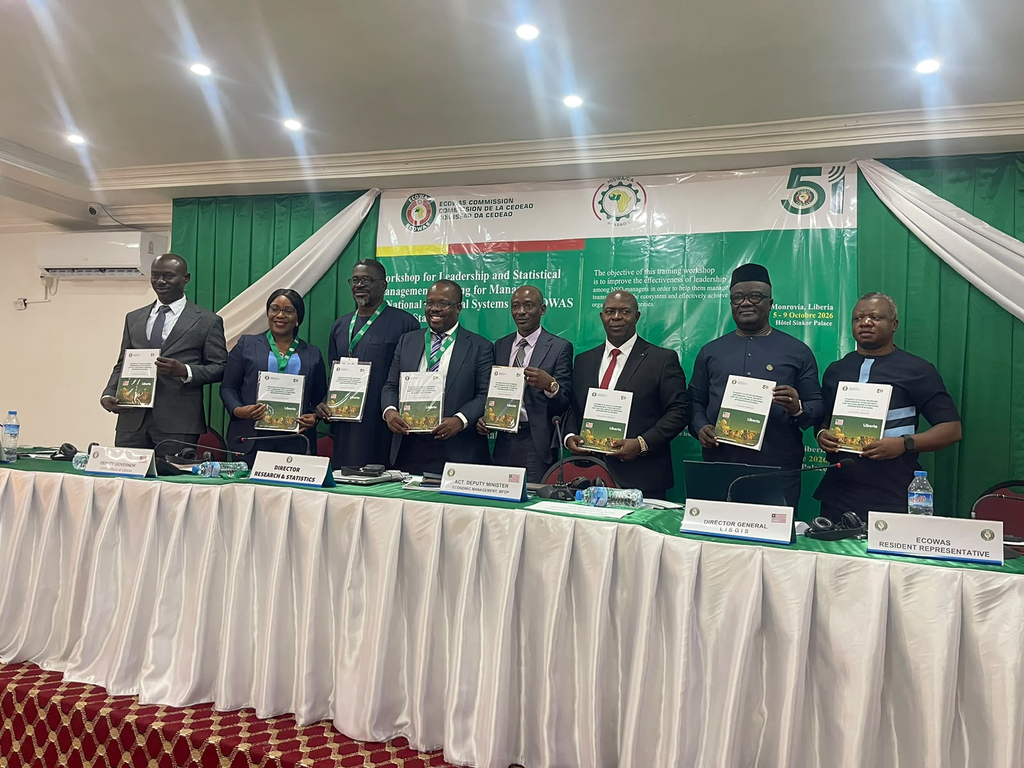
Meanwhile, Acting Deputy Minister for Economic Management at the Ministry of Finance and Development Planning, Henry Isa Yankun, officially launched the ECOWAS Country Report on Liberia during the gathering.
Yankun described the report as an important diagnostic tool for assessing Liberia’s macroeconomic performance, fiscal policy, debt sustainability, trade integration, and structural transformation.
He said the report would help inform government policy choices, sharpen reform priorities, and strengthen Liberia’s engagement with ECOWAS and development partners.
The Acting Deputy Minister said Liberia’s development agenda is focused on agriculture and food security, roads and infrastructure, governance and the rule of law, education and skills development, health and sanitation, and tourism and cultural heritage.
For his part, Sheik Tumah, Head of the West African Monetary Institute (WAMI), stressed the importance of reliable, timely, and credible statistics for sound economic management and regional integration.
He said statistical managers must now go beyond technical competence to effectively lead multidisciplinary teams, manage scarce resources, embrace innovation, and uphold professional standards.
Tumah said WAMI’s work on macroeconomic surveillance and economic convergence depends heavily on comparable national accounts, consumer prices, fiscal, monetary, financial, and external-sector statistics.
He also highlighted the opportunities presented by digitalization, administrative data, big data, and artificial intelligence, while cautioning that these technologies introduce challenges related to data governance, confidentiality, cybersecurity, quality assurance, and institutional capacity.
He urged statistical leaders to ensure that official statistics remain credible, comparable, accessible, and useful for public policy.
The five-day training brings together senior statistical managers from ECOWAS member states to strengthen leadership and institutional management, promote statistical harmonization, and build professional networks for addressing common challenges confronting national statistical systems across West Africa.
Support Independent Journalism
Your support helps FrontPage Africa continue delivering independent, credible, and impactful journalism. Every contribution strengthens our ability to investigate, inform, and hold power accountable while keeping quality journalism accessible to our readers.
Support our journalism or subscribe to receive the latest FrontPage Africa stories and updates.