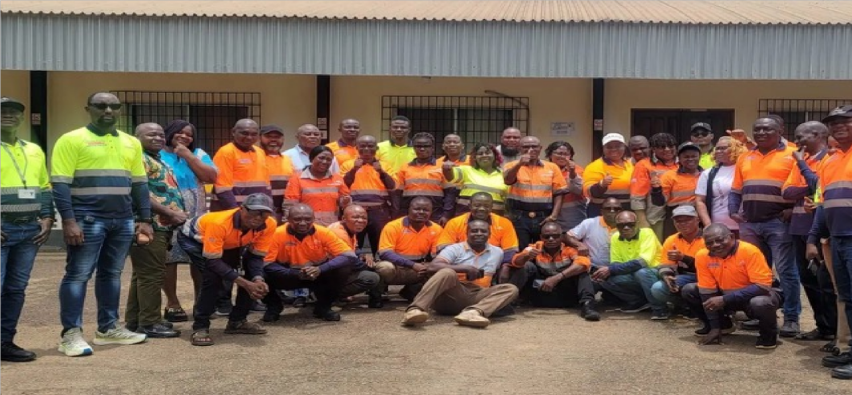
YEKepa, Nimba County — ArcelorMittal Liberia (AML) has completed a three-day digital literacy training for 38 teachers and administrators across its school system in Yekepa, equipping educators with practical technology skills to modernize classroom instruction and improve administrative efficiency.
The training was organized by the Learning and Development Section of AML’s Human Resources Department following a series of assessments that identified opportunities to strengthen digital literacy among school personnel.
The initiative forms part of AML’s broader investment in human resource development and its efforts to ensure that educators have the skills and tools needed to operate effectively in an increasingly digital learning environment.
Rosevelt Richard, AML Learning and Development Manager, said the training was developed after consultations with educators and school administrators.
“From initial engagements with the schools, we recognized that there were gaps, especially in terms of digital literacy,” Richard said. “We had to do multiple assessments, direct engagements, focus groups and online surveys, and based on the outcomes of those assessments, that’s how we developed the training plan that we’re currently implementing.”
Before the training, many educators continued to depend heavily on paper-based systems for lesson preparation, record keeping and other administrative responsibilities. Although teachers had been provided with laptop computers, some had not incorporated the devices into their daily work.
“We had a majority that had not opened their computers in six to seven months, though all of them were issued computers,” Richard said. “Even receiving emails was a problem on the first day and understanding how to use basic Microsoft programs was also a problem.”
He said the progress recorded during the three-day training demonstrated the value of practical, hands-on support.
“But the progress we have seen from the first day to today, the third day, has been really good,” Richard said. “All we have to do is keep on socializing it and make it part of their day-to-day routine.”
The training introduced educators to practical digital tools designed to reduce administrative workloads and improve lesson preparation.
Participants received hands-on instruction in basic laptop operations and commonly used Microsoft applications. They were also introduced to digital planning templates designed to replace paper-based lesson plans with structured Microsoft Word and Excel templates for daily logs, grade tallying and scheme-of-work tracking.
The educators also received training on the use of SharePoint to support information sharing and document management. Sessions further focused on effective email communication and the responsible use of Microsoft Copilot as an assistance tool for lesson planning, research and preparation of teaching materials.
The training emphasized that AI-generated information must be reviewed and validated by educators before it is used in the classroom.
For AML educators, the new digital skills are expected to make routine tasks faster while creating more opportunities to access teaching resources and improve the presentation of instructional materials.
Nathaniel K. Hodge Jr., Vice Principal of AML Senior High School, welcomed the training and said it would help educators build on the strong academic performance already recorded across AML schools.

“From administrators to the teaching staff, we’re happy that we had this training,” Hodge said.
He noted that AML schools have maintained a strong record in national examinations, including a 100 percent pass rate in this year’s West African Senior School Certificate Examination (WASSCE) for 12th grade students.
Hodge said the new digital skills could further strengthen teaching and learning by allowing educators to use technology to prepare lessons and develop resources for students.
“With this training in Copilot, where we can put in our topics and it gives us what we want, the students will benefit most, not just the teachers undergoing the training, because we came to be trained to train the students,” he said.
He also emphasized that the skills acquired through the program represent a lasting professional investment.
“Even if I was to leave from ArcelorMittal today, that knowledge will not leave from my head. I can use it elsewhere for my own benefit,” Hodge said.
Swomi Coursx Roberts, Dean of Students and Mathematics Instructor for Grades 4–6 at AML Area C School, said the training would make everyday responsibilities more efficient.
“This training will help us a lot. It will open us up to the digital world and help us make our work much easier,” Roberts said.
She said digital tools would reduce the time required for lesson preparation and improve access to teaching resources.
“Presentation of our work will be faster than the manual work, because before then we had to plan lessons on sheets of paper and send it in for the principal to sign. Finding our references and resource materials will now be very easy for us,” she said.
The completion of the training marks another step in AML’s efforts to strengthen the professional capacity of educators within its school system.
By equipping teachers and administrators with practical digital skills, the company is supporting a gradual transition from predominantly paper-based processes toward more efficient, technology-enabled teaching and school administration.
The initiative also provides educators with skills that can continue to benefit them beyond their current roles, while helping AML schools prepare students for an increasingly digital world.
This version keeps the AML human-resource-development angle strong while presenting the digital training as an investment in both educators and students, rather than simply a computer skills workshop.
Support Independent Journalism
Your support helps FrontPage Africa continue delivering independent, credible, and impactful journalism. Every contribution strengthens our ability to investigate, inform, and hold power accountable while keeping quality journalism accessible to our readers.
Support our journalism or subscribe to receive the latest FrontPage Africa stories and updates.